
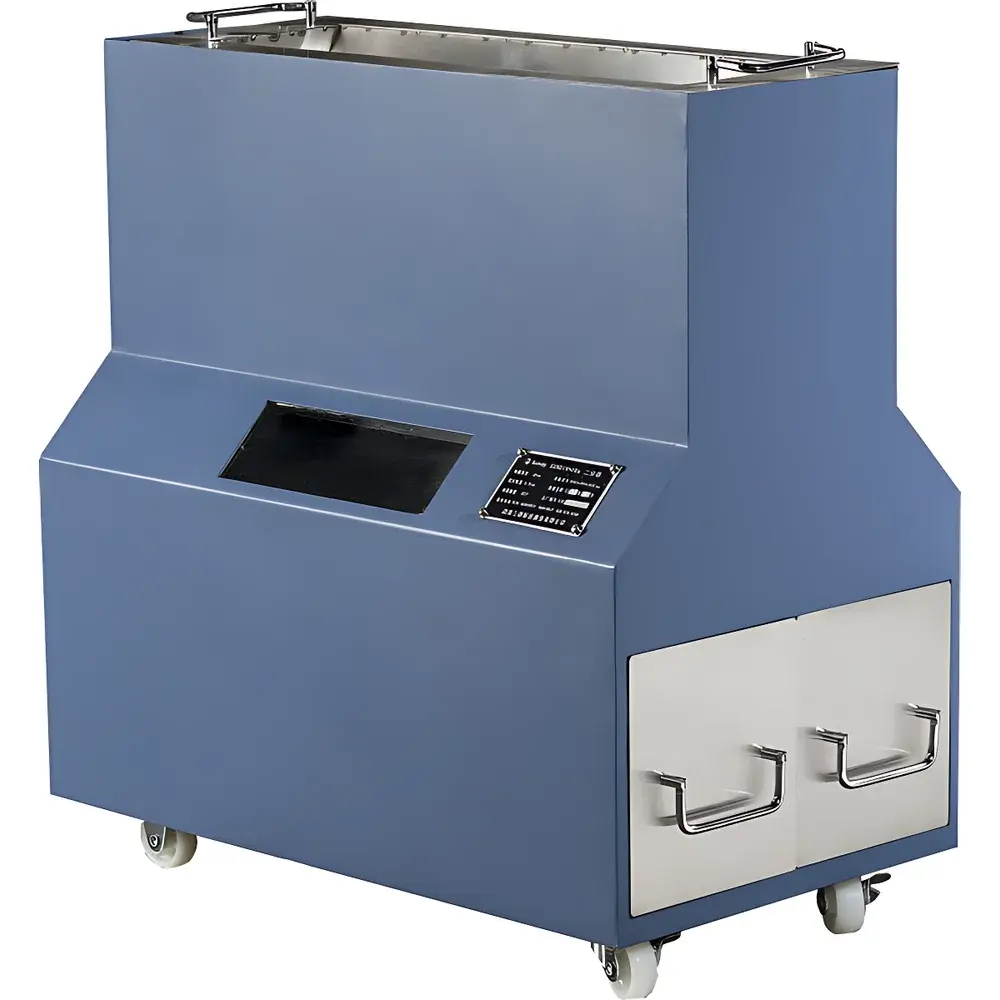
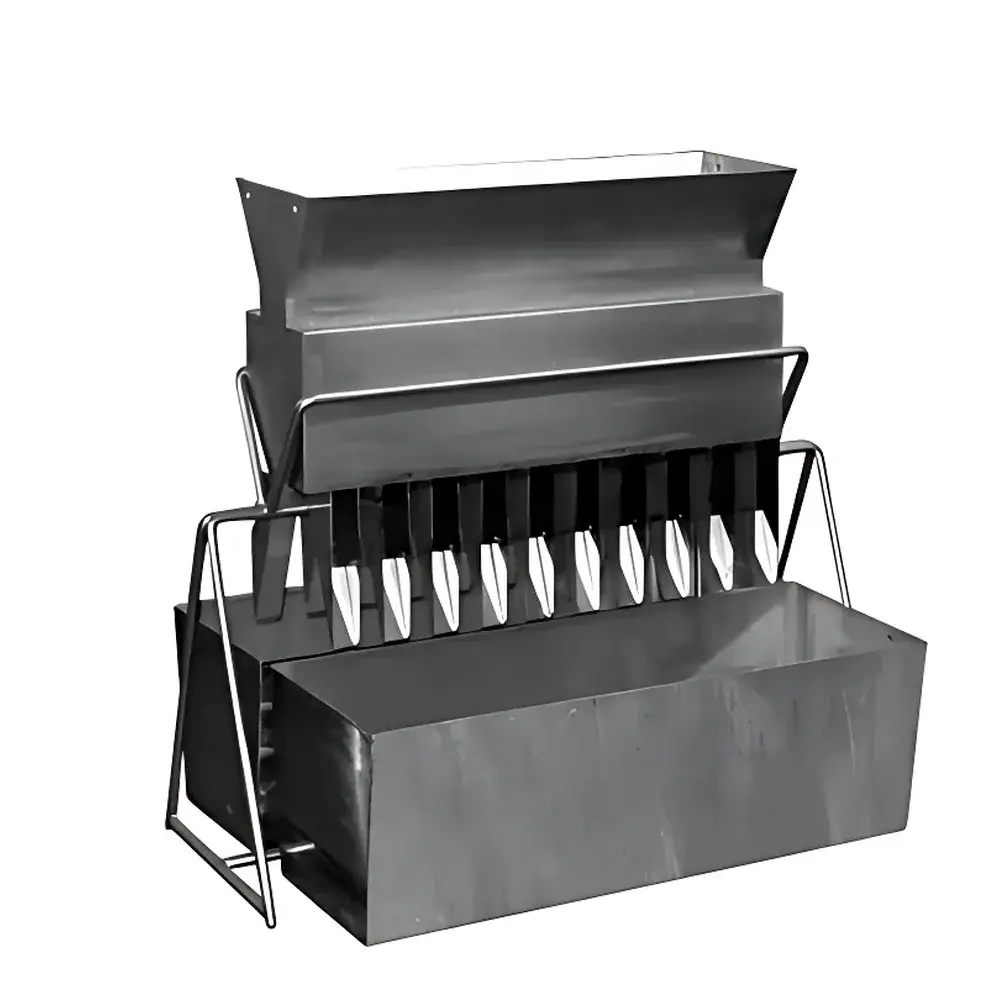
Sundy SDRD Series Rotary Sample Divider
| Brand | Sundy |
|---|---|
| Model | SDRD |
| Type | Rotary Sample Divider for Coal and Mineral Sample Preparation |
| Compliance | GB/T 474–2008 |
Overview
The Sundy SDRD Series Rotary Sample Divider is a precision mechanical sample splitting device engineered for reproducible, bias-free reduction of bulk particulate samples—primarily coal and other friable mineral materials—in analytical laboratories. Operating on the principle of riffle splitting (also known as rotary division), the SDRD employs a fixed array of evenly spaced, parallel grooves to physically divide a falling stream of material into two equal, representative sub-samples. This method ensures high statistical fidelity in sample reduction by eliminating operator-induced segregation and minimizing particle segregation effects inherent in manual quartering or coning-and-rolling techniques. Designed specifically to meet the procedural requirements of GB/T 474–2008 “Methods for the Preparation of Coal Samples”, the SDRD supports standardized sample preparation workflows in power generation, coal trading, metallurgical assay, cement production, geological survey, and chemical process control laboratories.
Key Features
- Mirror-finish stainless steel groove channels minimize surface friction and static adhesion, ensuring unimpeded flow of coarse to medium-grained particles (≤13 mm) and preventing cross-contamination or residual carryover between runs.
- Precision-stamped groove plates guarantee uniform slot spacing and consistent angular geometry across all models—critical for maintaining theoretical mass split ratios within ±1.5% deviation under calibrated operating conditions.
- Open-type configurations (SDRD11×32, SDRD19×20, SDRD40×16) offer direct visual access and rapid cleaning; sealed variants (SDRD11×32a, SDRD19×20a, SDRD40×16a) integrate full perimeter gasketing and dust-tight housing to suppress airborne particulates during operation.
- Sealed models incorporate dual-locking swivel casters for stable positioning and effortless relocation—enabling flexible integration into ISO/IEC 17025-accredited lab layouts where equipment mobility and containment compliance are jointly required.
- All structural components conform to ASTM E177 (Standard Practice for Use of the Terms Precision and Bias) and support traceable calibration using certified reference materials (CRMs) per ISO Guide 34 and ISO/IEC 17025 Clause 6.6.
Sample Compatibility & Compliance
The SDRD series accommodates dry, free-flowing granular solids with maximum top-size fractions ranging from ≤3 mm (SDRD11×32 / SDRD11×32a) to ≤13 mm (SDRD40×16 / SDRD40×16a). It is validated for use with bituminous coal, lignite, coke, limestone, bauxite, phosphate rock, and slag—provided moisture content remains below 8 wt% to prevent bridging or channeling. The device satisfies mandatory mechanical performance criteria defined in GB/T 474–2008, including groove symmetry tolerance (±0.2 mm), mass balance repeatability (RSD ≤ 2.0% over n=10 replicates), and dimensional stability after 5,000 operational cycles. Optional documentation packages include factory test reports aligned with ISO 9001:2015 production controls and optional third-party verification against ASTM D2013 (Standard Practice for Preparing Coal Samples for Analysis).
Software & Data Management
As a purely mechanical, non-electronic instrument, the SDRD requires no firmware, embedded software, or digital interface. Its operation is fully manual and independent of power supply—ensuring intrinsic reliability, zero electromagnetic interference, and unrestricted compatibility with Class I Division 1 hazardous area environments. All models support paper-based or LIMS-integrated recordkeeping via standardized log sheets (e.g., ISO/IEC 17025 Annex A.3 templates), documenting sample ID, lot number, feed mass, split date/time, operator signature, and post-split mass verification. For labs operating under FDA 21 CFR Part 11 or EU Annex 11, the sealed variants’ tamper-evident fasteners and serial-numbered nameplates facilitate audit-ready physical traceability without electronic validation overhead.
Applications
- Routine preparation of analytical subsamples for proximate analysis (ASTM D3172), ultimate analysis (ASTM D3176), calorific value determination (ASTM D5865), and ash fusion testing (ASTM D1857).
- Primary sample division prior to pulverization in ring-and-puck mills or vibratory disc grinders—ensuring representative feedstock for <75 µm grinding stages.
- Quality assurance sampling in coal blending facilities and port terminal laboratories where batch homogeneity must be verified pre-shipment.
- Reference material certification programs requiring strict adherence to ISO Guide 35 protocols for heterogeneity assessment and sub-sampling uncertainty quantification.
- Geological core logging workflows where lithological heterogeneity demands statistically robust mass reduction prior to XRF or ICP-MS digestion.
FAQ
Does the SDRD require electrical power or compressed air?
No—the SDRD operates entirely manually; no external energy source is needed.
Can the SDRD be used for wet or sticky samples?
It is designed exclusively for dry, free-flowing materials; moisture content above 8% may cause blockage or biased splitting.
Is calibration required before first use?
Yes—users must verify groove alignment and mass balance using certified reference samples per GB/T 474–2008 Section 7.3 prior to routine deployment.
What maintenance intervals are recommended?
Visual inspection and groove cleaning after each use; full disassembly and dimensional check every 6 months or 1,000 cycles—whichever occurs first.
Are replacement groove plates available as spare parts?
Yes—original-specification stainless steel groove assemblies are stocked and supplied with serialized traceability documentation.



