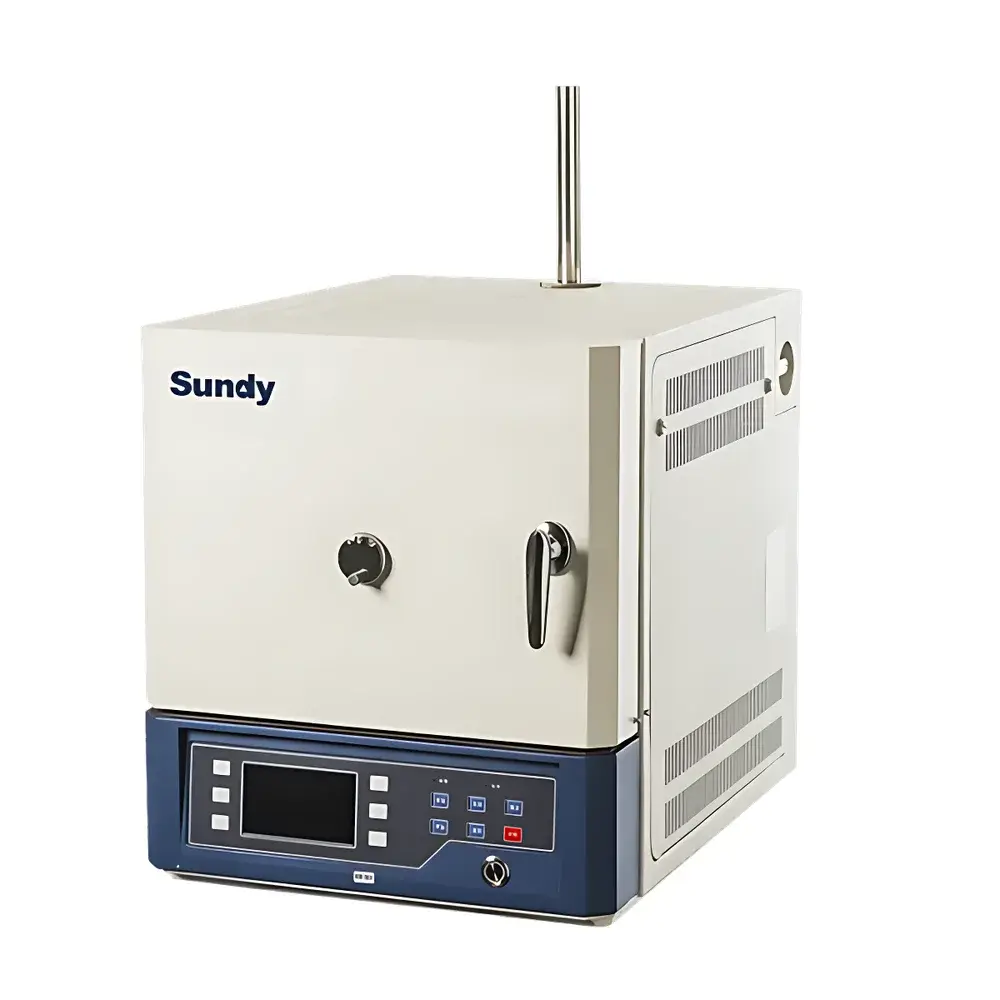
Sundys SDMF300 Industrial Muffle Furnace for Coal Quality Analysis
| Brand | Sundy |
|---|---|
| Origin | Hunan, China |
| Model | SDMF300 |
| Operating Temperature Range | Ambient to 1000 °C |
| Max Heating Rate | 100 °C/min |
| Temperature Control Accuracy | ±1 °C |
| Temperature Resolution | 1 °C |
| Max Power Consumption | 3.5 kW |
| Chamber Dimensions (L×W×H) | 298 mm × 203 mm × 121 mm |
| External Dimensions (L×W×H) | 600 mm × 460 mm × 575 mm |
| Net Weight | ~65 kg |
| Power Supply | AC 220 V ±10 %, 50 Hz ±1 Hz |
| Compliance | GB/T 212–2008 |
Overview
The Sundys SDMF300 Industrial Muffle Furnace is a precision-engineered thermal instrument designed specifically for standardized coal quality analysis in accordance with GB/T 212–2008, the Chinese national standard for industrial analysis of coal. It operates on resistive heating principles using high-stability heating elements and optimized thermal insulation architecture to deliver uniform, repeatable temperature profiles across its ceramic-lined chamber. Unlike general-purpose laboratory furnaces, the SDMF300 integrates application-specific control logic for sequential thermal protocols required in ash, volatile matter, and caking index (e.g., Roga or黏结性) determinations—critical parameters for coal classification, combustion efficiency modeling, and feedstock qualification in power generation and metallurgical coke production.
Key Features
- Multi-mode thermal protocol execution: Dedicated pre-programmed routines for slow ashing, fast ashing (Classical Fast Ash Mode 1 and Enhanced Fast Ash Mode 2), volatile matter determination, and Roga/Adhesion index testing—including two fully customizable universal modes (Universal 1 and Universal 2) supporting up to six independent ramp-hold segments per program, adjustable start temperature, reheat setpoints, dwell durations, and dynamic power modulation during recovery phases.
- Precision sample positioning system: A proprietary crucible rack alignment mechanism ensures reproducible placement of volatile matter samples directly into the furnace’s certified isothermal zone (±2 °C uniformity across working volume), minimizing thermal lag and inter-sample variability.
- Thermal integrity engineering: Full-wrap high-density ceramic fiber insulation combined with an integrated air-channel thermal barrier reduces external surface temperature to near-ambient levels (<45 °C at 1000 °C operation), enhancing lab safety and reducing ambient heat load—while maintaining chamber uniformity exceeding GB/T 212–2008 requirements (≤±5 °C across usable volume).
- Comprehensive hardware-level safety protection: Real-time thermocouple fault detection (open-circuit, short-circuit, polarity reversal), over-temperature cut-off with independent relay-based power interruption, and mains supply monitoring with audible/visual alarm and automatic heater disengagement.
- Human-centered operational interface: 5.7-inch backlit LCD with full Chinese character navigation, intuitive multi-level menu structure, one-touch test initiation, real-time temperature curve visualization, dual timing options (countdown/count-up) for volatile matter assays, and ergonomically shielded access points—including heat-insulated observation window and chimney actuation lever—to prevent operator contact with surfaces exceeding 60 °C during active cycles.
Sample Compatibility & Compliance
The SDMF300 is validated for use with standard ASTM D3174 (ash), ASTM D3175 (volatile matter), and ISO 562 (determination of volatile matter in coal and coke) sample geometries, including Gooch crucibles (Φ18 mm × 33 mm), silica crucibles, and nickel-chromium alloy boats conforming to GB/T 212–2008 dimensional tolerances. Its thermal stability profile supports both single-sample and batched multi-crucible configurations (up to 12 × 15 mL crucibles under controlled airflow). The furnace meets electromagnetic compatibility (EMC) Class B requirements per GB/T 18268.1–2010 and complies with electrical safety standards GB 4793.1–2007 (IEC 61010-1). While not inherently 21 CFR Part 11 compliant, audit-ready data logs (timestamped temperature records, cycle start/stop events, fault codes) can be exported via RS232 for integration into LIMS environments supporting GLP/GMP traceability workflows.
Software & Data Management
The embedded firmware stores up to 100 user-defined method templates with full parameter recall (ramp rates, hold times, power limits, cooling profiles). All thermal cycles generate immutable ASCII log files containing UTC timestamps, measured furnace temperature (every 5 seconds), setpoint deviations, and event flags (e.g., “Crucible Inserted”, “Hold Achieved”, “Fault Code E07”). Data export is supported via USB flash drive or RS232 serial link (Modbus RTU protocol) for direct ingestion into Excel, LabVIEW, or enterprise QC systems. No cloud connectivity or remote access functionality is implemented—ensuring data sovereignty and alignment with air-gapped laboratory security policies common in energy-sector QA/QC facilities.
Applications
Primary deployment domains include coal-fired power plant fuel laboratories, coking plant quality control centers, geological survey institutes conducting coal resource assessment, cement kiln raw mix optimization labs, and academic research groups studying solid fuel pyrolysis kinetics. Secondary applications encompass ash content validation for biomass pellets (ISO 18122), residue analysis in waste-derived fuels (EN 15403), catalyst support calcination (≤900 °C), and gravimetric moisture determination in mineral concentrates. The furnace’s programmable thermal inertia compensation makes it suitable for method development work requiring precise endothermic/exothermic event capture—such as low-temperature devolatilization profiling (200–500 °C) in lignite characterization studies.
FAQ
Does the SDMF300 support automated sample insertion or robotic integration?
No—the SDMF300 is a manually loaded benchtop furnace. Sample handling remains operator-executed to maintain compliance with GB/T 212–2008 procedural requirements for manual crucible placement and door closure timing.
Can the furnace be calibrated to NIST-traceable standards?
Yes—its Type K thermocouple input accepts calibration against accredited reference standards; users may perform field verification using portable dry-block calibrators meeting ISO/IEC 17025 requirements.
Is the chamber atmosphere controllable (e.g., inert gas purge)?
No—this model operates in ambient air only. For reducing or inert-atmosphere applications, a separate gas-tight furnace variant (e.g., SDMF300-G) must be specified at time of order.
What maintenance intervals are recommended for sustained accuracy?
Annual verification of thermocouple drift and insulation integrity is advised; heating element resistance should be measured semiannually. Ceramic fiber liner inspection is required after every 2,000 cumulative hours at ≥800 °C.
Are software updates available post-purchase?
Firmware revisions are distributed free-of-charge via Sundy’s authorized service network upon request, accompanied by version-controlled release notes and validation summaries aligned with IEC 62304 software lifecycle requirements.