
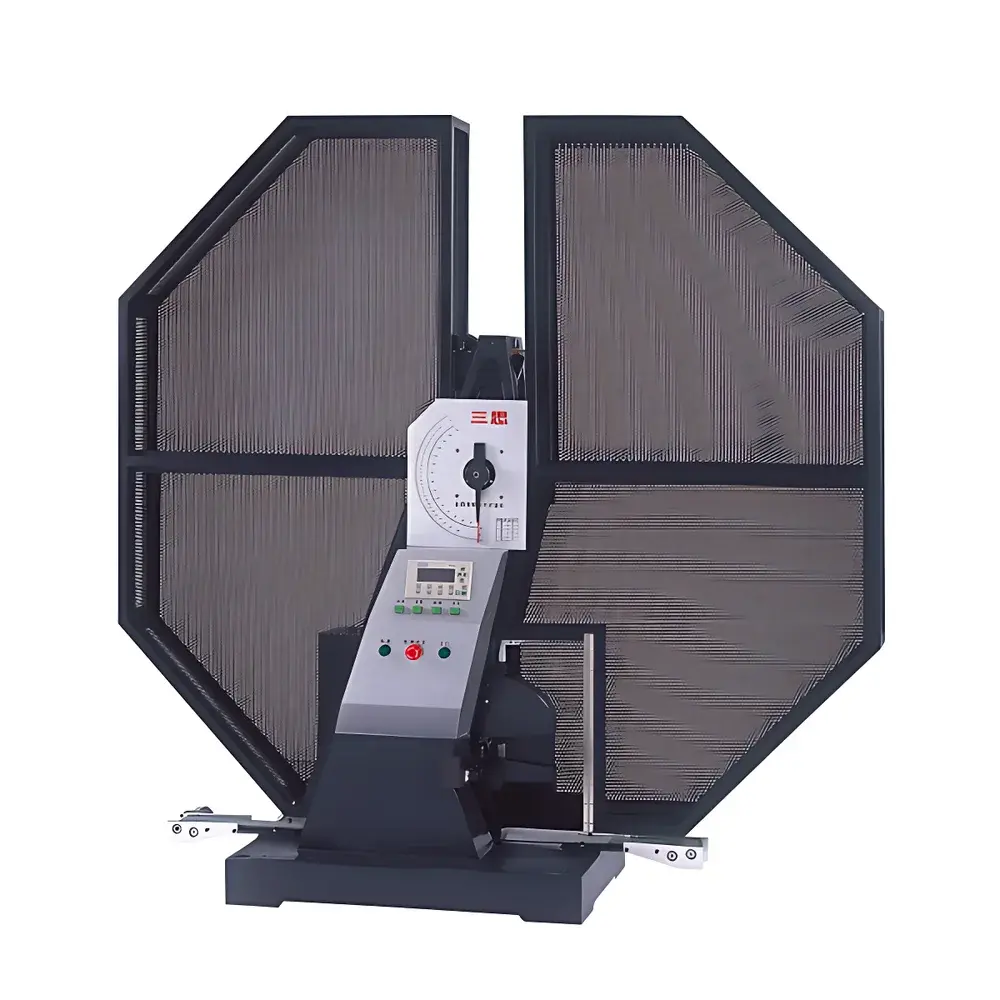
SUNS PTM Series Pendulum Impact Testing Machine for Metals
| Brand | SUNS |
|---|---|
| Origin | Shenzhen, China |
| Manufacturer Type | Direct Manufacturer |
| Product Category | Domestic |
| Model | PTM |
| Instrument Type | Pendulum Impact Tester |
| Impact Energy Range | 150 J to 750 J |
| Impact Velocity | 5.24 m/s |
| Pendulum Torque (Impact Constant) | 80.3848 N·m to 401.9238 N·m |
| Load Cell Stroke Range | 750 mm |
| Maximum Pendulum Lifting Height | 1.5 mm |
Overview
The SUNS PTM Series Pendulum Impact Testing Machine is a precision-engineered instrument designed for the standardized determination of Charpy and Izod impact resistance in metallic materials under dynamic loading conditions. Based on classical pendulum impact mechanics—where gravitational potential energy is converted into kinetic energy upon release—the system measures the energy absorbed by a notched specimen during fracture. This principle enables quantification of material toughness, ductile-to-brittle transition behavior, and notch sensitivity in accordance with internationally recognized test methodologies. The PTM series complies with core mechanical integrity requirements for quality control laboratories, metallurgical R&D facilities, and third-party certification bodies operating under ISO/IEC 17025-accredited environments. Its robust monolithic frame architecture, combined with high-stiffness simply supported pendulum shaft design, ensures minimal energy loss due to structural deflection or vibration—critical for achieving repeatability within ±0.5% of full-scale energy per ASTM E23 Annex A1 verification criteria.
Key Features
- Monolithic base-and-frame construction delivers exceptional rigidity and long-term dimensional stability, minimizing resonance effects during high-energy impact events.
- Simply supported pendulum shaft configuration ensures precise rotational kinematics and eliminates bending-induced torque errors across the full 150–750 J energy range.
- Aerodynamically optimized circular pendulum body reduces air resistance losses, improving energy transfer fidelity and measurement consistency.
- Hydraulic damping system for controlled pendulum lifting prevents mechanical shock to the pivot assembly, extends service life of bearings and locking mechanisms, and suppresses operational noise below 65 dB(A).
- Triple-redundant energy readout: simultaneous digital encoder-based angular displacement, load cell-derived force integration, and calibrated mechanical scale verification—enabling cross-validation and rapid fault diagnosis.
- Integrated specimen ejection mechanism automatically retrieves fractured samples post-impact, eliminating manual intervention inside the test zone and supporting unattended batch testing protocols.
- Full-height safety enclosure with interlocked mesh guarding meets EN ISO 13857 and OSHA 1910.212 requirements, preventing operator access during pendulum swing and containing fragment dispersion.
- Siemens S7-1200 PLC controller paired with high-resolution rotary encoder (≤0.01° angular resolution) ensures traceable, low-drift position feedback and supports deterministic real-time data acquisition at ≥10 kHz sampling rates.
Sample Compatibility & Compliance
The PTM series accommodates standard Charpy V-notch and U-notch specimens per GB/T 229–2007, ASTM E23–22, and ISO 148–1:2016 specifications—including dimensions 55 × 10 × 10 mm, 55 × 10 × 7.5 mm, and 55 × 10 × 5 mm. The anvil span is fixed at 40 mm ± 0.2 mm; support radius is adjustable between 1.0–1.5 mm; striker nose radius is configurable from 2.0–2.5 mm with ±0.05 mm tolerance. All mechanical tolerances conform to the verification requirements of ISO 148–2:2021 and JJG 145–2007 for Class 1 impact testers. Calibration certificates include traceability to NIM (National Institute of Metrology, China) and are compatible with GLP-compliant audit trails.
Software & Data Management
The embedded control interface supports export of raw angular position, torque, and time-stamped event logs in CSV format. Optional PC-based software (SUNS ImpactSuite™) provides automated report generation compliant with ISO/IEC 17025 documentation requirements—including operator ID, environmental conditions (temperature/humidity), calibration status, and digital signature fields. Audit trail functionality satisfies FDA 21 CFR Part 11 requirements for electronic records when configured with user authentication and role-based access control. Data encryption and backup scheduling are configurable via Ethernet TCP/IP connection.
Applications
This system serves critical roles in steel mill quality assurance (e.g., hot-rolled plate, seamless pipe, rail steel), aerospace alloy qualification (Ti-6Al-4V, Inconel 718), nuclear component material surveillance programs, and automotive powertrain material validation. It supports failure analysis investigations involving low-temperature embrittlement, weld heat-affected zone (HAZ) characterization, and aging studies of reactor pressure vessel steels. Routine use includes incoming raw material inspection, process parameter optimization (e.g., tempering temperature correlation), and compliance verification for ASME Section II, EN 10045, and MIL-STD-810H Method 516.6.
FAQ
What standards does the PTM series comply with for verification and testing?
The machine is verified per ISO 148–2:2021, GB/T 3808–2002, and JJG 145–2007. Testing follows GB/T 229–2007, ASTM E23–22, and ISO 148–1:2016.
Is the system suitable for low-temperature impact testing?
Yes—when integrated with a certified environmental chamber (–80 °C to +150 °C), the PTM platform maintains energy accuracy per ISO 148–2 Annex C requirements.
Can the PTM be integrated into a laboratory information management system (LIMS)?
Yes—via RS-232, Ethernet, or OPC UA protocol, supporting structured data exchange with major LIMS platforms including LabWare, Thermo Fisher SampleManager, and Siemens Opcenter.
What maintenance intervals are recommended for hydraulic and mechanical components?
Hydraulic buffer fluid replacement every 24 months; pendulum bearing lubrication every 12 months; encoder calibration verification semiannually or after 500 impacts, whichever occurs first.
Does the system support automated specimen feeding?
Yes—optional robotic specimen loader (SUNS AutoFeed–PTM) enables unattended operation for up to 30 specimens per cycle, compliant with ASTM E23 Annex B1 throughput guidelines.



