
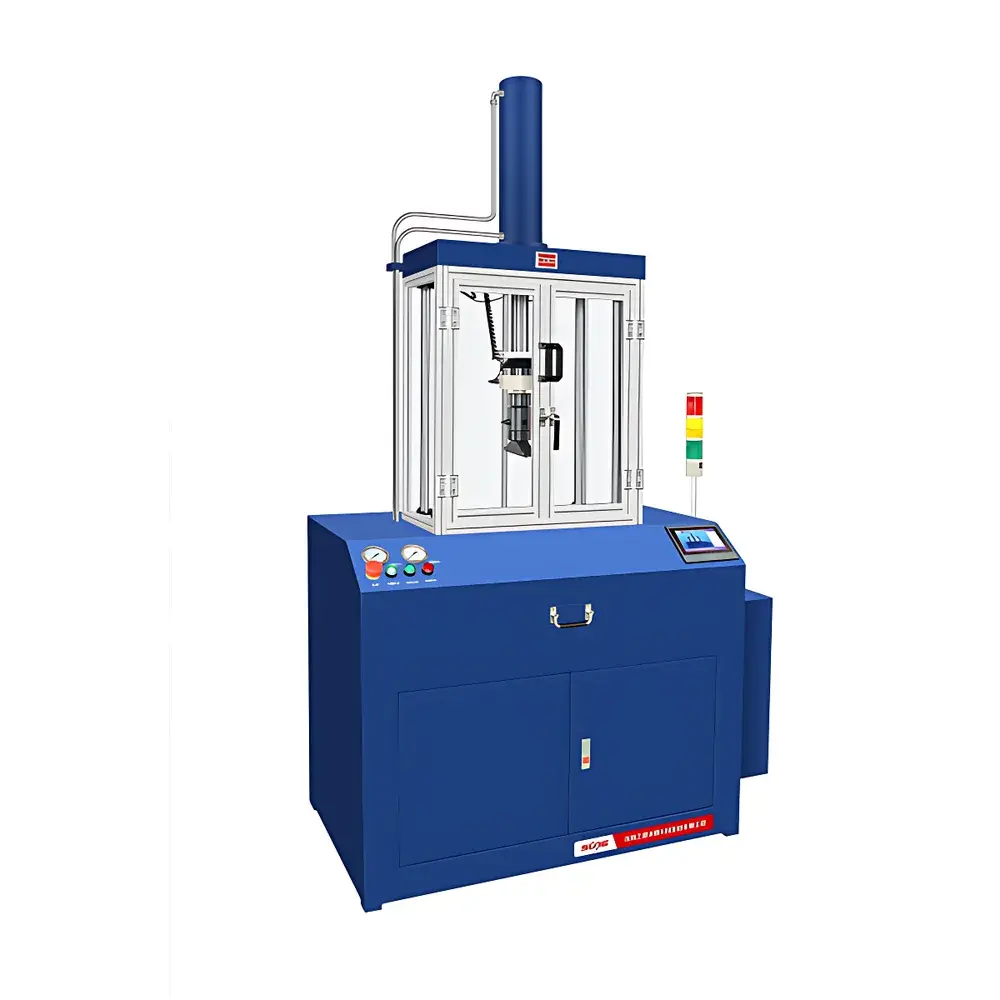
SUNS SANS WZW-100P Computer-Controlled Metal Sheet Bending Testing Machine
| Brand | SUNS SANS |
|---|---|
| Origin | Guangdong, China |
| Manufacturer Type | Direct Manufacturer |
| Model | WZW-100P |
| Max Vertical Thrust | 100 kN |
| Max Horizontal Thrust | 100 kN |
| Testing Frame | Monolithic Frame Structure |
| Test Accuracy Class | ISO 7500-1 Class 0.5 |
| Maximum Span | 130 mm |
| Main Cylinder Stroke | 360 mm |
| Main Cylinder Speed | 300 mm/min |
| Horizontal Cylinder Speed | 270 mm/min |
| Support Roller Dimensions | φ20 × 130 mm |
| Bend Mandrel Radii | R0.8–R4.8 (18 standard radii) |
| Applicable Specimen Thickness | 0.6–5 mm |
| Standards Compliance | GB/T 15825.5–2008, GB/T 232–2010, ISO 7438:2005, VDA 238-100 |
Overview
The SUNS SANS WZW-100P is a high-precision, computer-controlled bending testing machine engineered specifically for the mechanical characterization of metallic thin sheets in industrial quality control and metallurgical R&D environments. It implements a dual-actuator hydraulic architecture—featuring synchronized vertical and horizontal oil cylinders—to execute standardized bending tests under controlled load or displacement conditions. The system operates on the principle of three-point bending (support-roller–specimen–mandrel), where the specimen is clamped between two fixed support rollers and plastically deformed by a centrally positioned bend mandrel driven vertically downward. Simultaneously, lateral actuation enables precise angular positioning—including full 180° bending, zero-degree contact closure, and user-defined intermediate angles—ensuring compliance with geometric requirements across international standards. Designed to ASTM E292 and ISO 7500-1 Class 0.5 accuracy specifications, the WZW-100P delivers traceable force resolution down to 0.5% of full scale and positional repeatability within ±0.02 mm over its 360 mm main cylinder stroke.
Key Features
- Monolithic frame construction with reinforced steel base and rigid crosshead assembly, minimizing deflection during high-load bending (up to 100 kN vertical/horizontal thrust)
- Dual independent hydraulic circuits: one for vertical mandrel actuation (300 mm/min max speed), another for lateral specimen alignment and angular control (270 mm/min)
- Modular mandrel set comprising 18 precision-ground radii (R0.8 to R4.8), each certified to ±0.01 mm tolerance and hardened to ≥60 HRC for wear resistance
- Support roller geometry optimized per ISO 7438 and VDA 238-100: φ20 mm diameter × 130 mm length, surface-ground to Ra ≤ 0.4 µm
- Real-time closed-loop control modes: constant-rate loading (kN/s), constant-rate displacement (mm/min), and hybrid two-stage control (e.g., force-controlled initial deformation followed by displacement-controlled final bend)
- Automatic transition logic between control modes without interruption—enabling seamless execution of multi-phase test protocols required by GB/T 232–2010 Annex A
Sample Compatibility & Compliance
The WZW-100P is validated for flat-rolled ferrous and non-ferrous sheet materials with thicknesses ranging from 0.6 mm to 5.0 mm, including cold-rolled steel, aluminum alloys (e.g., AA5xxx, AA6xxx), and stainless grades (e.g., AISI 304, 430). Its maximum span of 130 mm accommodates standard specimen widths up to 30 mm per GB/T 15825.5–2008 and ISO 7438. All mechanical and software functions are aligned with regulatory expectations for laboratory equipment used in accredited testing laboratories: force calibration traceable to NIM (China National Institute of Metrology); displacement verification via laser interferometry; and audit-ready event logging compliant with GLP principles. The system satisfies functional requirements of ISO/IEC 17025:2017 Clause 6.4.3 for equipment suitability and meets the mechanical performance criteria outlined in VDA 238-100 for automotive sheet metal qualification.
Software & Data Management
The embedded Windows-based control interface (SUNS TestMaster v4.2) provides real-time graphical monitoring of load-displacement curves, bend angle feedback, and cycle counter status. Test sequences are programmable using IEC 61131-3–compatible logic blocks, supporting conditional branching (e.g., “if load > 95% F.S., switch to displacement control”). Raw data exports comply with ASTM E1434–19 format: ASCII-delimited .csv files containing timestamped columns for applied force (kN), crosshead position (mm), mandrel angle (°), and system status flags. Audit trail functionality records all operator actions, parameter modifications, and calibration events with user ID, timestamp, and IP address—meeting FDA 21 CFR Part 11 electronic record requirements when deployed in GMP-regulated facilities. Optional integration with LIMS via OPC UA enables automated result transfer to enterprise quality databases.
Applications
- Quantitative assessment of sheet metal formability via bend angle vs. crack initiation threshold (per VDA 238-100)
- Evaluation of springback behavior in stamped components through controlled unloading sequences
- Validation of annealing process efficacy by comparing post-bend fracture morphology across heat treatment batches
- Material certification for Tier-1 automotive suppliers requiring conformance to VW 60320 or Ford WSS-M29520-A2
- Research into texture-dependent bending ductility in textured Al-Mg alloys using variable mandrel radius sweeps
- Interlaboratory round-robin testing under ISO/IEC 17043 proficiency schemes
FAQ
What standards does the WZW-100P natively support?
It is pre-configured for GB/T 232–2010, GB/T 15825.5–2008, ISO 7438:2005, and VDA 238-100—including built-in test templates, pass/fail criteria, and report formatting.
Can the system perform reverse bending or cyclic bending tests?
Yes—the dual-cylinder architecture supports bidirectional motion, enabling programmed reverse bending cycles with dwell periods at defined angles for fatigue evaluation.
Is third-party calibration certification available?
SUNS provides optional NIST-traceable calibration certificates issued by CNAS-accredited labs, valid for 12 months and including uncertainty budgets per ISO/IEC 17025.
How is mandrel wear monitored and compensated?
Each mandrel includes a QR-coded identification tag linked to its metrology history; software prompts recalibration alerts after 5,000 cycles or upon detected dimensional deviation > ±0.015 mm.
Does the system meet electromagnetic compatibility (EMC) requirements for EU deployment?
Yes—it carries CE marking per EN 61326-1:2013 (industrial environment) and complies with EN 55011:2016 Group 1 Class B emission limits.
Related Products



