
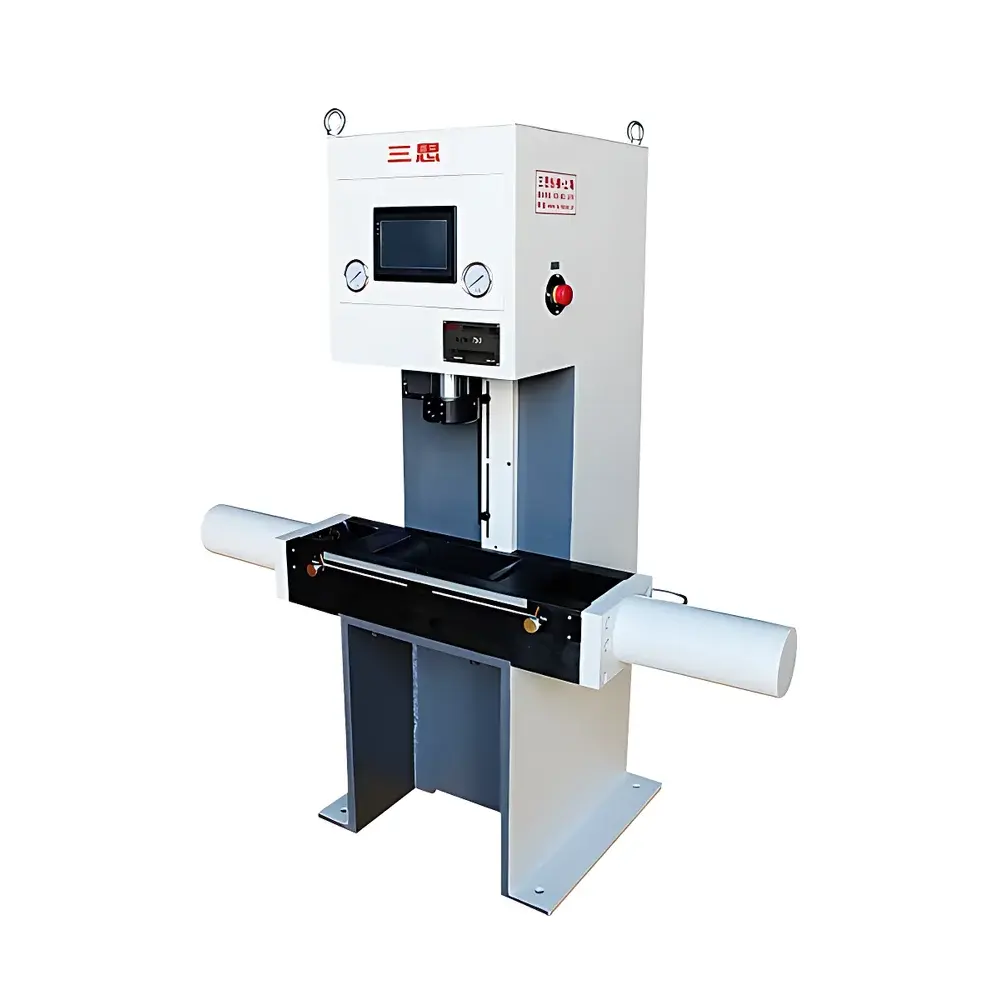
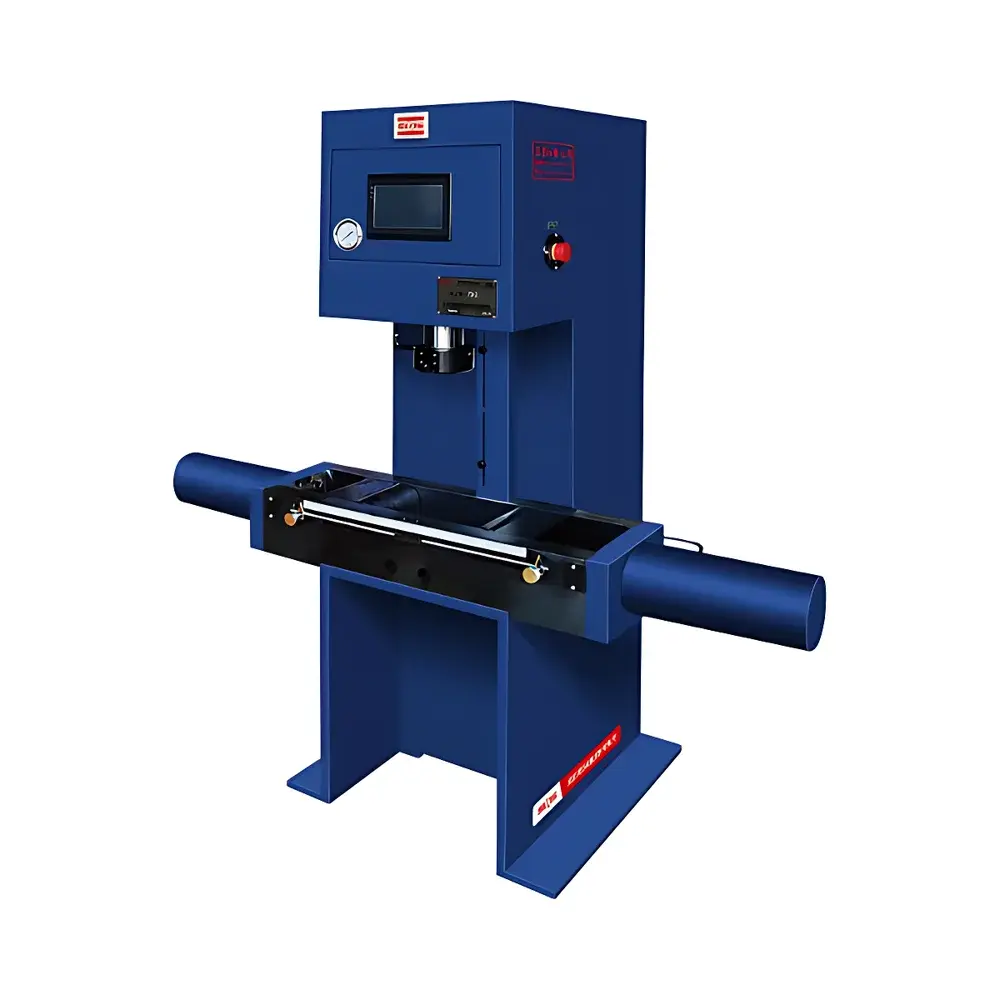
SUNS WZW-250GJ Reinforcing Bar Bending Testing Machine
| Brand | SUNS |
|---|---|
| Origin | Shanghai, China |
| Manufacturer Type | Direct Manufacturer |
| Country of Origin | China |
| Model | WZW-250GJ |
| Max Torque | 200 kN·m |
| Torque Measurement Range | 360 kN·m |
| Torque Resolution | 500 N·m |
| Torsion Angle Measurement Range | 180° |
| Motor Power | 1.5 kW |
| Max Test Force | 200 kN |
| Support Roller Diameter | φ100 mm |
| Bend Mandrel Diameters | Φ6, Φ12, Φ20, Φ28, Φ32, Φ36, Φ40, Φ48, Φ60, Φ75 mm |
| Max Specimen Thickness | Φ6–Φ32 mm |
| Vertical Cylinder Speed | 500 mm/min |
| Horizontal Cylinder Speed | 360 mm/min |
| Main Piston Stroke | 360 mm |
| Max Span | 400 mm |
| Overall Dimensions (L×W×H) | 1350×1250×900 mm |
| Weight | 700 kg |
Overview
The SUNS WZW-250GJ Reinforcing Bar Bending Testing Machine is a purpose-built, hydraulically actuated static bending tester engineered for standardized evaluation of the flexural behavior of hot-rolled ribbed steel bars used in reinforced concrete construction. It operates on the principle of controlled three-point bending under quasi-static loading, conforming to internationally recognized test protocols including ASTM A615/A615M, ISO 15630-1, and GB/T 232–2010 (Metallic Materials — Bend Test). The machine applies precise, repeatable bending moments via dual hydraulic actuators — a primary vertical cylinder for initial mandrel engagement and a secondary horizontal cylinder for final 180° bending — ensuring consistent deformation geometry across specimens. Its integrated hydraulic power unit and rigid monoblock frame eliminate external piping complexity and enhance mechanical stability during high-force loading cycles. Designed for laboratory and quality control environments, the system delivers traceable, operator-independent results essential for structural material certification and process validation in steel production, prefabrication, and civil engineering QA/QC workflows.
Key Features
- Monolithic卧式 (horizontal) structural design with integrated hydraulic station, minimizing footprint and improving rigidity and alignment repeatability.
- Dual-actuator bending mechanism: main vertical cylinder for pre-bending and auxiliary horizontal cylinder for full 180° plastic deformation — enabling precise control over bending sequence and force distribution.
- Manually adjustable support rollers and interchangeable bend mandrels (Φ6–Φ75 mm), supporting full compliance with standard bar diameters per ASTM A615 and EN 10080.
- High-speed hydraulic actuation: vertical stroke at up to 500 mm/min and horizontal displacement at 360 mm/min, reducing cycle time without compromising load fidelity.
- Robust base frame and precision-machined load train components ensure long-term dimensional stability and minimal deflection under 200 kN maximum test force.
- Electro-hydraulic control system with real-time pressure feedback, enabling closed-loop load regulation and programmable dwell timing at peak bending angle.
Sample Compatibility & Compliance
The WZW-250GJ accommodates reinforcing bars ranging from Φ6 mm to Φ32 mm in nominal diameter, with bending mandrel selection aligned to standardized ratios (e.g., 1×, 2×, 3×, or 4× bar diameter per ASTM A615 Table 3). It supports testing of both as-received hot-rolled bars and welded splices (e.g., flash-butt or arc-welded joints), meeting requirements for weld integrity assessment under ISO 15614-1 and GB 50661. The machine’s mechanical configuration satisfies metrological traceability requirements per ISO/IEC 17025 when operated with calibrated load cells and angular encoders. All bending fixtures are manufactured to dimensional tolerances specified in ISO 7500-1 Class 1, ensuring force measurement uncertainty ≤ ±1.0% of reading over the full 200 kN range.
Software & Data Management
While the base WZW-250GJ operates via panel-mounted manual controls and analog pressure gauges, optional digital upgrade packages integrate with SUNS’ proprietary TestExpert™ software suite. This platform provides real-time load–displacement curve acquisition, automatic pass/fail classification against user-defined bend angle and crack criteria, and export of ASCII or Excel-compatible data files. Audit trails include operator ID, timestamp, test parameters, and environmental metadata — supporting GLP-compliant documentation and FDA 21 CFR Part 11 readiness when configured with electronic signatures and role-based access control. Raw sensor outputs are sampled at ≥100 Hz to capture transient yielding events during plastic hinge formation.
Applications
- Quality assurance testing of hot-rolled deformed steel bars (HRB335, HRB400, HRB500) in steel mills and distribution centers.
- Evaluation of weld joint ductility in construction site QA programs, per ACI 318 and JGJ 18 standards.
- R&D characterization of new alloy compositions or thermomechanical processing routes affecting bendability and fracture resistance.
- Third-party certification testing for CE marking (EN 10080), CCC (China Compulsory Certification), and ISO 9001 internal audits.
- Calibration verification of bending fixtures and alignment jigs used in field-testing equipment.
FAQ
What standards does the WZW-250GJ comply with for rebar bending tests?
It supports ASTM A615/A615M, ISO 15630-1, GB/T 232–2010, and EN ISO 7438, with mechanical configuration validated for mandated support span and mandrel geometry.
Can the machine test welded rebar splices?
Yes — its dual-cylinder architecture and rigid fixture mounting enable reliable bending of flash-butt, gas-pressure, and arc-welded joints per ISO 15614-1 Annex B and GB 50661 Clause 5.3.
Is torque measurement traceable to national standards?
When equipped with certified load cells and calibrated angular transducers, the system meets ISO/IEC 17025 requirements for force and angle metrology; calibration certificates are issued with NIST-traceable references.
What maintenance intervals are recommended for hydraulic components?
Hydraulic oil replacement every 2,000 operating hours or biannually, filter elements every 500 hours, and annual verification of cylinder seal integrity and pressure relief valve setpoint accuracy.
Does the system support automated reporting for ISO 9001 documentation?
With the TestExpert™ software option, it generates PDF test reports containing specimen ID, test parameters, pass/fail status, raw curves, and digital signature fields — fully compatible with QMS platforms such as MasterControl and TrackWise.



