
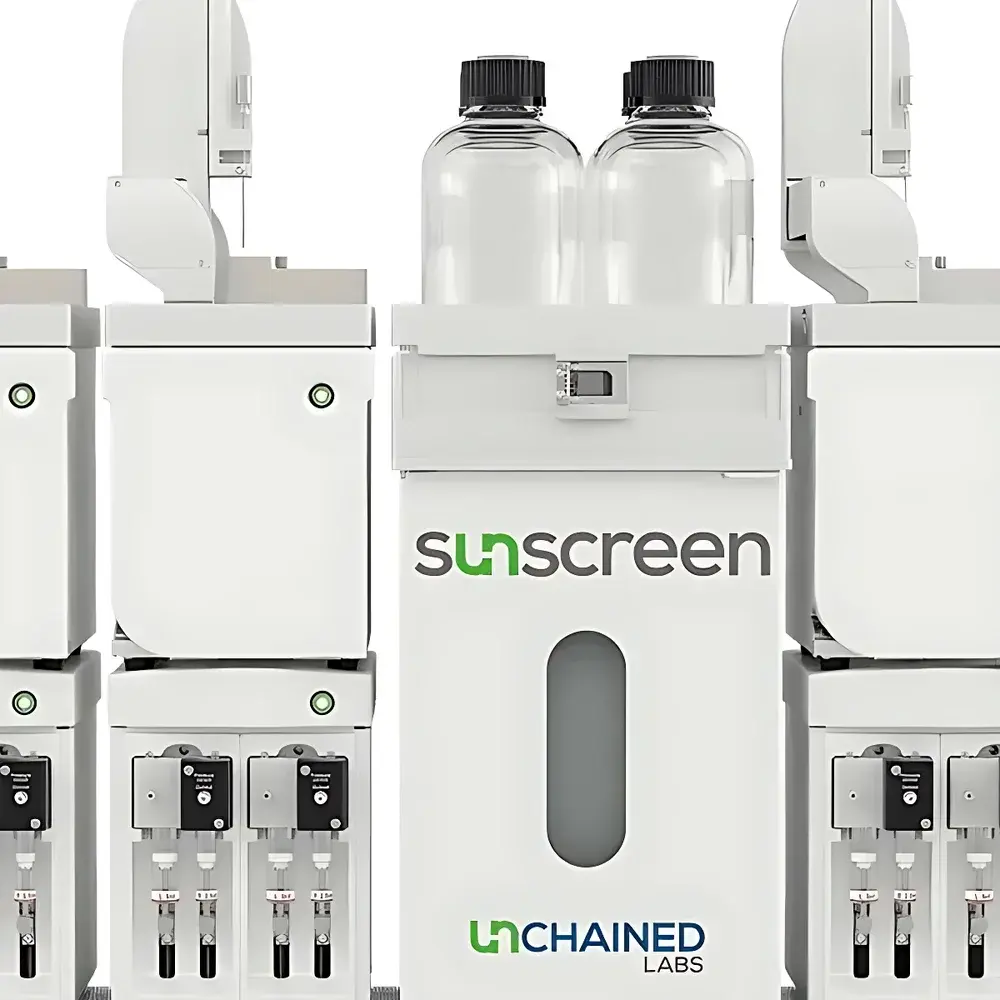
Sunscreen High-Throughput LNP Formulation Screening System by Unchained Labs
| Brand | Unchained Labs |
|---|---|
| Origin | USA |
| Model | Sunscreen |
| Flow Rate Range | 0.1–30 mL/min |
| Throughput | 96 formulations per run |
| Per-Well Volume | 200 µL–2 mL |
| Chip Type | Interchangeable Sunny microfluidic chips (Sunny, Sunny XT, Sunny Trident) |
| Scalability | Compatible with Sunshine platform for process transfer and scale-up |
| Software | Sunny Suite (automated protocol validation, plate mapping, run scheduling, audit trail) |
Overview
The Sunscreen High-Throughput LNP Formulation Screening System is an automated microfluidic platform engineered for rapid, reproducible, and scalable lipid nanoparticle (LNP) formulation development. It operates on the principle of controlled turbulent mixing within precision-machined microchannels—leveraging hydrodynamic focusing and defined residence time to achieve consistent particle size distribution, encapsulation efficiency, and polydispersity index (PDI) across parallel formulations. Designed specifically for early-stage nanomedicine process development, Sunscreen enables systematic exploration of critical formulation variables—including lipid composition ratios (ionizable, helper, cholesterol, PEG-lipid), lipid-to-nucleic acid (L:N) molar ratios, total flow rate, flow rate ratio (aqueous:organic), and mixing geometry—without manual intervention or serial experimentation. Its architecture supports both discovery-phase screening and translational process definition, bridging the gap between benchtop feasibility and GMP-aligned manufacturing.
Key Features
- Parallelized 96-well formulation synthesis in under 6 hours—enabling statistically robust design-of-experiments (DoE) workflows
- Modular microfluidic chip ecosystem: Sunny (T-junction), Sunny XT (cross-junction with enhanced interfacial area), and Sunny Trident (full independent control of total flow, flow ratio, and integrated inline dilution)
- Programmable per-well volume delivery from 200 µL to 2 mL, supporting both analytical-scale characterization and preclinical dose preparation
- Adjustable flow rate range (0.1–30 mL/min) with sub-milliliter precision, validated for consistent Reynolds number control across operating conditions
- Reusable, autoclavable Sunny chips—minimizing consumable cost and reducing batch-to-batch variability through hardware standardization
- Automated liquid handling integration: dual plate loading (payload solution + lipid-in-ethanol stock) with barcode-assisted sample tracking
Sample Compatibility & Compliance
Sunscreen accommodates a broad spectrum of nucleic acid payloads—including mRNA, siRNA, saRNA, and CRISPR RNP complexes—as well as conventional plasmid DNA. Compatible lipid classes include ionizable lipids (e.g., DLin-MC3-DMA, SM-102, ALC-0315), phospholipids (DSPC, DOPE), sterols (cholesterol), and PEGylated lipids (DMG-PEG2000, ALC-0159). All fluidic pathways are constructed from chemically inert, USP Class VI-certified materials (e.g., cyclic olefin copolymer, stainless steel, fluoropolymer tubing), ensuring compatibility with ethanol-based organic phases and aqueous buffers containing chelators, salts, or cryoprotectants. The system meets ISO 13485 design control principles and supports 21 CFR Part 11-compliant operation when deployed with validated Sunny Suite configurations—including electronic signatures, audit trail logging, and role-based access control.
Software & Data Management
Sunny Suite is a dedicated Windows-based application that orchestrates experimental setup, real-time monitoring, and post-run data export. Users define plate maps (source wells, concentrations, mixing ratios), specify chip type and operational parameters, and initiate automated validation checks—including priming status, pressure stability, and reagent volume sufficiency—prior to run commencement. During execution, the software logs timestamped flow metrics, temperature (if equipped with optional environmental module), and chip-specific calibration offsets. All raw metadata—including formulation IDs, mixing conditions, and run timestamps—is exported in CSV/JSON format for integration with LIMS or statistical analysis platforms (e.g., JMP, Python pandas). Audit trails comply with GLP/GMP documentation requirements and support retrospective review during regulatory submissions.
Applications
- Rapid empirical optimization of LNP formulations for improved transfection efficiency, serum stability, and biodistribution profiles
- Screening of novel ionizable lipid candidates against standardized payload panels
- Establishment of quality target product profiles (QTPPs) and identification of critical quality attributes (CQAs)
- Generation of design space boundaries for QbD (Quality by Design) filings
- Process transfer validation from Sunscreen to Sunshine continuous manufacturing platform—ensuring seamless scalability from µg to gram-scale production
- Support for academic, CRO, and biopharma labs engaged in mRNA vaccine development, gene editing therapeutics, and RNAi-based oncology programs
FAQ
Can Sunscreen be used for non-LNP nanocarriers such as polymeric nanoparticles or liposomes?
Yes—while optimized for LNP self-assembly kinetics, its microfluidic architecture supports alternative nanoprecipitation and thin-film hydration workflows when adapted with appropriate solvent systems and chip configurations.
Is Sunny Suite compatible with third-party plate readers or DLS instruments?
Sunny Suite exports structured metadata compatible with common instrument drivers; direct hardware integration requires custom API configuration via Unchained Labs’ Professional Services team.
What maintenance is required for long-term reliability?
Routine cleaning with ethanol/water followed by air purging is recommended after each run; chip lifetime exceeds 500 cycles under standard operating conditions when maintained per manufacturer guidelines.
Does Sunscreen support temperature-controlled mixing?
An optional environmental control module enables ambient temperature regulation (15–35°C) of the chip holder and inlet manifolds, critical for thermosensitive payloads or low-viscosity lipid formulations.
How is method transfer to Sunshine ensured?
Sunny Suite generates transfer-ready parameter sets—including Reynolds number, mixing energy input, and residence time—that map directly to Sunshine’s continuous processing parameters, minimizing re-optimization effort during scale-up.




