
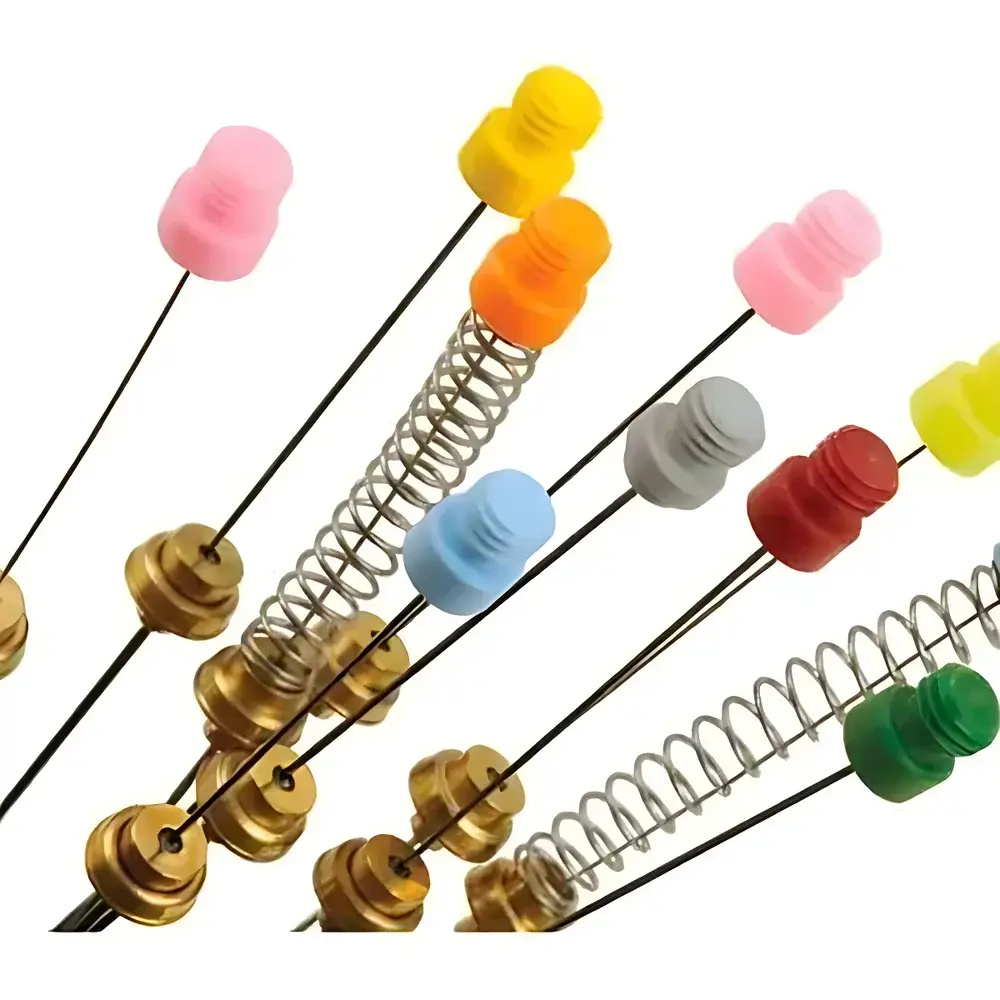
Supelco 57328-U / 57329-U DVB/CAR/PDMS 50/30 µm Solid Phase Microextraction (SPME) Fiber Assembly
| Brand | Supelco |
|---|---|
| Origin | USA |
| Product Type | Imported SPME Fiber for Volatile and Semi-Volatile Compounds (C₃–C₂₀) |
| Model | 57328-U (Manual) / 57329-U (Automated) |
| Coating | Divinylbenzene/Carboxen/Polydimethylsiloxane (DVB/CAR/PDMS), 50/30 µm |
| Package | 3 fibers per vial |
| Compatibility | GC, GC-MS, HS-GC, HS-GC-MS |
Overview
The Supelco 57328-U and 57329-U DVB/CAR/PDMS 50/30 µm Solid Phase Microextraction (SPME) fiber assemblies represent a rigorously engineered solution for the selective enrichment of volatile and semi-volatile organic compounds (VOCs and SVOCs) across a broad molecular weight range (C₃–C₂₀). Developed by Merck KGaA under the Supelco brand—pioneer of commercial SPME technology since its introduction in 1994—the fiber leverages a triple-layer composite coating architecture: divinylbenzene (DVB) provides high surface area and strong adsorption for low-molecular-weight polar and non-polar analytes; Carboxen (CAR) contributes enhanced selectivity toward small molecules, including aldehydes, ketones, sulfur compounds, and light hydrocarbons; polydimethylsiloxane (PDMS) delivers robust affinity for mid-to-high polarity organics and ensures thermal stability up to 250 °C. This synergistic combination enables balanced extraction efficiency across diverse compound classes without solvent use, making it ideal for headspace (HS), direct immersion (DI), and membrane-assisted SPME workflows. The fiber is housed on a fused-silica core (1 cm active length) within a stainless-steel sheath, compatible with both manual and automated SPME platforms.
Key Features
- Triple-phase composite coating (DVB/CAR/PDMS, 50/30 µm total thickness) optimized for C₃–C₂₀ volatile and semi-volatile analytes, including flavor compounds, residual solvents, pesticides, metabolites, and environmental VOCs
- Fused-silica fiber core with high mechanical integrity and consistent coating adhesion—engineered for reproducible extraction kinetics and minimal carryover
- StableFlex™ substrate technology enhances fiber durability during repeated retraction/extension cycles and thermal desorption in GC injectors
- Two platform-specific configurations: 57328-U for manual SPME holders (e.g., Supelco 57330-U); 57329-U with reinforced mounting interface for robotic autosamplers (e.g., Gerstel MPS, CTC PAL, Thermo TriPlus)
- Validated for use with standard split/splitless GC injectors, cold on-column inlets, and programmable temperature vaporization (PTV) systems
- Each vial contains three individually packaged fibers with inert crimp-sealed vials to prevent ambient contamination and preserve coating integrity
Sample Compatibility & Compliance
The DVB/CAR/PDMS 50/30 µm fiber demonstrates validated performance across aqueous, biological, gaseous, and semi-solid matrices—including serum, urine, plasma, fruit juice, wine, wastewater, soil headspace, tobacco smoke condensate, and polymer leachates. Its extraction profile aligns with established method requirements under EPA Method 8260D (VOCs in water and soil), ASTM D7715-14 (volatile organic compounds in beverages), ISO 17034 (reference material competence), and USP (residual solvents). When deployed in GLP- or GMP-regulated environments, the fiber supports full traceability when paired with audit-trail-enabled SPME autosamplers compliant with FDA 21 CFR Part 11. Routine calibration verification using certified VOC standards (e.g., NIST SRM 1850b) confirms inter-batch consistency and long-term retention time stability.
Software & Data Management
While the fiber itself is a passive consumable, its analytical utility is maximized through integration with instrument control software supporting SPME sequence programming, thermal desorption timing, and method parameter logging. Compatible platforms include OpenLab CDS (Agilent), Chromeleon (Thermo), Empower (Waters), and Maestro (Shimadzu). All Supelco SPME fibers are assigned unique lot numbers traceable to manufacturing batch records, enabling full chain-of-custody documentation. For laboratories implementing LIMS-based workflow management, fiber lot data can be imported via CSV or integrated through API endpoints for automated inventory reconciliation and expiry tracking.
Applications
- Flavor & Fragrance Analysis: Quantification of esters, alcohols, terpenes, and lactones in wines, spirits, dairy products, and essential oils
- Environmental Monitoring: Detection of BTEX, chlorinated ethenes, carbonyl sulfide, and mercaptans in ambient air, groundwater, and landfill leachate
- Clinical & Forensic Toxicology: Extraction of benzodiazepines, opioids, amphetamines, and volatile anesthetics from blood, urine, and vitreous humor
- Food Safety: Screening for pesticide residues (e.g., chlorpyrifos, diazinon), mycotoxin metabolites, and packaging migrants in fruits, vegetables, and infant formula
- Pharmaceutical QC: Residual solvent profiling (ICH Q3C Class 2/3) in APIs and final drug products using HS-SPME/GC-FID or GC-MS
- Polymer & Materials Testing: Headspace analysis of plasticizers, antioxidants, and degradation volatiles in polyolefins, PVC, and elastomers
FAQ
What is the maximum recommended desorption temperature for this fiber?
The DVB/CAR/PDMS 50/30 µm fiber is rated for routine desorption at 250 °C in splitless or PTV injectors. Extended exposure above 260 °C may accelerate CAR phase degradation.
Can this fiber be used for liquid-phase (direct immersion) SPME?
Yes—optimized for both headspace and direct immersion modes. For DI applications, pre-equilibration in matrix and agitation control (e.g., magnetic stirring at 500 rpm) are recommended to ensure kinetic reproducibility.
How many extractions can be performed before fiber replacement?
Under controlled conditions (clean matrices, proper conditioning, and injector maintenance), typical lifetime exceeds 100–150 extractions. Performance decline is indicated by reduced peak area, increased baseline noise, or ghost peaks—monitoring n-decane or toluene response is advised.
Is this fiber compatible with Shimadzu GC systems?
Yes, provided the SPME holder or autosampler is mechanically adapted. Note that certain Supelco injection liners (e.g., 57356-U) are not compatible with Shimadzu GC inlets due to dimensional constraints.
Does the fiber require preconditioning before first use?
Yes—condition at 250 °C for 30 minutes in a dedicated GC inlet or oven under helium flow (1 mL/min) to remove residual solvents and stabilize the coating.



