
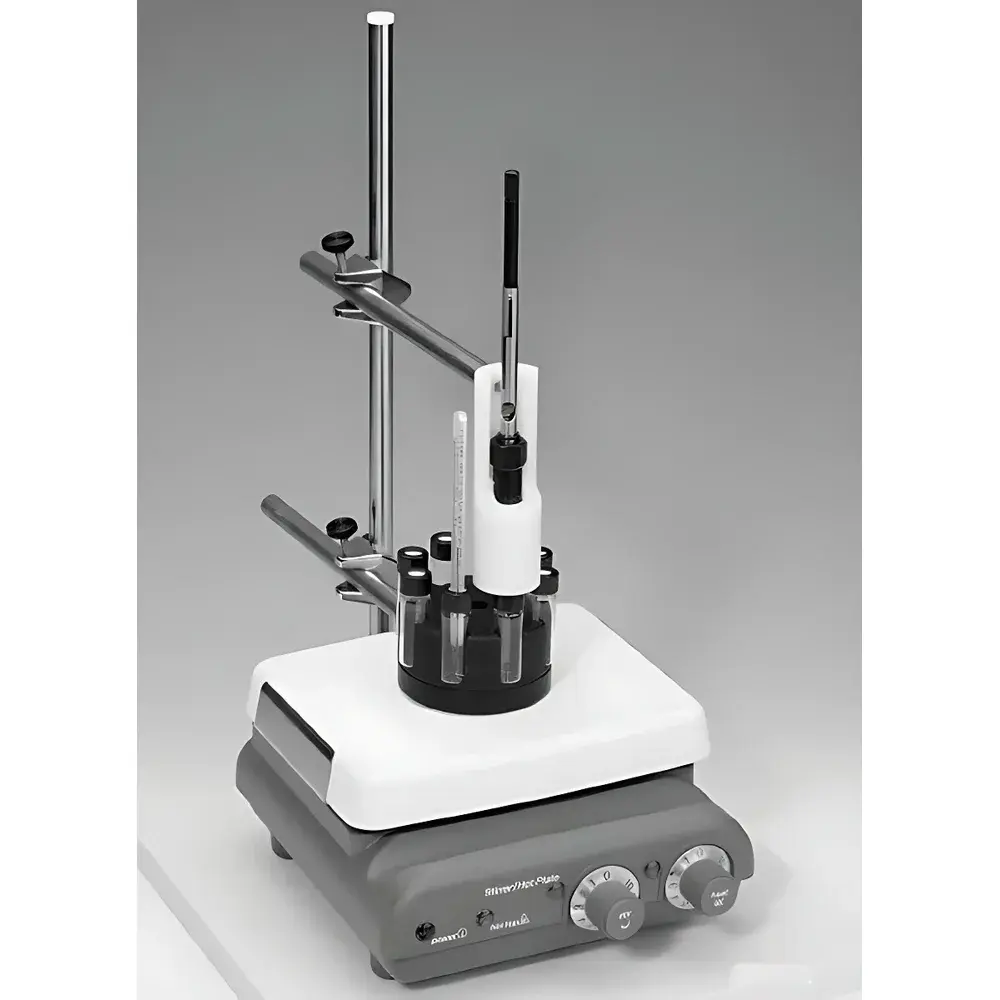
Supelco KLGC-SPME Manual Solid Phase Microextraction Device for GC and GC-MS
| Brand | Supelco |
|---|---|
| Origin | USA |
| Model | KLGC-SPME |
| Configuration | Manual SPME Holder with Adjustable Depth Sleeve and Replaceable Coated Fibers |
| Compliance | Designed for ASTM D7219, ISO 17935, USP <467>, EPA Method 8260/8270 Compatible |
| Software Integration | Standalone manual operation |
Overview
The Supelco KLGC-SPME Manual Solid Phase Microextraction Device is a precision-engineered sample preparation tool designed for seamless integration with gas chromatography (GC) and gas chromatography–mass spectrometry (GC-MS) platforms. Based on the patented Solid Phase Microextraction (SPME) technology developed by Supelco (a Sigma-Aldrich brand, Merck KGaA), this device implements a solvent-free, equilibrium-based extraction principle rooted in partitioning thermodynamics. A fused-silica fiber—coated with a chemically selective stationary phase—is exposed to the sample matrix (liquid, headspace, or solid) to adsorb or absorb analytes reversibly. Following equilibration (typically 5–15 min, dependent on analyte volatility, matrix complexity, and fiber chemistry), the fiber is retracted into its protective stainless-steel sheath and directly inserted into a heated GC inlet, where thermal desorption releases analytes onto the column. This closed-system design eliminates transfer losses, minimizes contamination risk, and ensures high reproducibility across replicate analyses. First introduced in 1994 and awarded the R&D 100 Award at Pittcon, KLGC-SPME represents a foundational advancement in miniaturized, field-deployable sample enrichment—replacing traditional liquid–liquid extraction (LLE), solid-phase extraction (SPE), and purge-and-trap methods with a single-step, low-volume, low-waste workflow.
Key Features
- Adjustable-depth sleeve mechanism enables precise positioning of the fiber tip within the GC injection port’s optimal heating zone (±0.5 mm repeatability), critical for consistent thermal desorption efficiency and peak shape fidelity.
- Robust stainless-steel holder with ergonomic grip and tactile locking collar ensures stable fiber extension/retraction under laboratory or field conditions; fully reusable with no consumable components beyond the fiber itself.
- Fiber protection system maintains coating integrity during handling, sampling, and transport—minimizing mechanical abrasion and oxidation of sensitive coatings (e.g., CAR/PDMS, DVB/CAR/PDMS).
- Modular compatibility: Accepts all standard Supelco SPME fibers (1 cm length, 85 µm, 70 µm, 65 µm, 50 µm, 30 µm, 7 µm film thicknesses) across polar (PA, CW/TPR), mid-polarity (PDMS/DVB), and non-polar (PDMS, CAR) chemistries.
- Designed for manual operation without external power or automation—ideal for method development, low-throughput QA/QC labs, forensic casework, and on-site environmental screening where portability and simplicity are paramount.
Sample Compatibility & Compliance
The KLGC-SPME device supports direct immersion (DI), headspace (HS), and membrane-assisted (for viscous or particulate-laden samples) modes. It accommodates aqueous matrices (surface water, wastewater, biological fluids), volatile organic compounds (VOCs) in air or soil headspace, residual solvents in pharmaceuticals, trace pesticides in food extracts, and semi-volatile organics (SVOCs) in polymer leachates. All configurations comply with regulatory frameworks governing analytical method validation: fiber selection and extraction parameters adhere to ASTM D7219 (SPME for VOC analysis in water), ISO 17935 (determination of PAHs in soil), USP (residual solvents), and EPA Methods 8260D (VOCs) and 8270E (SVOCs). When used in GLP- or GMP-regulated environments, the manual nature of KLGC-SPME requires documented operator training, fiber lot traceability, and calibration verification per SOP—fully supported by Supelco’s Certificate of Analysis (CoA) for each fiber batch.
Software & Data Management
As a hardware-only, non-instrumented sampling interface, the KLGC-SPME does not include embedded firmware or proprietary software. Its operation is independent of instrument control systems—requiring only standard GC/GC-MS acquisition software (e.g., Agilent MassHunter, Thermo Xcalibur, Shimadzu GCMSsolution). However, it integrates transparently into LIMS and electronic lab notebook (ELN) workflows: fiber lot numbers, extraction time/temperature, and sample ID are manually entered or scanned into audit trails. For 21 CFR Part 11 compliance, laboratories implement procedural controls—including dual-operator verification of fiber insertion depth and desorption temperature—and retain digital records of fiber usage logs alongside raw chromatographic data.
Applications
- Environmental monitoring: Quantification of BTEX, chlorinated hydrocarbons, and phthalates in drinking water and groundwater per EPA protocols.
- Clinical toxicology: Rapid screening of drugs of abuse (e.g., benzodiazepines, opioids) and ethanol metabolites in urine and blood plasma.
- Food and flavor analysis: Profiling volatile aroma compounds (e.g., esters, aldehydes, terpenes) in beverages, dairy, and roasted coffee without derivatization.
- Forensic science: Recovery of accelerants (gasoline, kerosene) from fire debris and illicit drug residues from surfaces.
- Pharmaceutical quality control: Residual solvent testing (e.g., acetone, dichloromethane) in active pharmaceutical ingredients (APIs) per ICH Q3C guidelines.
- Materials testing: Headspace analysis of VOC emissions from automotive interiors, packaging films, and adhesives.
FAQ
Is the KLGC-SPME holder compatible with all GC inlets?
Yes—mechanically compatible with Agilent/HP (5890, 6890, 7890, 8890), Thermo Fisher (Trace 1300/1600), Shimadzu (GC-2010/2030), and PerkinElmer (Clarus 680/690) split/splitless injectors when used with appropriate inlet liners (e.g., Supelco 53523).
How many times can a single SPME fiber be reused?
Under optimized conditions (proper conditioning, avoidance of particulates, controlled desorption temperature), PDMS-based fibers typically sustain 50–100 extractions; CAR/PDMS and DVB/CAR/PDMS fibers average 30–70 uses before signal degradation exceeds 15% RSD.
Can KLGC-SPME be used for quantitative analysis?
Yes—when coupled with internal standardization (e.g., deuterated analogs), matrix-matched calibration, and rigorous method validation (linearity, LOD/LOQ, recovery, precision), KLGC-SPME delivers quantitative performance meeting ISO/IEC 17025 requirements.
What accessories are essential for routine operation?
A calibrated heating/stirring platform (e.g., Supelco Z262137), temperature probe (52244), inert sampling vials with crimp caps (KL04/KL15), high-temperature septa (54663), and an adjustable-height SPME stand (510381 or 513171) are recommended to ensure reproducible extraction kinetics and operator ergonomics.
Does Supelco provide fiber certification documentation?
Each SPME fiber batch ships with a Certificate of Analysis specifying coating thickness uniformity, thermal stability limits, and batch-specific performance data against reference standards (e.g., n-alkanes, PAHs).



