
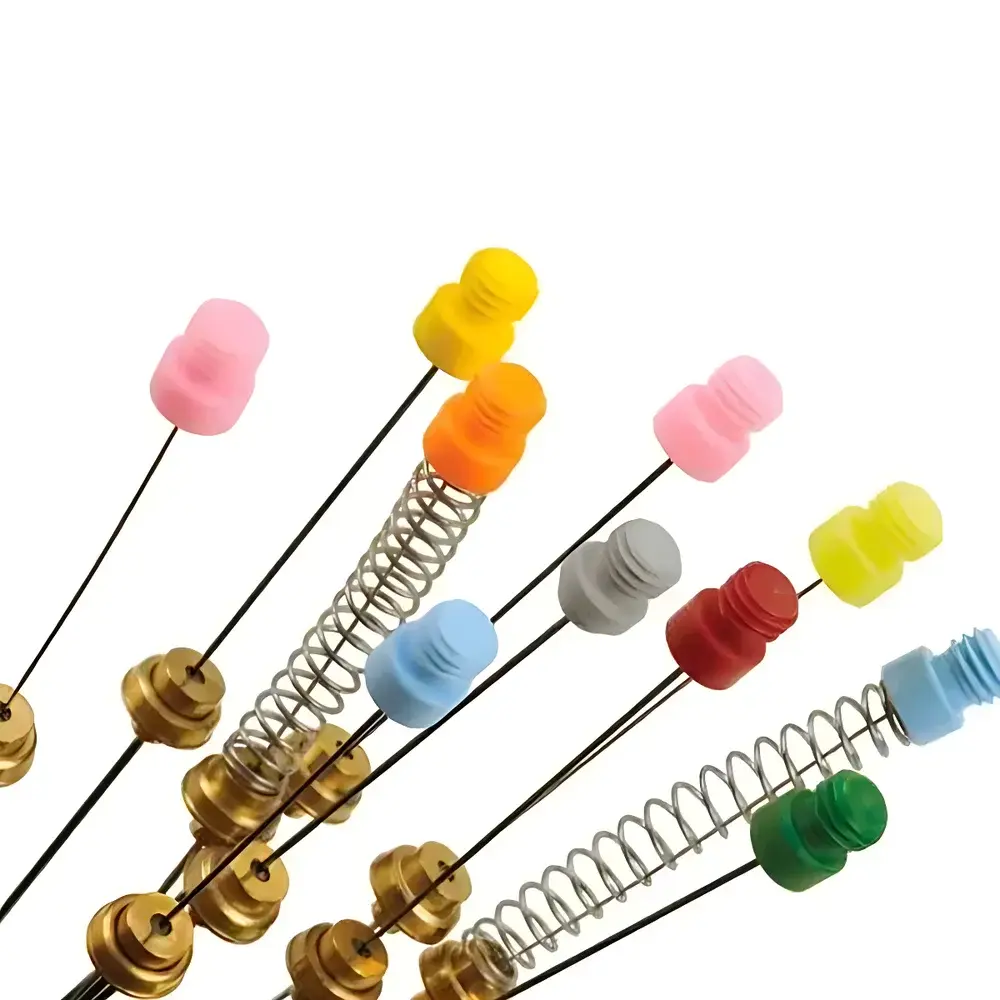
Supelco SPME Fiber Assembly Kit 1 (85 µm PA / 100 µm PDMS / 7 µm PDMS)
| Brand | Supelco |
|---|---|
| Origin | USA |
| Product Type | Manual SPME Fiber Kit |
| Compatible Holder | Manual SPME Holder (24-gauge needle) |
| Fiber Coatings | Polyacrylate (85 µm), Polydimethylsiloxane (100 µm and 7 µm) |
| Reusability | ≥100 extractions (up to 200+ in clean matrices) |
| Compliance | Designed for ASTM D6866, ISO 17993, USP <467>, and EPA Methods 8260/8270 compatible workflows |
Overview
The Supelco SPME Fiber Assembly Kit 1 is a rigorously engineered solid-phase microextraction (SPME) consumable set designed for reproducible, solvent-free extraction of volatile and semi-volatile organic compounds (VOCs and SVOCs) from complex aqueous, gaseous, and headspace matrices. Based on the fundamental principle of equilibrium partitioning between sample matrix and stationary-phase-coated fused-silica fiber, this kit leverages three complementary chemistries—85 µm polyacrylate (PA), 100 µm polydimethylsiloxane (PDMS), and 7 µm PDMS—to provide broad polarity coverage across molecular weight ranges (MW ~60–600 Da). Each fiber features a robust stainless-steel needle housing and precise 1 cm exposed coating length, ensuring consistent insertion depth and thermal desorption efficiency in GC, GC-MS, and HPLC interfaces. Developed by Supelco (a Merck KGaA company), this kit reflects over two decades of refinement in SPME methodology since its introduction at Pittcon 1994, meeting stringent requirements for trace-level analysis in regulated environments.
Key Features
- Triple-coating configuration enables method flexibility: PA for polar semi-volatiles (e.g., phenols, carboxylic acids); 100 µm PDMS for highly volatile neutrals (e.g., BTEX, chlorinated solvents); 7 µm PDMS for rapid equilibration with low-MW gases and headspace analytes.
- Fibers are manufactured under ISO 9001-certified processes with batch-specific QC documentation; each lot undergoes retention time stability testing using certified reference standards (e.g., NIST SRM 1648a).
- Optimized for manual SPME holders (e.g., Supelco 57330-U) with 24-gauge needle compatibility; fibers withstand repeated thermal desorption up to 325 °C without coating degradation or bleed.
- No solvent consumption, no phase separation, and minimal sample volume requirement (as low as 1 mL aqueous or 10 mL headspace), aligning with green analytical chemistry principles (ICH Q5C, EPA Method 8260D Section 7.3).
- Validated reusability: ≥100 extractions demonstrated under GLP-compliant conditions; performance monitored via internal standard recovery (e.g., deuterated toluene) per USP system suitability criteria.
Sample Compatibility & Compliance
This kit supports direct immersion (DI), headspace (HS), and membrane-assisted (MA) SPME modes across diverse sample types including environmental water (drinking, wastewater, surface water), biological fluids (urine, plasma, saliva), food homogenates, polymer leachates, and ambient air samples. It complies with key regulatory frameworks: EPA Method 8260D (VOCs in water), EPA Method 8270E (SVOCs), ASTM D6866 (biobased content), ISO 17993 (SPME validation guidelines), and USP (residual solvents). All fibers are manufactured in accordance with ICH Q5A(R2) for biopharmaceutical impurity profiling and meet FDA 21 CFR Part 11 requirements when used with compliant data acquisition systems (e.g., Thermo Chromeleon, Agilent OpenLab CDS).
Software & Data Management
While the fibers themselves are passive consumables, their integration into automated workflows requires traceable calibration and audit-ready documentation. When paired with autosamplers (e.g., Gerstel MPS, CTC CombiPAL), the kit supports full electronic recordkeeping—including fiber usage logs, desorption temperature profiles, and carryover checks—as mandated by 21 CFR Part 11 Annex 11. Supelco provides optional SOP templates aligned with ISO/IEC 17025:2017 for SPME method validation, covering precision (RSD ≤15% for n=6), linearity (r² ≥0.995), LOD/LOQ determination, and matrix effect assessment. Raw data files retain embedded metadata (fiber ID, lot number, extraction time, temperature) for retrospective forensic reconstruction.
Applications
- Environmental monitoring: Quantification of VOCs (e.g., benzene, chloroform) in drinking water per EPA 524.2; detection of pesticides (e.g., chlorpyrifos, diazinon) in agricultural runoff.
- Clinical toxicology: Extraction of drugs of abuse (e.g., amphetamines, opioids) and metabolites from urine and blood; validated per SAMHSA cutoff concentrations.
- Food & flavor analysis: Profiling of esters, aldehydes, and terpenes in beverages and dairy products; compliant with ISO 11014 for safety data sheet generation.
- Forensic science: Recovery of accelerants (e.g., gasoline, kerosene) from fire debris; adherence to SWGTOX guidelines for evidentiary chain-of-custody.
- Pharmaceutical QA/QC: Residual solvent screening in APIs per ICH Q3C; headspace SPME of ethyl acetate and isopropanol from lyophilized formulations.
FAQ
What is the maximum recommended desorption temperature for these fibers?
For optimal longevity and minimal bleed, desorb at ≤325 °C for 3–5 minutes in splitless GC inlet mode.
Can these fibers be used with automated SPME systems?
Yes—Kit 1 fibers are mechanically compatible with Gerstel, CTC, and Shimadzu autosamplers when mounted on appropriate fiber carriers; however, 57307 (auto-specific variant) includes reinforced mounting geometry for high-cycle robotic arms.
How should fiber lifetime be monitored in regulated labs?
Track peak area response of internal standards across ≥10 consecutive injections; initiate recalibration when RSD exceeds 15% or absolute response drops >20% from baseline.
Is conditioning required before first use?
Yes—condition each fiber at its maximum desorption temperature for 30 min in GC inlet prior to initial extraction, following Supelco Technical Bulletin TB-102.
Are these fibers suitable for HPLC-UV analysis?
Only the 60 µm PDMS/DVB fiber (not included in Kit 1) is validated for HPLC elution; Kit 1 fibers are optimized for thermal desorption GC/GC-MS applications.



