
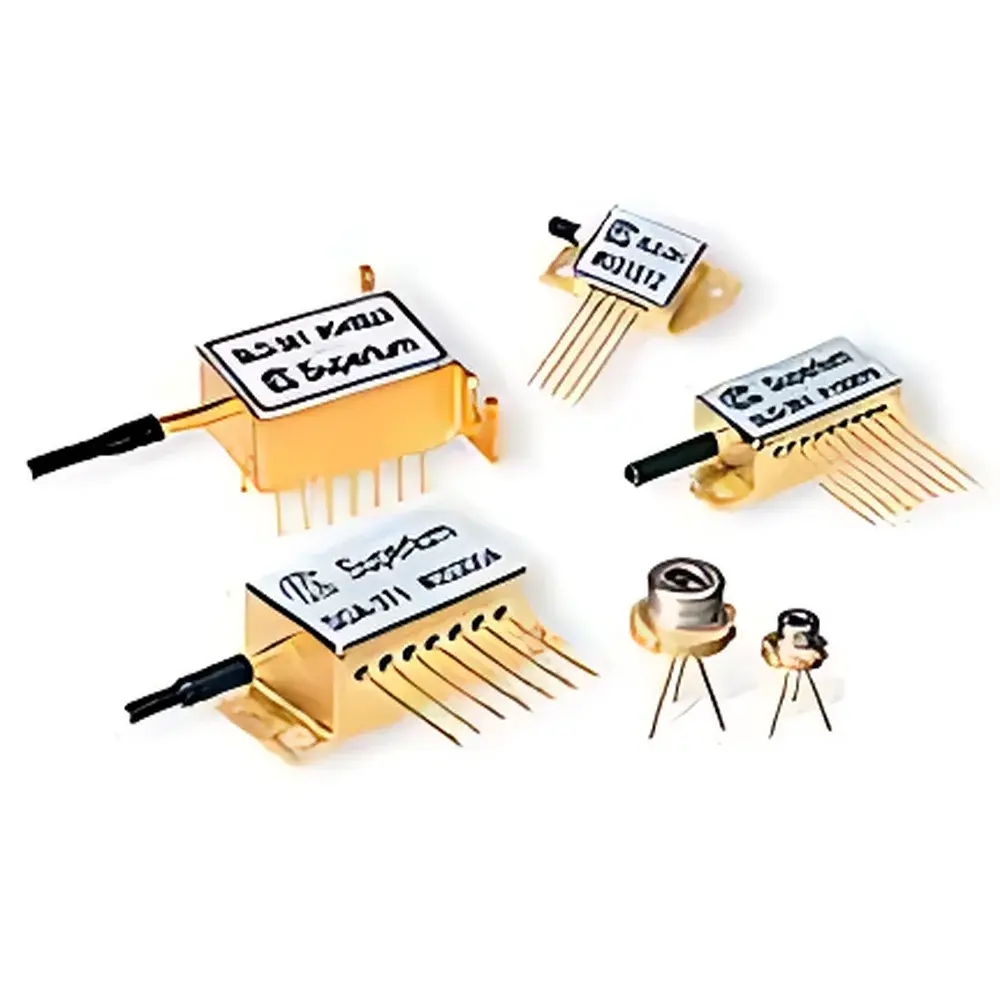
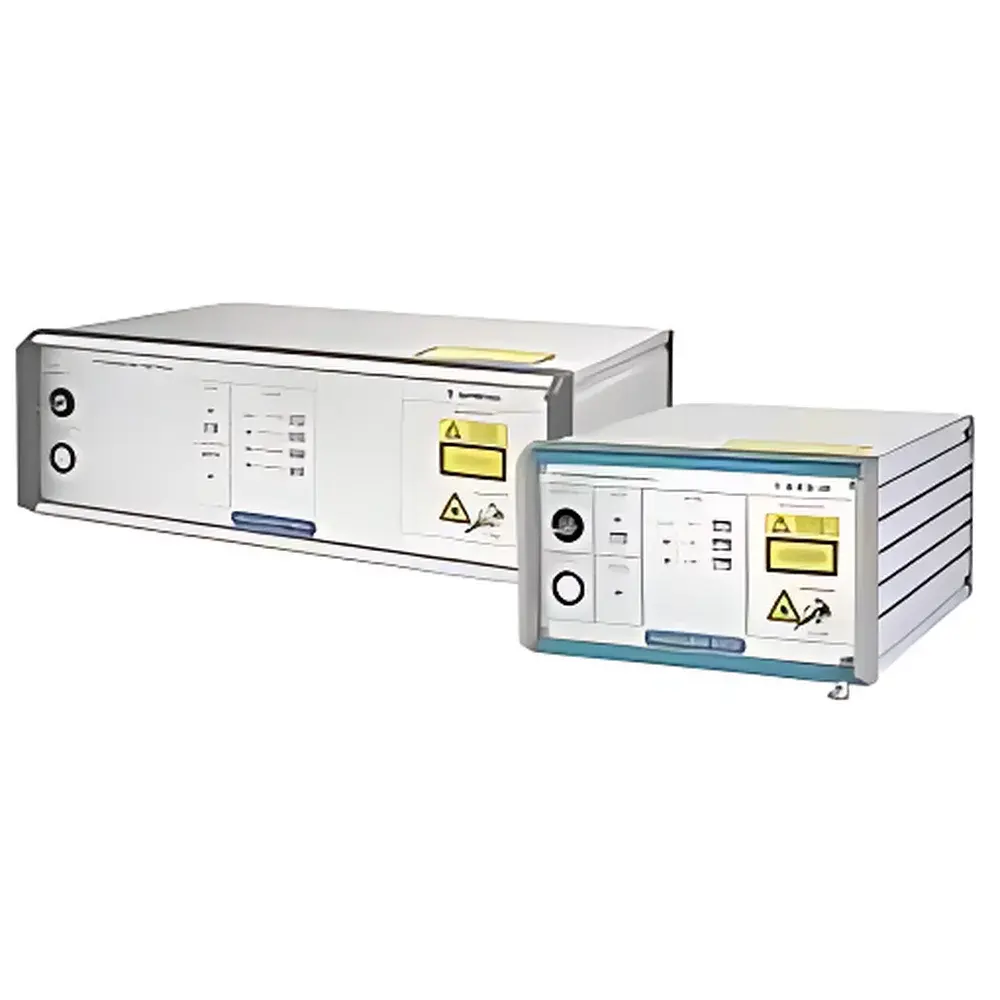
Superlum SLD Module – Desktop Broadband Superluminescent Diode Light Source
| Brand | Superlum |
|---|---|
| Origin | Russia |
| Model Range | 670–1610 nm |
| Output Type | Fiber-Coupled or Free-Space |
| Spectral Bandwidth (FWHM) | 0.2–100 nm |
| Output Power (Fiber-Coupled) | 0.3–100 mW |
| Output Power (Free-Space) | 1–50 mW |
| Component Category | Optical Component |
Overview
The Superlum SLD Module is a compact, benchtop superluminescent diode (SLD) light source engineered for high-stability broadband emission across the visible to near-infrared spectrum (670–1610 nm). Unlike lasers, SLDs operate below lasing threshold, producing spatially coherent yet temporally incoherent light with low temporal coherence length—ideal for applications requiring high brightness without interference fringes. This module leverages edge-emitting semiconductor gain media with anti-reflection coated facets and integrated optical isolators to suppress back reflections and ensure stable spectral output. Designed for integration into optical coherence tomography (OCT), fiber-optic sensing, interferometric metrology, and calibration systems, it delivers Gaussian-like spectral profiles with minimal ripple and excellent power stability (<±0.5% over 8 hours, typical).
Key Features
- Wide wavelength coverage: 19 discrete center-wavelength options spanning 670 nm (red) to 1610 nm (extended infrared), enabling selection matched to detector sensitivity, tissue penetration depth, or material absorption bands.
- Multiple power and bandwidth configurations: Low-power (LP), medium-power (MP), and high-power (HP) variants available per wavelength band—e.g., SLD-35-MP (825–870 nm, 1.25 nm FWHM, 6 mW fiber-coupled) vs. SLD-35-HP (same band, 25 nm FWHM, 50 mW fiber-coupled).
- Fiber-coupled and free-space output options: FC/PC or FC/APC connectors standard; optional collimated free-space beam with adjustable divergence (typical M² < 1.3).
- Integrated thermal stabilization: Thermoelectric cooler (TEC) and precision temperature controller maintain junction temperature within ±0.1 °C, ensuring long-term spectral centroid drift < 0.02 nm/°C.
- Low polarization-dependent loss (PDL 20 dB) for polarization-sensitive setups.
- Compliant with IEC 60825-1:2014 Class 1 or Class 3R laser product safety requirements depending on output configuration—fully documented in included conformity statement.
Sample Compatibility & Compliance
The SLD Module is compatible with single-mode (SMF-28, HI1060), polarization-maintaining (PM980, PM1300), and multimode fibers (50/125 µm, 62.5/125 µm) via standardized FC receptacles. All models meet RoHS 2015/863/EU and REACH SVHC compliance. For regulated environments—including medical device R&D labs operating under ISO 13485 or OCT system developers targeting FDA 510(k) clearance—the modules support traceable calibration certificates (NIST-traceable spectral radiance and power measurements) and provide full electrical safety testing reports (EN 61010-1). Optional factory-installed monitoring photodiodes enable real-time power feedback for closed-loop intensity control in GLP/GMP-aligned test benches.
Software & Data Management
No proprietary driver software is required: the module operates as a stand-alone analog-controlled instrument. Analog voltage input (0–5 V) adjusts drive current linearly; temperature setpoint is configured via front-panel potentiometer or external 0–10 V signal. Optional USB-to-TTL interface (sold separately) enables remote control of power-on/off, temperature setpoint, and fault status reporting via ASCII command protocol. All operational parameters—including actual TEC current, case temperature, and photodiode monitor output—are accessible through analog monitor outputs (BNC), facilitating integration into LabVIEW, MATLAB, or Python-based automation frameworks. Audit trails are maintained externally by host DAQ systems compliant with FDA 21 CFR Part 11 when used in regulated development workflows.
Applications
- Optical Coherence Tomography (OCT): High-resolution retinal, dermatological, and endoscopic imaging—SLD-34-HP (840 nm, 30–50 nm bandwidth) and SLD-56-HP (1300 nm, 35 nm bandwidth) are widely adopted for axial resolution optimization.
- Fiber Bragg Grating (FBG) Interrogation: Broadband sources for static and dynamic strain/temperature sensing networks—SLD-76-MP (1440–1610 nm) supports C+L-band FBG arrays.
- White-Light Interferometry: Surface profilometry and thin-film thickness measurement using low-coherence interferometers—SLD-26-HP (670 nm, 75 nm bandwidth) provides sub-micron axial resolution.
- Spectrometer Calibration: NIST-traceable spectral reference sources for CCD/CMOS array calibration across UV-VIS-NIR ranges.
- Photonic Integrated Circuit (PIC) Testing: On-wafer characterization of Mach-Zehnder modulators, ring resonators, and AWGs requiring broadband excitation with minimal speckle noise.
FAQ
What is the typical coherence length of Superlum SLD modules?
Coherence length ranges from ~15 µm (broadband HP models, e.g., SLD-34-HP at 840 nm, 50 nm FWHM) to ~2 mm (narrowband LP models, e.g., SLD-66-LP at 1390 nm, 0.35 nm FWHM), calculated as λ₀²/(π·Δλ) where Δλ is FWHM bandwidth.
Can multiple SLD modules be combined spectrally?
Yes—using fused-fiber wavelength combiners or free-space dichroic mirrors, modules spanning non-overlapping bands (e.g., 840 nm + 1300 nm + 1550 nm) can be multiplexed into a single output port for ultra-broadband OCT or spectroscopic applications.
Is optical isolation included?
All fiber-coupled models integrate ≥25 dB optical isolators; free-space versions require external isolators for reflection-sensitive interferometers.
Do you offer custom center wavelengths or bandwidths?
Superlum offers OEM customization including non-standard center wavelengths, tailored spectral shapes (flat-top, Gaussian), and hermetic packaging for space-qualified or high-reliability deployments—subject to minimum order quantities and qualification timelines.
What is the expected lifetime under continuous operation?
MTTF exceeds 25,000 hours at rated drive current and stabilized temperature, per Telcordia GR-468-CORE reliability testing protocols.



