
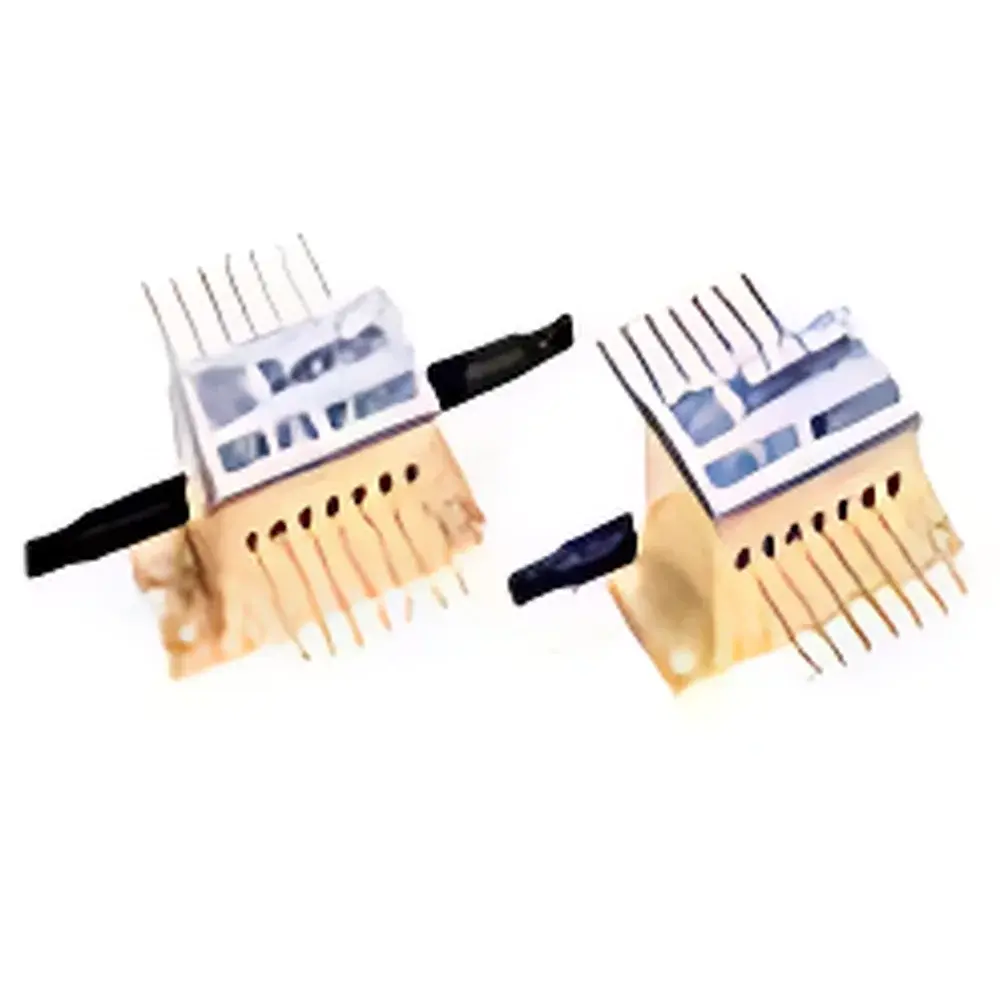
Superlum SOA-332 Series Semiconductor Optical Amplifier
| Origin | Russia |
|---|---|
| Manufacturer Type | Distributor |
| Origin Category | Imported |
| Model | SOA-332, SOA-382-800, SOA-352-830, SOA-382-840, SOA-372, SOA-352-870, SOA-382-870, SOA-472, SOA-482, SOA-522, SOA-532, SOA-542 |
| Gain | 22–30 dB |
| Spectral Bandwidth | 16–95 nm |
| Package Type | Butterfly |
| Operating Current | 160–350 mA |
| Component Category | Optical Component |
Overview
The Superlum SOA-332 Series Semiconductor Optical Amplifier (SOA) is a compact, electrically pumped gain medium designed for integration into fiber-optic systems operating across the visible to near-infrared spectrum (785 nm to 1060 nm). Unlike erbium-doped fiber amplifiers (EDFAs), which rely on rare-earth ion transitions and require pump lasers, SOAs operate on the principle of stimulated emission in a forward-biased semiconductor heterostructure—typically InGaAsP/InP-based quantum-well active regions. This architecture enables direct current injection, fast gain dynamics (sub-nanosecond response), and wavelength agility within defined gain bands. The SOA-332 series is engineered for precision optical signal boosting in low-to-moderate power regimes, with typical small-signal gains ranging from 22 dB to 30 dB and spectral bandwidths spanning 16 nm (e.g., SOA-382-800) to 95 nm (SOA-522 at 1010 nm). Its butterfly package integrates thermoelectric cooling (TEC), monitor photodiode, and polarization-maintaining or single-mode fiber pigtails—ensuring thermal stability, gain reproducibility, and compatibility with polarization-sensitive architectures.
Key Features
- Wavelength-flexible platform covering 785–1060 nm, with discrete models optimized for key telecom and sensing bands (e.g., 800 nm for biomedical OCT, 850 nm for VCSEL-based datacom, 1060 nm for swept-source OCT)
- High gain uniformity and low noise figure (<7 dB typical) achieved through optimized anti-reflection coatings and facet passivation
- Butterfly housing with integrated TEC and thermistor for precise temperature control (±0.1 °C stability), critical for gain flatness and long-term drift mitigation
- Low drive current requirements (160–350 mA), enabling efficient operation in portable or power-constrained systems
- Compact footprint (<25 mm × 12 mm × 7 mm) and hermetic sealing compliant with Telcordia GR-468-CORE reliability standards
- Configurable fiber interface: single-mode (SM) or polarization-maintaining (PM) pigtails, with optional DBUT (Dual Butterfly) packaging for dual-stage or bidirectional configurations
Sample Compatibility & Compliance
The SOA-332 series is compatible with standard SMF-28, HI1060, and PM980 fibers, supporting both free-space coupling and pigtailed integration. Input saturation powers range from −10 dBm to +3 dBm depending on model and wavelength, permitting use in pre-amplifier, in-line, or booster configurations. All units comply with IEC 60825-1:2014 (laser safety Class 1M when enclosed), RoHS 2015/863/EU, and REACH SVHC regulations. Device-level traceability includes full electro-optical characterization reports (L-I-V curves, gain vs. wavelength, ASE spectra, polarization-dependent gain <0.5 dB) per unit, supporting GLP-aligned calibration workflows and audit-ready documentation for R&D labs and ISO/IEC 17025-accredited facilities.
Software & Data Management
While the SOA is a standalone analog component, its operational parameters are fully controllable via external bias controllers (e.g., Thorlabs LDCxx, Wavelength Electronics QCL series) supporting analog voltage/current input and digital interfaces (USB, RS-232, or Modbus RTU). Integration with LabVIEW, Python (PyVISA), or MATLAB enables automated sweep routines—such as gain-vs-current mapping or wavelength-dependent ASE profiling—for system-level characterization. Built-in monitor photodiodes provide real-time feedback for closed-loop current stabilization, essential for maintaining constant gain during extended acquisition sequences in OCT or distributed fiber sensing applications. Firmware-agnostic control ensures compatibility with existing test benches without proprietary lock-in.
Applications
- Fiber-optic sensing: Amplification of weak backscattered signals in OFDR (Optical Frequency Domain Reflectometry) and phase-sensitive OTDR systems
- Biomedical imaging: Enabling high-speed, high-sensitivity swept-source OCT at 800 nm, 840 nm, 1010 nm, and 1060 nm bands
- Quantum optics: Low-noise pre-amplification of heralded single photons in SPDC-based sources
- All-optical signal processing: Implementation of Mach–Zehnder interferometric switches and cross-gain modulation-based wavelength converters
- Test & measurement: Boosting output from tunable laser sources or SLEDs prior to spectral analysis or interferometric calibration
FAQ
What is the maximum input power before gain compression occurs?
Saturation input power (Psat) varies by model and wavelength—typically −10 dBm for SOA-332 at 785 nm and +1 dBm for SOA-532 at 1060 nm. Exact values are provided in the individual device datasheet.
Can the SOA be operated in pulsed mode?
Yes. The sub-nanosecond carrier lifetime supports gain switching at frequencies up to 1 GHz, enabling use in gated amplification and time-domain multiplexing schemes.
Is polarization-dependent gain (PDG) specified?
All SOA-332 variants exhibit PDG ≤ 0.5 dB under stabilized thermal and current conditions, verified per IEC 61282-5.
Do you provide aging data or MTTF estimates?
Accelerated life testing per Telcordia GR-468-CORE indicates >100,000 hours MTTF at 25 °C case temperature and rated drive current.
Are custom wavelengths or fiber types available?
Yes—Superlum offers tailored SOA designs for non-standard wavelengths (e.g., 760 nm, 940 nm) and specialty fibers (e.g., hollow-core photonic bandgap, fluoride, or mid-IR ZBLAN pigtails) upon request and NRE agreement.




