
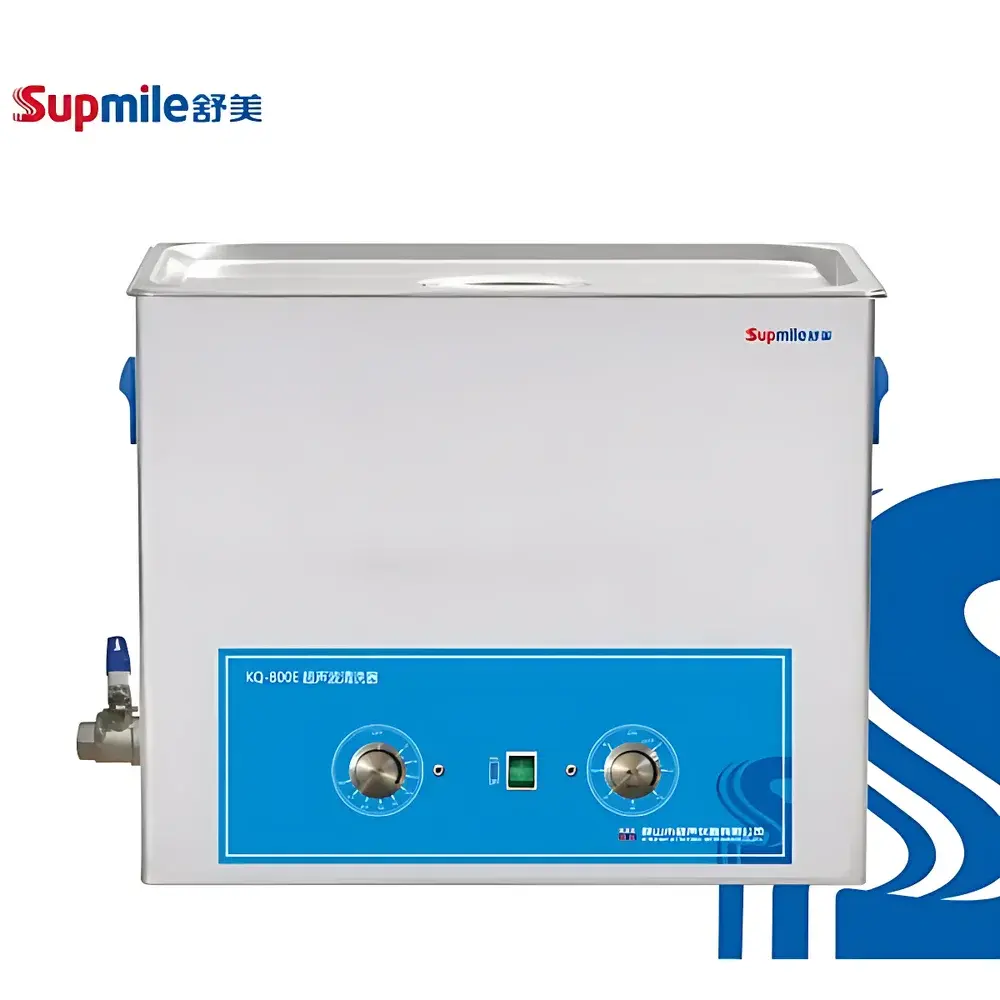
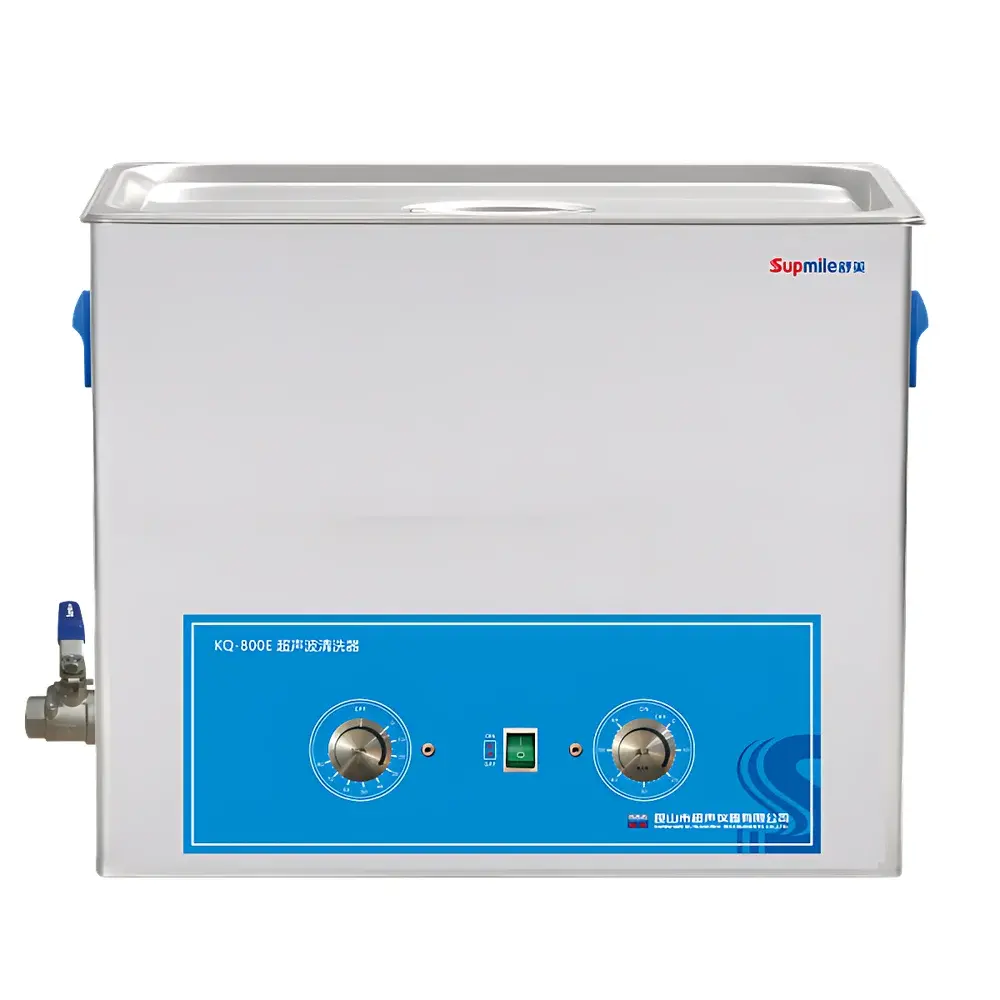
Supmile KQ-800E Benchtop Ultrasonic Cleaner
| Brand | Supmile |
|---|---|
| Origin | Jiangsu, China |
| Manufacturer Type | Direct Manufacturer |
| Product Category | Domestic |
| Model | KQ-800E |
| Instrument Type | General-Purpose |
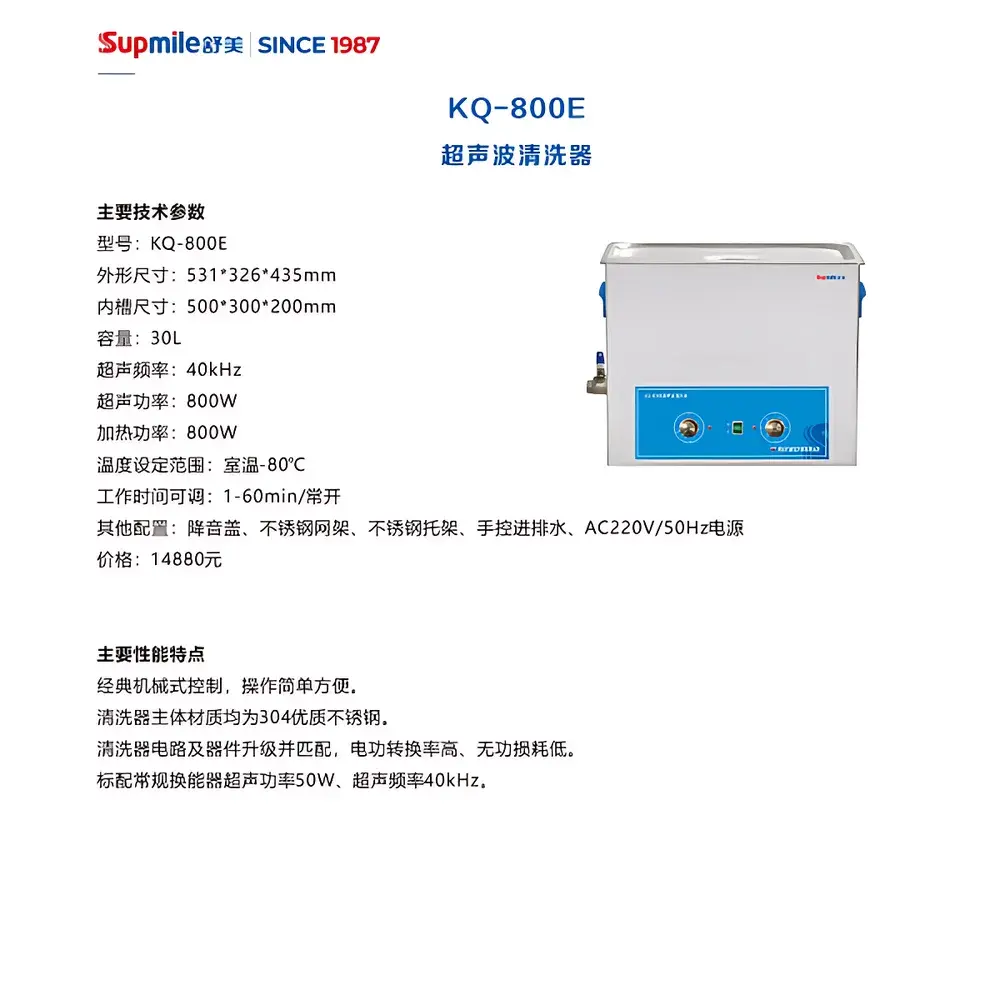
| Capacity | 30 L |
| Ultrasonic Frequency | 40 kHz |
| Ultrasonic Power | 800 W |
| Heating Power | 800 W |
| Temperature Range | Ambient to 80 °C (adjustable) |
| Timer Range | 1–60 min or Continuous Operation |
| Sound-Dampening Lid | Yes |
| Drain/Inlet | Manual Control |
| External Dimensions | 531 × 326 × 435 mm |
| Inner Tank Dimensions | 500 × 300 × 200 mm |
| Construction Material | 304 Stainless Steel |
| Power Supply | AC 220 V / 50 Hz |
Overview
The Supmile KQ-800E is a general-purpose benchtop ultrasonic cleaner engineered for consistent, non-destructive removal of particulate contaminants, organic residues, and loosely adhered films from laboratory glassware, metal parts, optical components, and precision instrumentation. It operates on the principle of acoustic cavitation: high-frequency (40 kHz) ultrasonic energy transmitted through an aqueous or solvent-based cleaning medium generates transient microbubbles that collapse violently near solid surfaces, producing localized shear forces and micro-jets capable of dislodging sub-micron debris without mechanical abrasion. Designed for routine use in QC labs, R&D facilities, and maintenance workshops, the KQ-800E integrates robust 304 stainless steel construction, precise thermal control, and stable power delivery to support reproducible cleaning protocols across diverse sample geometries and material sensitivities.
Key Features
- 30-liter capacity stainless steel tank (500 × 300 × 200 mm internal dimensions) with reinforced corner welds and electropolished interior surface for corrosion resistance and ease of decontamination.
- Dual 800 W output system: 800 W ultrasonic transducer array (40 kHz) paired with 800 W immersion heating element, enabling simultaneous sonication and temperature-controlled cleaning.
- Precise analog control interface with independent dials for time (1–60 min or continuous mode) and temperature (ambient to 80 °C), ensuring intuitive operation without software dependency.
- Integrated sound-dampening lid with ergonomic handle and safety interlock—reduces ambient noise to ≤55 dB(A) at 1 m distance and prevents solvent evaporation during heated cycles.
- Standard accessories include a 304 stainless steel mesh basket, adjustable support rack, manual drain valve, and fill-level indicator—designed for secure placement and uniform energy distribution.
- High-efficiency piezoelectric transducers mounted on the tank bottom provide uniform cavitation field distribution; electrical architecture optimized for >85% electroacoustic conversion efficiency and low reactive power draw.
Sample Compatibility & Compliance
The KQ-800E accommodates a wide range of substrates including borosilicate glassware (vials, cuvettes, pipette tips), stainless steel tools, aluminum fixtures, ceramic filters, and polymer-based microfluidic chips—provided compatibility with aqueous or low-volatility solvents (e.g., isopropanol, ethanol, alkaline detergents) is confirmed. Its operating envelope meets baseline requirements for ISO 13485-certified device cleaning validation when integrated into documented SOPs. While not intrinsically compliant with FDA 21 CFR Part 11 or EU Annex 11, its analog controls and absence of digital data logging simplify qualification under GLP/GMP environments where manual logbook recording suffices. The unit conforms to IEC 61000-6-3 (EMC emission limits) and IEC 61000-6-2 (immunity standards), and carries CE marking per Machinery Directive 2006/42/EC.
Software & Data Management
The KQ-800E employs a fully analog control architecture with no embedded firmware, network interface, or onboard data storage. This design eliminates cybersecurity risks, reduces long-term calibration drift associated with digital sensors, and ensures deterministic behavior across voltage fluctuations typical in shared lab infrastructure. All operational parameters (time, temperature) are set manually and verified via calibrated analog dials and visual indicators—facilitating straightforward IQ/OQ documentation and audit readiness. For laboratories requiring electronic recordkeeping, external USB or RS-232 data loggers may be connected to optional analog-output temperature probes (sold separately) to capture time-stamped thermal profiles aligned with cleaning cycle execution.
Applications
- Routine pre-sterilization cleaning of autoclave loads, including surgical instruments, glassware, and reusable plastic components.
- Removal of polishing compounds and oxide layers prior to SEM/EDS sample mounting or thin-film deposition.
- Decontamination of HPLC columns, syringe filters, and autosampler vials to prevent carryover and baseline drift.
- Preparation of calibration standards by eliminating adsorbed surfactants or residual solvents from volumetric flasks and pipettes.
- Maintenance cleaning of optical lenses, laser optics mounts, and precision metrology fixtures where mechanical wiping is prohibited.
- Supporting ASTM D2247 (standard practice for cleaning metal specimens prior to corrosion testing) and ISO 14971 risk management workflows for cleaning process validation.
FAQ
Is the KQ-800E suitable for cleaning delicate MEMS devices or semiconductor wafers?
Yes—when operated at lower temperatures (≤40 °C) with low-surface-tension, residue-free solvents (e.g., ultra-pure IPA), and cycle times limited to 5–10 min. Use the stainless steel mesh basket to prevent direct contact with tank walls.
Does the unit support degassing prior to cleaning?
No dedicated degas mode is provided; however, initiating sonication at ambient temperature for 2–3 minutes before heating achieves effective dissolved gas removal in most aqueous solutions.
Can the heater and ultrasonics operate independently?
Yes—the temperature and timer controls are fully decoupled, allowing cold sonication only or heated soaking without ultrasonic activation.
What maintenance is required for long-term reliability?
Monthly inspection of transducer bonding integrity, quarterly descaling of heating elements using 5% citric acid solution, and annual verification of thermostat accuracy against a NIST-traceable RTD probe.
Is the tank depth sufficient for submerging tall beakers or graduated cylinders?
With 200 mm internal depth, the tank accommodates vessels up to 180 mm in height; taller items may require partial submersion or custom fixture support.



