
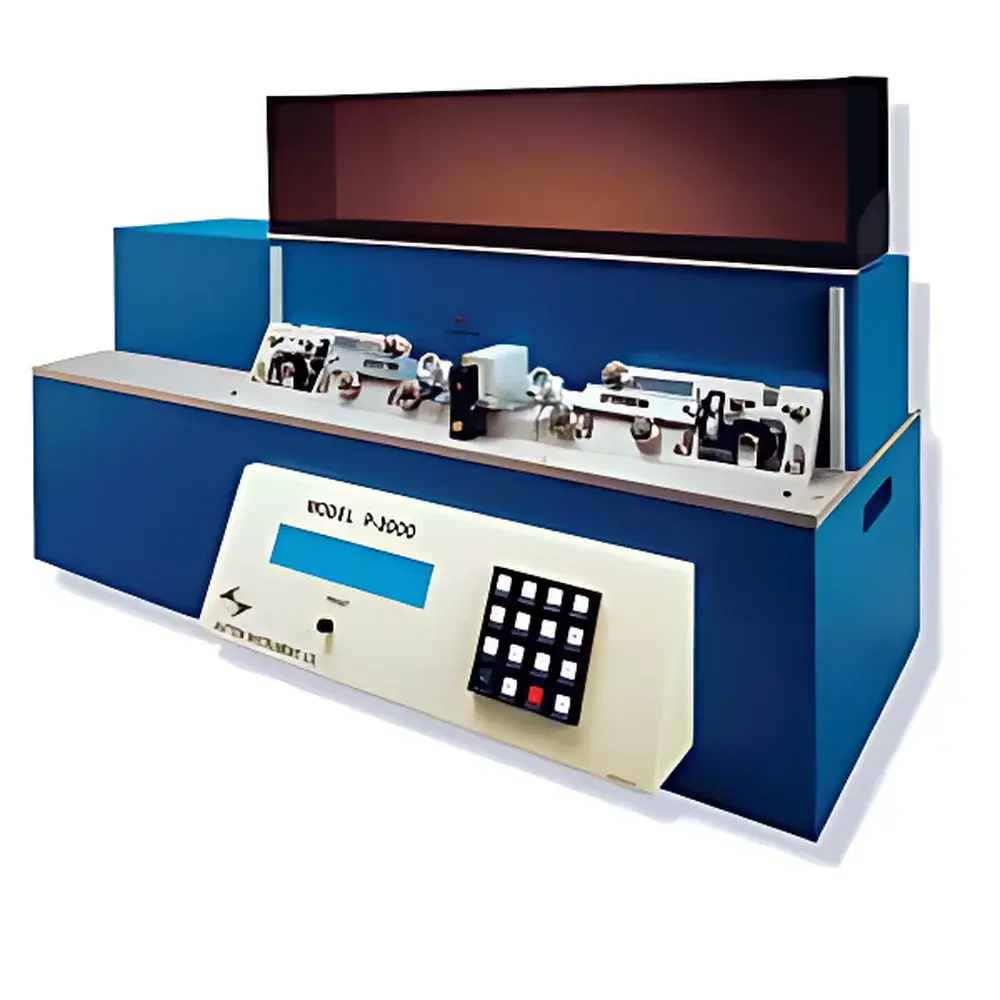
Sutter P-2000 Laser-Based Micropipette Puller
| Brand | Sutter |
|---|---|
| Origin | USA |
| Model | P-2000 |
| Dimensions | 76 cm × 36 cm × 33.5 cm |
| Weight | 36 kg |
| Power Supply | 115/230 V, 50/60 Hz |
| Laser Type | CO₂ |
| Max. Glass OD | 1.5 mm (quartz), 1.8 mm (borosilicate) |
| Programmable Protocols | 100 × 8-step |
| Tip Diameter Reproducibility | < 30 nm |
| Laser Lifetime | > 10 years |
Overview
The Sutter P-2000 Laser-Based Micropipette Puller is a microprocessor-controlled instrument engineered for the precise, repeatable fabrication of glass and fused quartz micropipettes used in electrophysiology, microinjection, patch-clamp recording, and nanoscale fluid delivery. Unlike conventional resistive-heating pullers, the P-2000 employs a focused CO₂ laser as its thermal source—enabling controlled, localized heating with exceptional spatial and temporal resolution. This laser-based architecture eliminates mechanical wear associated with filament-based systems and provides superior thermal stability across diverse glass compositions, including high-melting-point fused quartz (SiO₂), which exhibits ultra-low electrical noise, high mechanical rigidity, and exceptional chemical inertness. The system operates on the principle of symmetric or asymmetric two-stage pulling: glass capillaries are heated to their softening point and drawn under programmable tension and velocity profiles, yielding tip geometries with sub-30 nm reproducibility. Its design adheres to fundamental requirements for GLP-compliant electrophysiology workflows, where electrode consistency directly impacts signal fidelity and experimental repeatability.
Key Features
- Laser-driven thermal control: CO₂ laser (wavelength ~10.6 µm) enables non-contact, contamination-free heating—ideal for ultra-pure fused quartz and borosilicate capillaries.
- Dual-configurable platform: P-2000/G variant optimized for capillaries ≥ 0.6 mm outer diameter (OD); P-2000/F variant calibrated for capillaries < 0.6 mm OD—including sub-100 µm tubing and optical fibers.
- High-resolution programmability: Stores up to 100 independent protocols, each comprising up to eight sequential commands; five adjustable parameters per command (heat, pull, velocity, delay, ramp) enable fine-tuned control over taper angle, shank length, and tip geometry.
- Robust mechanical architecture: Precision-machined aluminum frame with vibration-damped base ensures stable operation during multi-second pull cycles.
- Long-lifetime laser source: Industrial-grade CO₂ laser module rated for >10 years of continuous laboratory use under standard operating conditions.
- Interchangeable puller assemblies: P-2000/G and P-2000/F configurations feature distinct pull rods and reflective mirror housings; conversion between models is supported by Sutter Instrument service centers (fee applies).
Sample Compatibility & Compliance
The P-2000 accommodates a broad range of capillary materials and dimensions: fused quartz (OD 0.125–1.5 mm), borosilicate glass (OD 0.125–1.8 mm), and specialty silica-based fibers. Its laser heating profile is compatible with standard electrophysiology capillaries (e.g., BF150-86-10, QF100-78-10) and custom-drawn microfluidic conduits. The system supports fabrication of electrodes compliant with ASTM F2983 (Standard Guide for Electrophysiological Recording Electrodes) and meets essential functional criteria for FDA-regulated preclinical neurophysiology studies. While not a medical device itself, P-2000-fabricated electrodes are routinely validated under ISO 13485-aligned QC protocols in academic and industrial neuroscience labs conducting GLP- or GMP-adjacent research.
Software & Data Management
The P-2000 operates via an integrated front-panel interface with tactile keypad and LCD display—no external computer required for routine operation. All protocols are stored onboard in non-volatile memory, preserving parameter integrity during power cycling. For advanced workflow integration, optional RS-232 or USB-to-serial connectivity allows remote protocol loading, real-time logging of pull events, and timestamped audit trails—supporting traceability requirements under 21 CFR Part 11 when paired with validated laboratory information management systems (LIMS). Each protocol includes user-defined metadata fields (e.g., operator ID, date, capillary lot number), facilitating retrospective analysis and cross-experiment correlation.
Applications
- Whole-cell and cell-attached patch-clamp recordings in acute brain slices and cultured neurons.
- Intracellular sharp-electrode recording requiring low-noise, mechanically robust quartz electrodes.
- Single-cell microinjection and pressure-mediated dye loading in developmental biology assays.
- Fabrication of nanoscale HPLC emitters and near-field scanning optical microscopy (NSOM) probes.
- Custom pull profiles for ion-selective microelectrodes and enzyme-coated biosensors.
- Reproducible production of tapered capillaries for microfluidic interconnects and lab-on-chip interfaces.
FAQ
What glass types are compatible with the P-2000?
Fused quartz (for low-noise electrophysiology), borosilicate (e.g., Kimax, Pyrex), and aluminosilicate capillaries—with outer diameters ranging from 125 µm to 1.8 mm depending on model configuration.
Can I switch between P-2000/G and P-2000/F configurations myself?
No. Conversion requires recalibration of laser focus, pull rod geometry, and mirror alignment—only performed by Sutter Instrument-certified technicians.
Is the laser output power user-adjustable?
Laser intensity is controlled automatically via closed-loop feedback based on real-time capillary temperature estimation; manual power override is not provided to ensure process safety and reproducibility.
How is tip diameter reproducibility verified?
Consistency is validated using scanning electron microscopy (SEM) and scanning ion conductance microscopy (SICM); typical coefficient of variation (CV) across 20 consecutive pulls is ≤ 2.3% for quartz tips < 50 nm.
Does the P-2000 support automated calibration routines?
Yes—the system performs self-diagnostic checks at startup, including laser emission verification, motor homing, and thermal sensor validation; full calibration reports are accessible via service mode.



