SVT Associates PLD-01 / PLD-02 Pulsed Laser Deposition System
| Brand | SVT Associates |
|---|---|
| Origin | USA |
| Model | PLD-01 / PLD-02 |
| Chamber Diameter | 12" (305 mm) |
| Base Pressure | ≤5×10⁻⁸ Torr (with 250 L/s turbomolecular pump) |
| Target Mount | 6×1" (25 mm) rotating and Z-adjustable |
| Substrate Holder | 1" (25 mm), heated to 800 °C (1000 °C optional), rotation & Z-motion enabled |
| In-situ Monitoring | Quartz Crystal Microbalance (QCM) deposition rate monitor |
| Optional Add-ons | RHEED, differential pumping, laser beam scanning, RF plasma source (O₂/N₂), load-lock integration, L-MBE upgrade |
Overview
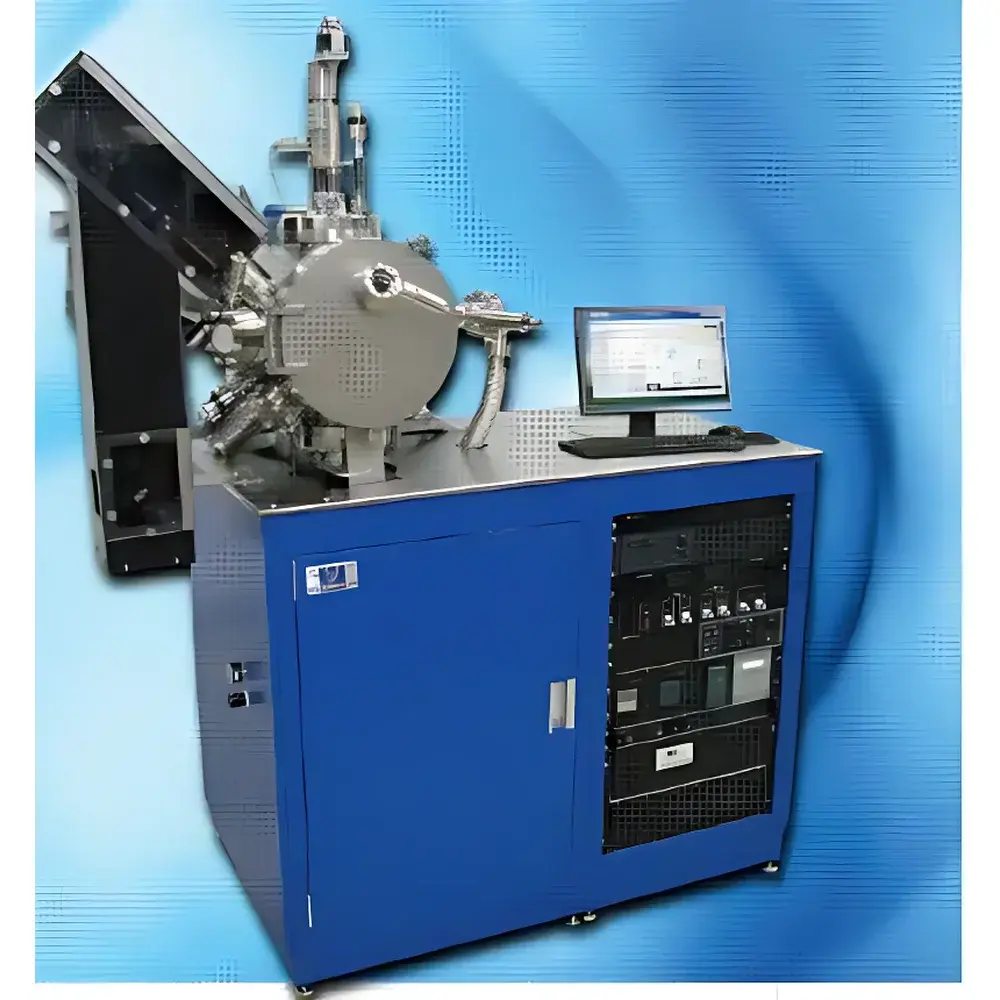
The SVT Associates PLD-01 and PLD-02 Pulsed Laser Deposition Systems are high-vacuum, modular thin-film growth platforms engineered for precision epitaxial synthesis of complex functional materials. Based on the fundamental principle of laser ablation—where a high-energy pulsed laser beam irradiates a solid target in controlled background gas (e.g., O₂, N₂, or inert atmosphere), generating a transient plasma plume that condenses onto a heated substrate—the system enables stoichiometric transfer of multi-element compounds with minimal thermal decomposition. Designed around SVT’s SMART (Scientific Materials and Applied Research Tool) architecture, these systems integrate PLD with complementary physical vapor deposition (PVD) capabilities—including optional RF plasma-assisted oxidation/nitridation—supporting hybrid growth modes critical for oxide electronics, superconductors, and magnetic heterostructures.
Key Features
- Modular ultra-high vacuum (UHV) chamber with 12-inch diameter and fast-transfer gate valve; base pressure <5×10⁻⁸ Torr achieved via 250 L/s turbomolecular pump and full-range vacuum gauge
- 6-position rotating target carousel accommodating 1-inch (25 mm) targets, each independently Z-adjustable and motorized for precise ablation positioning
- Heated, rotatable 1-inch (25 mm) substrate stage with programmable temperature control up to 800 °C (1000 °C available as option), enabling epitaxial growth under thermodynamically stable conditions
- Integrated quartz crystal microbalance (QCM) for real-time deposition rate and thickness monitoring, directly linked to automated feedback loops
- Differential pumping architecture minimizes gas-phase scattering and maintains optimal pressure gradients between ablation zone and substrate region
- Standard compatibility with excimer (e.g., KrF, ArF) and Nd:YAG lasers (266 nm–1064 nm); optical path includes motorized shutter, beam attenuation, and optional laser scanning optics
- Comprehensive automation suite: closed-loop temperature regulation, target indexing/rotation, gas flow sequencing (MFC-controlled), vacuum cycling (pump-down/purge), and QCM-derived thickness calculation
Sample Compatibility & Compliance
The PLD-01/PLD-02 supports deposition of technologically demanding material classes including multicomponent oxides (e.g., YBCO, LSMO, PZT), high-Tc superconductors, ferromagnetic and antiferromagnetic thin films, low-vapor-pressure refractory metals (e.g., Nb, Ta, W), and MEMS-compatible functional layers. The system’s UHV environment, combined with optional RHEED (Reflection High-Energy Electron Diffraction) and load-lock integration, ensures atomic-level surface cleanliness and process reproducibility—key requirements for GLP-compliant R&D and pre-production qualification. All vacuum components comply with ASTM F2789 (Standard Guide for Vacuum System Integrity Testing), while software logging meets audit-trail requirements aligned with FDA 21 CFR Part 11 when configured with secure user authentication and electronic signature modules.
Software & Data Management
SVT’s proprietary SMART Control Software provides a unified interface for hardware orchestration, recipe management, and real-time data acquisition. It supports synchronized logging of substrate temperature, target position, laser pulse count, chamber pressure, gas flows, and QCM frequency shift—with timestamped CSV export and configurable alarm thresholds. Process recipes are version-controlled and exportable for cross-system replication. Optional integration with LabVIEW or Python APIs enables custom algorithm development for adaptive growth control (e.g., feedback-driven laser fluence adjustment based on RHEED oscillation analysis). Data files adhere to HDF5 format for long-term archival and interoperability with materials informatics platforms.
Applications
- Growth of epitaxial cuprate and iron-based superconducting films requiring precise oxygen stoichiometry and lattice-matched substrates
- Atomic-layer-resolved synthesis of complex perovskite oxides for resistive switching memory and ferroelectric tunnel junctions
- Deposition of spinel and garnet ferrites for magnonic waveguide and microwave absorber applications
- Low-defect growth of wide-bandgap semiconductors (e.g., Ga₂O₃, AlN) where conventional CVD yields non-stoichiometric phases
- Hybrid PLD-RF sputtering for graded interfaces in multiferroic heterostructures
- Preparation of model catalyst surfaces (e.g., supported Co₃O₄, NiO) under controlled oxidizing environments
FAQ
What vacuum level is achievable with the standard configuration?
The system achieves ≤5×10⁻⁸ Torr with the included 250 L/s turbomolecular pump and cryo-shielded chamber walls.
Can the system be upgraded to support molecular beam epitaxy (MBE) techniques?
Yes—the PLD platform supports L-MBE (Laser-MBE) conversion via optional effusion cells, electron-beam evaporators, and additional differential pumping stages.
Is RHEED integration available as a factory-installed option?
RHEED is offered as a fully integrated, UHV-compatible add-on with calibrated electron gun, phosphor screen, and digital camera subsystem.
How is laser safety managed during automated operation?
The system incorporates interlocked beam shutters, Class 1 enclosure certification, and software-enforced laser enable/disable protocols synchronized with chamber pressure and viewport status.
Does the software support remote monitoring and control?
Remote access is enabled via TLS-secured web interface or VNC-over-SSH, with role-based permissions and session logging compliant with institutional IT security policies.