
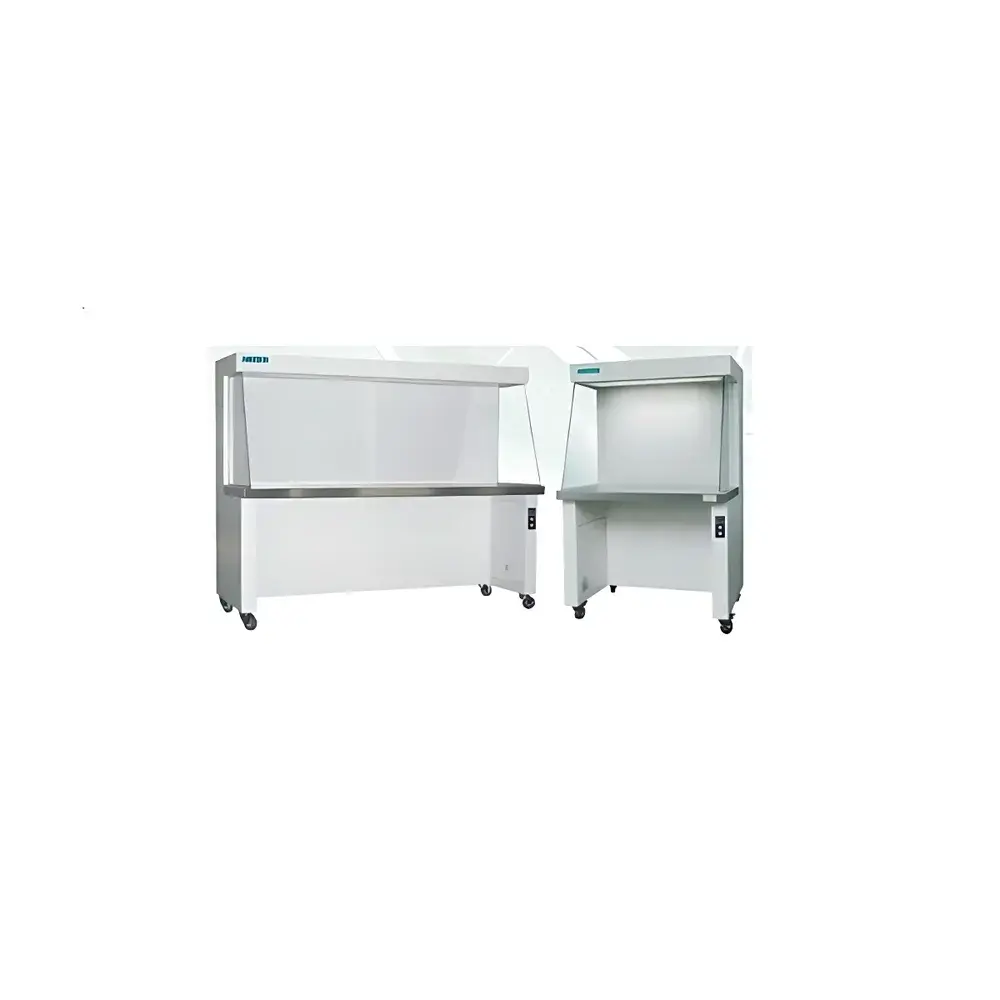
SW-CJ-1BU Horizontal Laminar Flow Clean Bench
| Origin | Jiangsu, China |
|---|---|
| Manufacturer Type | Distributor |
| Product Origin | Domestic |
| Model | SW-CJ-1BU |
| Quotation | USD 890 (est.) |
| Instrument Category | Horizontal Laminar Flow Clean Bench |
| Cleanliness Class | ISO Class 5 (equivalent to US Federal Standard 209E Class 100) |
| Noise Level | ≤62 dB(A) |
| User Capacity | Single-user, single-front configuration |
| Airflow Pattern | Horizontal laminar flow |
| Average Air Velocity | 0.3–0.6 m/s (adjustable) |
| Vibration (Half-Peak) | ≤3 µm |
| Illumination | ≥300 lx |
| Power Supply | AC 220 V, 1Φ, 50 Hz |
| Max. Power Consumption | 1.2 kW (including auxiliary socket) |
| Net Weight | 110 kg |
| Work Area Dimensions (W×D×H) | 820 × 480 × 600 mm |
| Overall Dimensions (W×D×H) | 900 × 700 × 1450 mm |
| HEPA Filter Specification | 820 × 600 × 50 mm, single unit |
| Lighting | 20 W fluorescent lamp × 1 |
| UV Lamp | 20 W × 1 |
| Work Surface Material | Imported stainless steel (AISI 304) |
| Pressure Differential Gauge | Integrated |
| Fan System | Variable-speed centrifugal blower with touch-control voltage regulation |
Overview
The SW-CJ-1BU Horizontal Laminar Flow Clean Bench is an ISO Class 5-certified laboratory containment device engineered for non-hazardous applications requiring particle-free working environments. It operates on the principle of horizontal unidirectional airflow: ambient air is drawn through a pre-filter, then passed through a certified HEPA filter (≥99.99% efficiency at 0.3 µm), and delivered across the work surface as a uniform, low-turbulence laminar stream—effectively sweeping airborne contaminants away from the operator and sample zone. Unlike biological safety cabinets, this clean bench provides product protection only—not personnel or environmental protection—and is therefore strictly intended for aseptic procedures involving non-toxic, non-pathogenic materials. Its design complies with core performance benchmarks outlined in ISO 14644-1 (cleanroom classification), IEST-RP-CC002.3 (HEPA filter testing), and JIS B 9920 (Japanese standard for clean benches). The unit is widely deployed in upstream bioprocessing workflows, pharmaceutical formulation labs, plant tissue culture facilities, microbiological assay preparation, and analytical chemistry sample handling where particulate control is critical to result integrity.
Key Features
- Integrated differential pressure gauge enabling real-time monitoring of HEPA filter loading and timely maintenance scheduling.
- Digitally regulated variable-speed centrifugal blower system with touch-sensitive voltage controls—ensures consistent face velocity (0.3–0.6 m/s) across operational life and compensates for gradual filter resistance increase.
- Work surface fabricated from electropolished AISI 304 stainless steel, offering corrosion resistance, non-porosity, and compatibility with common disinfectants (e.g., 70% ethanol, sodium hypochlorite).
- Dual lighting system: 20 W daylight-balanced fluorescent lamp for visual inspection and 20 W germicidal UV-C lamp (254 nm) for pre-use surface decontamination—interlocked to prevent UV exposure during operation.
- Structural frame constructed from powder-coated cold-rolled steel; front sash designed for ergonomic access without compromising laminar flow integrity.
- Comprehensive electrical safety: grounded chassis, thermal overload protection, and dedicated auxiliary power outlet (10 A, 220 V) integrated into the base housing.
Sample Compatibility & Compliance
The SW-CJ-1BU supports open-vessel manipulations including Petri dish inoculation, media pouring, sterile filtration setup, reagent aliquoting, and microinjection preparation. It is validated for use with cell cultures (non-infectious lines), botanical explants, vaccine adjuvant mixing, and chromatographic standard preparation. While not compliant with NSF/ANSI 49 or EN 12469 (standards governing biological safety cabinets), its performance aligns with ISO 14644-1 Class 5 requirements for airborne particulate concentration (≤3,520 particles/m³ ≥0.5 µm). Units undergo factory certification per ISO 14644-3 protocols—including airflow visualization (smoke studies), velocity mapping (ISO 14644-3 Annex B), and filter integrity testing (DOP/PAO scan). Documentation includes filter test reports, calibration certificates for integrated gauges, and conformity statements referencing GB/T 16292–2010 (Chinese national standard for clean bench testing).
Software & Data Management
This model operates as a standalone electromechanical system with no embedded firmware or digital interface. All operational parameters are manually controlled via tactile switches; no software-driven data logging, remote diagnostics, or audit trail functionality is included. However, the integrated pressure differential gauge provides analog output suitable for connection to external SCADA or lab infrastructure monitoring systems (e.g., via 4–20 mA signal conversion). For GLP/GMP-regulated environments, users may implement manual logbook entries tracking daily velocity verification, UV lamp usage hours, and filter replacement dates—consistent with FDA 21 CFR Part 11 expectations for paper-based records when supplemented by controlled document management practices.
Applications
- Plant tissue culture laboratories performing meristem isolation and callus propagation under defined sterility conditions.
- Pharmaceutical QC labs conducting dissolution medium preparation, tablet coating validation, and excipient blending prior to encapsulation.
- Veterinary diagnostic centers preparing bacterial culture plates and serological reagents without cross-contamination risk.
- Academic research facilities engaged in CRISPR plasmid transformation, PCR master mix assembly, and antibody conjugation chemistry.
- Industrial R&D settings requiring inert-atmosphere sample staging for thin-film deposition substrate handling or optical component cleaning.
FAQ
Is the SW-CJ-1BU suitable for handling pathogenic organisms or volatile chemicals?
No. This is a product-protection-only clean bench. It does not provide personnel or environmental protection. Pathogens, toxins, or volatile organic compounds require containment in a Class II biological safety cabinet or fume hood.
What HEPA filter replacement interval is recommended?
Filter service life depends on ambient air quality and usage frequency. Under typical lab conditions (8 hrs/day, ISO Class 8 environment), replace every 18–24 months—or sooner if differential pressure exceeds 250 Pa or face velocity falls below 0.3 m/s.
Can the unit be installed in a room without HVAC supply?
Yes, but ambient temperature must remain between 15–30°C and relative humidity below 70% to prevent condensation on internal components and maintain filter integrity.
Does the UV lamp meet IEC 62471 photobiological safety requirements?
Yes. The 20 W low-pressure mercury UV-C lamp emits at 254 nm and is classified as Risk Group 2 (moderate risk) under IEC 62471; interlock circuitry prevents activation when sash is open.
Is third-party ISO 14644-1 certification available upon request?
Yes. Optional post-installation certification by accredited bodies (e.g., SGS, TÜV) can be arranged—covering airborne particle counts, airflow uniformity, and recovery time testing per ISO 14644-3 Annex D.



