
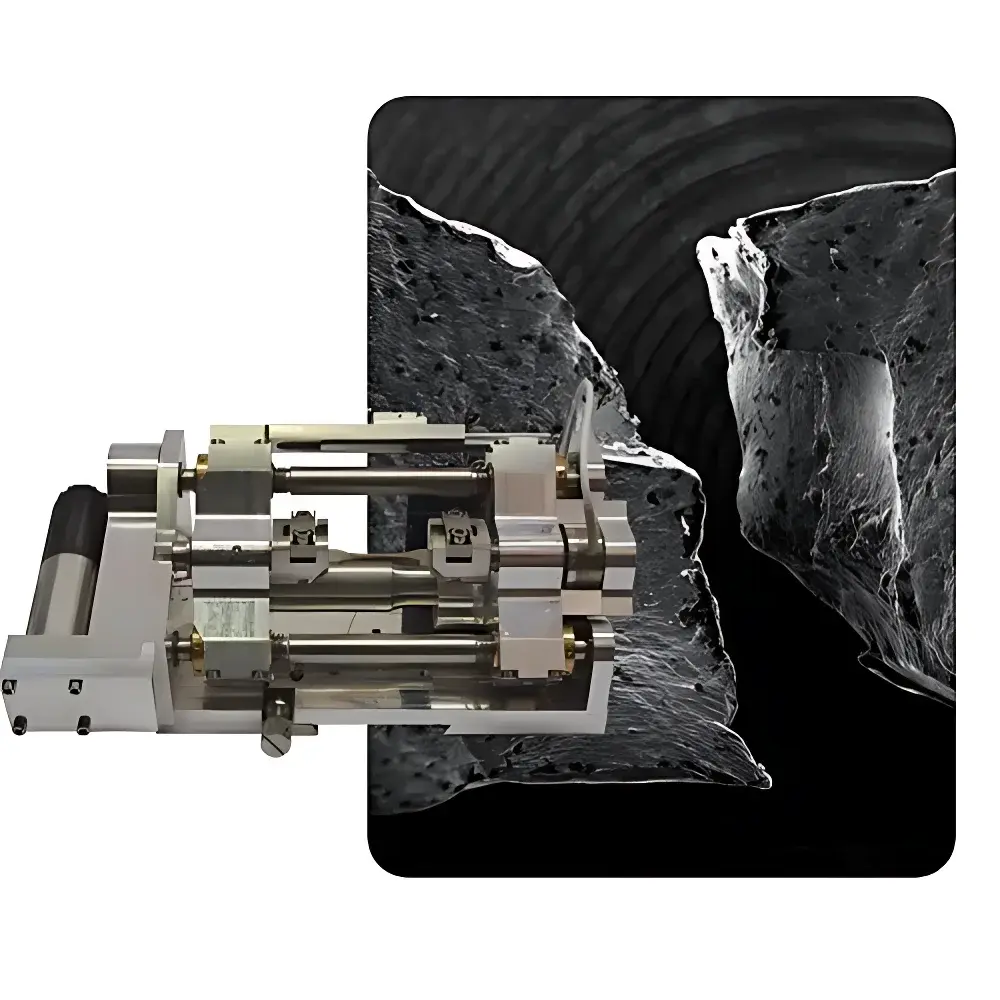
SWIFT In Situ Tensile Stage
| Brand | SWIFT |
|---|---|
| Origin | United Kingdom |
| Manufacturer Type | Authorized Distributor |
| Origin Category | Imported |
| Model | SWIFT In Situ Tensile Stage |
| Instrument Classification | In Situ Mechanical Testing Stage |
| Application Field | Materials Science |
| Maximum Load Capacity | 10 kN |
| Temperature Range | 0–1200 °C |
| Tensile Load Capacity | 10 kN |
| Stroke | 26 mm |
Overview
The SWIFT In Situ Tensile Stage is an engineered mechanical testing platform designed for real-time, high-fidelity structural and mechanical characterization of materials under controlled thermo-mechanical loading within vacuum-compatible imaging environments. Based on precision electromechanical actuation and closed-loop load control, the stage enables quantitative in situ observation of deformation mechanisms—including dislocation dynamics, crack nucleation and propagation, phase transformation, grain rotation, slip system activation, interfacial delamination, and creep behavior—during uniaxial tension, compression, shear, combined loading (e.g., tension–shear), and cyclic fatigue. Its modular architecture supports integration with scanning electron microscopes (SEM), transmission electron microscopes (TEM), optical microscopes (OM), confocal laser scanning microscopes (CLSM), X-ray diffraction (XRD) systems, Raman spectrometers, and atomic force microscopes (AFM), maintaining full compatibility with EBSD detectors and high-resolution imaging optics.
Key Features
- Precision electromechanical actuation delivering ultra-low-velocity quasi-static loading (down to sub-µm/s displacement rates) for synchronized imaging and mechanical response capture
- Integrated high-stability load cell with full-scale capacities up to 10 kN (standard 5 kN; upgradeable), calibrated per ISO 376 and traceable to NPL standards
- Active temperature control module enabling programmable heating/cooling from ambient to 1200 °C, with ±1 °C thermal stability over 30-minute dwell periods
- Vacuum-rated construction (≤1 × 10⁻⁶ mbar compatible) using non-magnetic, low-outgassing alloys (Inconel 718, TZM molybdenum alloy, ceramic insulators)
- EBSD-optimized sample stage geometry supporting both 0° horizontal and 70° tilted configurations without repositioning
- Compact footprint (model-dependent): optimized for limited-chamber SEMs (e.g., Zeiss Sigma, Thermo Fisher Apreo) and benchtop systems
- EMI-shielded signal paths and differential analog outputs ensure noise-free acquisition of load, displacement, and thermocouple data during concurrent imaging
Sample Compatibility & Compliance
The SWIFT In Situ Tensile Stage accommodates standardized tensile specimens (ASTM E8/E9, ISO 6892-1) as well as custom geometries including thin films (≥50 nm), nanowires, freestanding membranes, fiber bundles, and miniature joints (e.g., solder, braze, weld interfaces). It complies with vacuum safety requirements per ISO 14644-1 Class 5 cleanroom protocols and electromagnetic compatibility standards IEC 61326-1. All firmware and controller electronics meet CE marking directives. When operated with validated test protocols, data output satisfies GLP/GMP audit trails and FDA 21 CFR Part 11 electronic record integrity requirements via optional software validation packages.
Software & Data Management
Control and data acquisition are managed through Swift Instruments’ proprietary Windows-based software suite, compatible with Windows 10 (64-bit) on desktop, laptop, or tablet platforms. The GUI employs a drag-and-drop workflow builder for defining multi-step mechanical tests—including ramp-hold, cyclic loading, temperature ramps, and hybrid thermo-mechanical profiles. Real-time acquisition records synchronized time-stamped channels: load (kN), displacement (µm), temperature (°C), and user-defined external inputs (e.g., EBSD pattern quality, XRD intensity). Stress–strain curves are auto-calculated using specimen cross-sectional area and gauge length inputs. Raw data exports to CSV, HDF5, or MATLAB .mat formats; metadata adheres to FAIR principles (Findable, Accessible, Interoperable, Reusable) for integration into institutional LIMS or digital lab notebooks.
Applications
- Quantitative analysis of deformation-induced microstructural evolution in metallic alloys, ceramics, and intermetallics under elevated temperature
- In situ tracking of fracture initiation at grain boundaries, phase interfaces, or coating–substrate junctions in hard coatings and thin-film devices
- Mechanistic study of fatigue crack growth in polymer matrix composites and fiber-reinforced laminates
- Correlation of local crystallographic orientation (via EBSD) with strain localization and slip band formation during monotonic loading
- Real-time monitoring of oxidation-assisted cracking and environmental embrittlement in turbine blade superalloys
- Characterization of viscoelastic recovery and permanent set in shape-memory alloys and hydrogels
- Investigation of interfacial decohesion in solder joints, brazed assemblies, and adhesive bonds under thermal cycling
FAQ
Is the SWIFT In Situ Tensile Stage compatible with field-emission SEMs?
Yes—the stage is fully compatible with FE-SEM systems, including those equipped with in-lens detectors, STEM-in-SEM configurations, and integrated EBSD cameras.
Can the stage be used outside vacuum environments—for example, in optical or AFM setups?
Yes—vacuum-capable hardware variants are available, but non-vacuum versions (with modified sealing and cooling interfaces) are offered for ambient or inert-gas optical/AFM applications.
What level of positional resolution does the stage achieve during loading?
Displacement resolution is ≤50 nm (16-bit encoder feedback), with repeatability better than ±0.1% of full stroke under closed-loop control.
Does the system support third-party software integration (e.g., Python API, LabVIEW drivers)?
Yes—Swift Instruments provides documented DLL libraries and TCP/IP communication protocols for custom automation and integration with MATLAB, Python, or LabVIEW-based experimental frameworks.
Are calibration certificates provided with each unit?
Each load cell and thermocouple channel is supplied with UKAS-accredited calibration certificates traceable to NPL standards, valid for 12 months from shipment.




