
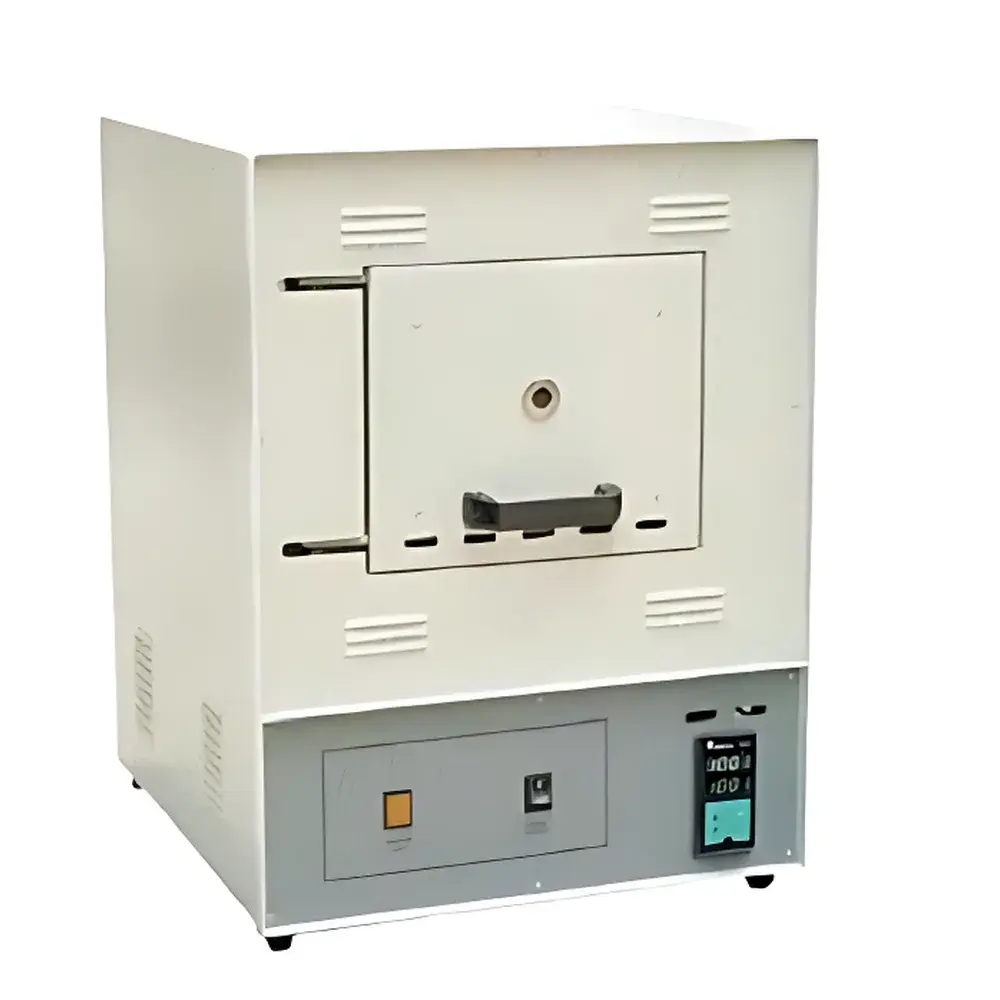
Swiss-made D482 Petroleum Ash Content Analyzer (ASTM D482 / ISO 6245 Compliant)
| Key | Origin: Switzerland |
|---|---|
| Model | D482 |
| Standards Compliance | ASTM D482, D874, D4422, IP 4, IP 163, ISO 3987, ISO 6245 |
| Max Operating Temperature | 1100 °C |
| Chamber Internal Dimensions (W×D×H) | 210 × 320 × 362.5 mm |
| External Dimensions (W×D×H) | 500 × 650 × 1625 mm |
| Power Supply | 220 V, 50 Hz, 3.9 kW |
| Door Type | Horizontal front-loading |
| Heating Configuration | Rear-mounted heating elements |
| Exhaust | Natural convection fume venting |
| Controller | Digital PID with safety interlocks |
| Insulation | Ceramic fiber thermal insulation |
Overview
The Swiss-made D482 Petroleum Ash Content Analyzer is a precision laboratory furnace engineered for the quantitative determination of ash content in petroleum products according to standardized gravimetric combustion procedures. It operates on the principle of controlled high-temperature incineration—typically at 775 °C ± 25 °C (per ASTM D482) or 750 °C ± 5 °C (per ISO 6245)—to oxidize organic matter and volatilize non-metallic components, leaving behind inorganic oxide residues (ash) that are subsequently weighed to calculate mass percent ash. This method is applicable to distillate fuels, residual oils, crude oil, lubricating oils, waxes, and other hydrocarbon-based materials where ash-forming contaminants—such as metallic soaps, catalyst residues, or corrosion inhibitors—must be quantified for quality control, refining process monitoring, or regulatory compliance. The instrument is not intended for samples containing ash-contributing additives (e.g., certain phosphorus-based anti-wear agents), as their inclusion would invalidate results per standard scope definitions.
Key Features
- High-purity ceramic fiber insulation enabling rapid thermal ramp-up, stable temperature uniformity across the chamber, and reduced energy consumption relative to traditional refractory brick furnaces.
- Rear-mounted heating elements ensure symmetrical heat distribution and minimize thermal gradient effects during prolonged ashing cycles.
- Horizontal front-loading door design facilitates safe, ergonomic handling of hot crucibles and evaporating dishes without vertical lifting or overhead access constraints.
- Natural convection exhaust pathway allows passive removal of acidic and toxic combustion byproducts (e.g., SOx, NOx, halogenated vapors) without requiring forced-air ducting or external scrubbers—ideal for dedicated analytical hoods or well-ventilated lab environments.
- Digital PID temperature controller with real-time display, programmable ramp/soak profiles, over-temperature cut-off, and door-interlocked power disable for operator safety and procedural integrity.
- Maximum operating temperature of 1100 °C supports extended applications beyond ASTM D482—including ASTM D874 (sulfated ash) and ISO 3987 (lubricant ash)—while maintaining long-term thermal stability and calibration traceability.
Sample Compatibility & Compliance
The D482 analyzer is validated for use with standard sample containers specified in major international methods: platinum evaporation dishes (100 mL) per ASTM D482 and ceramic crucibles (100 mL) per ISO 6245. Its internal chamber dimensions (210 × 320 × 362.5 mm) accommodate multiple sample positions while preserving required airflow dynamics and thermal homogeneity. All operational protocols align with Good Laboratory Practice (GLP) requirements for documented temperature verification, calibration frequency, and ash residue handling. The system supports audit-ready documentation when paired with compliant analytical balances and calibrated thermocouples traceable to NIST or equivalent national metrology institutes. It meets essential electrical safety standards (IEC 61010-1) and is compatible with laboratories operating under ISO/IEC 17025 accreditation frameworks.
Software & Data Management
While the D482 operates as a standalone furnace with embedded digital control, its temperature profile logging capability (via optional RS-232 or USB interface) enables integration with LIMS or electronic lab notebooks (ELN). When used in regulated environments—including those subject to FDA 21 CFR Part 11 or EU Annex 11—the instrument’s digital PID controller supports configurable audit trails, user-access levels, and timestamped event logs (e.g., start time, soak duration, final temperature, door open/close events). Data export formats include CSV and XML, facilitating automated calculation of ash % using pre-defined formulas aligned with ASTM D482 Section 11 reporting conventions.
Applications
- Quality assurance of finished lubricants and base oils against maximum allowable ash limits (e.g., API SP, ACEA C-class specifications).
- Monitoring catalyst carryover in fluid catalytic cracking (FCC) units via residual ash analysis in heavy fuel oils.
- Verification of additive package integrity—detecting unintended metal contamination from wear debris or storage tank corrosion.
- Supporting refinery desalting efficiency assessments through comparative ash profiling of crude feedstocks and desalted fractions.
- Research-grade characterization of biofuel blends (e.g., FAME, HVO) where inorganic impurities impact combustion chamber deposit formation.
FAQ
What is the difference between ASTM D482 and ASTM D874 ash testing methods?
ASTM D482 determines total ash from unadditized petroleum products via direct ignition; ASTM D874 measures sulfated ash—where samples are treated with sulfuric acid prior to ignition—to quantify metallic detergent additives in lubricants.
Can this instrument be used for coal or biomass ash analysis?
No. The D482 is specifically designed and validated for petroleum-derived matrices per ASTM/ISO petroleum standards. Coal and biomass require different ignition protocols (e.g., ASTM D3174) and higher temperature stability profiles not guaranteed under D482 calibration conditions.
Is the furnace compatible with GLP-compliant recordkeeping?
Yes—when operated with traceable calibration records, documented temperature uniformity mapping, and integrated data logging, it fulfills core GLP requirements for equipment qualification and result reproducibility.
What safety certifications does the unit carry?
It conforms to IEC 61010-1:2010 for electrical safety in laboratory equipment and includes dual redundant thermal cutoffs, door-actuated power interruption, and grounded chassis construction.
How often should temperature uniformity mapping be performed?
Per ISO/IEC 17025 and ASTM E1142, initial mapping must be conducted before first use; thereafter, annual verification is recommended—or after any maintenance affecting heating elements or insulation integrity.





