
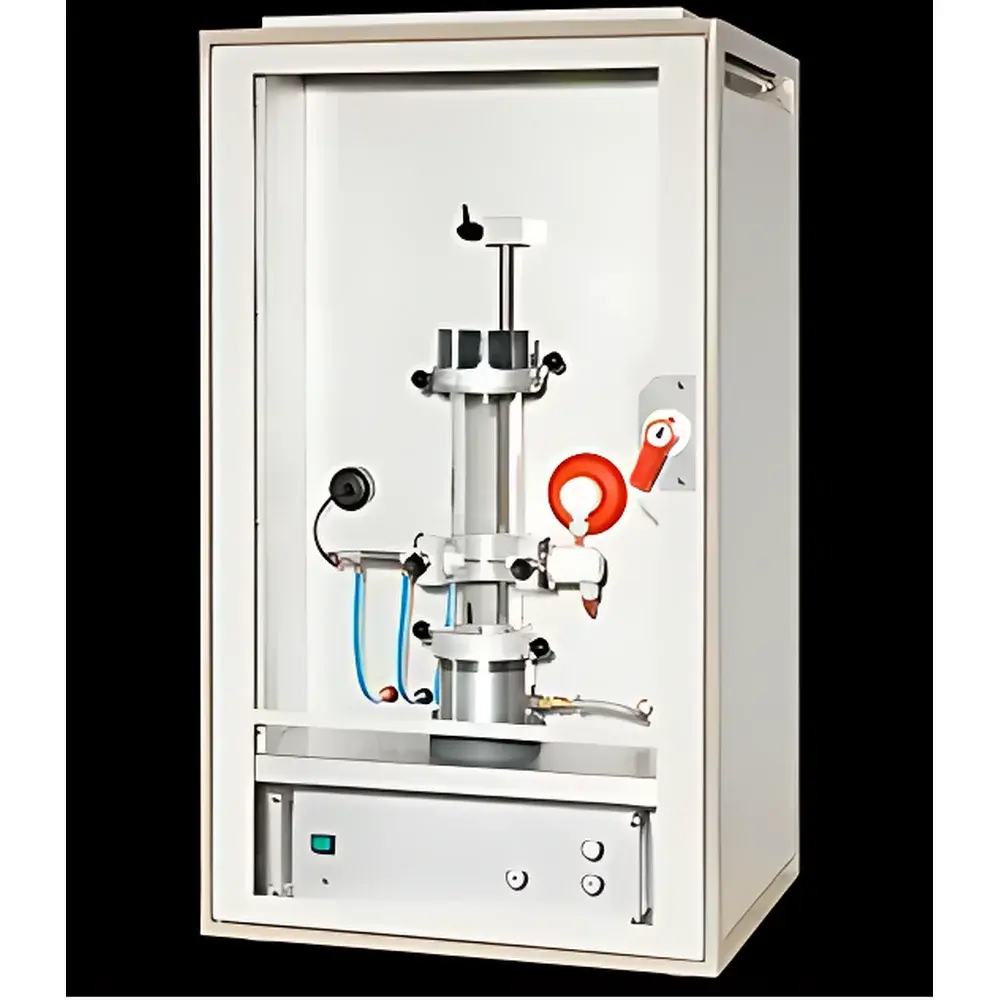
Swiss-made MIKE3 Minimum Ignition Energy (MIE) Tester
| Origin | Switzerland |
|---|---|
| Manufacturer Type | Authorized Distributor |
| Origin Category | Imported |
| Model | MIKE3 |
| Pricing | Upon Request |
Overview
The Swiss-made MIKE3 Minimum Ignition Energy (MIE) Tester is a precision-engineered laboratory instrument designed to determine the lowest electrical spark energy capable of igniting a suspended dust cloud under standardized atmospheric conditions. It operates on the fundamental principle of controlled capacitive discharge through a defined electrode gap within a modified Hartmann tube, generating reproducible spark events that simulate electrostatic or mechanical ignition sources encountered in industrial powder handling environments. As a core tool in combustible dust hazard assessment, the MIKE3 supports quantitative evaluation of dust cloud ignition sensitivity—critical for defining explosion protection strategies, selecting appropriate equipment protection levels (EPL), and fulfilling regulatory requirements for process safety management (PSM) in chemical, pharmaceutical, food, and metal processing facilities.
Key Features
- Modular spark generation system with selectable capacitor banks (20 nF, 6 nF, 2 nF, 600 pF) enabling precise energy tuning across the full 1 mJ–2000 mJ range
- Two-tier high-voltage charging architecture: 15 kV for low-energy testing (1–10 mJ), 11 kV for mid-to-high energy ranges (30–1000 mJ)
- Dual spark triggering mechanisms: high-voltage delay circuitry for sub-3 mJ precision; movable electrode assembly for stable arc initiation at 10 mJ–1 J
- Modified Hartmann tube (1.2 L volume) with mushroom-shaped dispersion nozzle ensuring uniform, repeatable dust cloud formation via 7 bar compressed air pulse
- Integrated voltage transient recorder capturing capacitor discharge waveforms to calculate actual delivered spark energy—not nominal stored energy—ensuring traceable metrology
- Robust steel frame construction with dimensions 553 × 620 × 980 mm (W × D × H); compliant with 230 V / 50 Hz mains supply
Sample Compatibility & Compliance
The MIKE3 accommodates dry, free-flowing powders with particle size distributions representative of process-relevant material—typically < 500 µm, though optimal sensitivity is achieved with median diameters between 10–100 µm. Sample moisture content must be controlled and documented per test, as hygroscopicity directly influences MIE outcomes. The system complies with internationally recognized standards including ASTM E2019-03 (Standard Test Method for Minimum Ignition Energy of a Dust Cloud), IEC 61241-2-3 (Electrical apparatus for use in the presence of combustible dust — Part 2-3: Test methods — Methods for determining the minimum ignition energy of dust clouds), and GB/T 16428 (Determination of minimum ignition energy of dust clouds). All test procedures align with Good Laboratory Practice (GLP) principles, supporting audit readiness for OSHA 1910.1200 (HCS), NFPA 652, and ATEX/IECEx conformity assessments.
Software & Data Management
The MIKE3 includes dedicated analysis software for post-test evaluation of voltage decay curves, enabling automated calculation of actual spark energy based on integral ∫V(t)·I(t)dt methodology. The software supports parametric studies—including influence of capacitance selection, charging voltage, and electrode gap—facilitating uncertainty quantification per ISO/IEC 17025. Raw waveform data are exported in CSV format for integration into enterprise LIMS or statistical process control platforms. Audit trails record operator ID, timestamp, calibration status, and environmental parameters (ambient T/RH), satisfying FDA 21 CFR Part 11 requirements for electronic records and signatures when validated in GMP-regulated environments.
Applications
- Quantitative classification of dust explosibility per EN 14034-1 and UN ST/SG/AC.10/11/Rev.5 (UN Manual of Tests and Criteria, Section 38.3)
- Development and validation of inerting, suppression, and venting system design parameters
- Supporting Process Hazard Analysis (PHA) and Layer of Protection Analysis (LOPA) documentation
- Raw material qualification for pharmaceutical blend safety and battery cathode powder handling protocols
- Root cause investigation of historical dust ignition incidents through comparative MIE benchmarking
FAQ
What sample mass is required per test?
Typical dust loading is 0.5–2.0 g, optimized to achieve a nominal concentration of 500–1000 g/m³ within the Hartmann tube—within the range specified by ASTM E2019-03.
How is energy calibration verified?
Calibration is performed using NIST-traceable high-voltage dividers and digital oscilloscopes with ≥1 GHz bandwidth; certificate includes uncertainty budget per ISO/IEC 17025.
Can the MIKE3 test nano-sized powders?
Yes—with caution: agglomeration effects must be mitigated via dispersant-assisted pneumatic dispersion; results require correlation with BET surface area and electrostatic charge decay measurements.
Is humidity control integrated?
No—ambient RH must be monitored externally (±2% accuracy recommended); for controlled humidity testing, optional desiccator or climate chamber integration is available.
Does the system support automated sequence testing?
Manual operation is standard; semi-automated sequencing (e.g., stepped energy ladder tests) can be implemented via optional PLC interface and custom script modules.



