
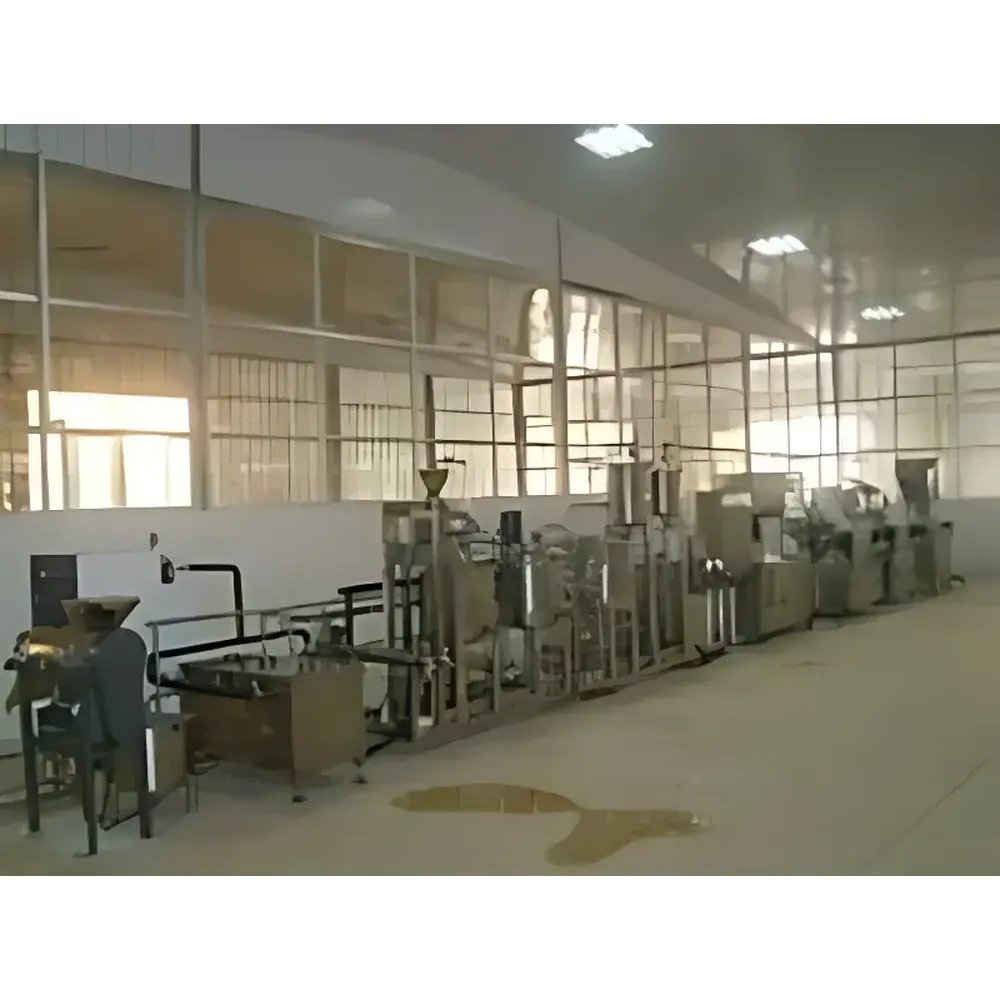
SY-100 Compact Beverage Pilot Plant for Juice and Functional Drink Processing
| Origin | Shanghai, China |
|---|---|
| Manufacturer Type | Authorized Distributor |
| Origin Category | Domestic (China-made) |
| Model | SY-100 |
| Pricing | Available Upon Request |
Overview
The SY-100 Compact Beverage Pilot Plant is an integrated, modular pilot-scale processing system engineered for laboratory-based development, process validation, and small-batch production of juice, fruit-vegetable blends, herbal infusions, and functional beverages. Designed on the principle of scaled-down industrial continuity—retaining core unit operations including blending, homogenization, thermal processing (HTST/UHT), sterile/aseptic filling, and cooling—the system replicates full-scale production dynamics while operating at a controllable capacity range of 20–500 L/h. Its architecture follows ISO 22000-aligned hygienic design principles, with stainless-steel (316L) wetted parts, sanitary tri-clamp connections, and CIP-compatible flow paths. Unlike benchtop extractors or single-unit demonstrators, the SY-100 functions as a fully synchronized line where residence time, temperature profiling, shear history, and fill accuracy are preserved across scale—enabling statistically valid shelf-life studies, formulation optimization, and regulatory-compliant process mapping prior to commercial rollout.
Key Features
- Modular configuration supporting four primary beverage categories: dairy-based drinks, tea infusions, fruit-vegetable juice blends, and herbal/functional tonics.
- Three thermally distinct filling modes: hot-fill (85–92°C), ambient-fill (20–25°C), and cold-fill (4–10°C), each compatible with PET bottles, glass containers, or customer-supplied packaging formats.
- Low-volume throughput design minimizes raw material consumption during R&D trials without compromising process fidelity—ideal for sensory panel testing, additive compatibility screening, and accelerated stability protocols.
- Self-contained utility interface: requires only municipal water (or purified water feed), standard 3-phase industrial power (380 V / 50 Hz), and compressed air (if optional pneumatic controls are specified).
- Core sterilization module—a plate-type HTST pasteurizer—features PID-controlled temperature zones, real-time log recording, and validated hold-tube residence time (≥15 s at ≥72°C), consistent with ISO 13485 and FDA 21 CFR Part 11 data integrity requirements.
- Individual unit operations—including vacuum deaerator, high-shear mixer, and positive-displacement filler—retain full standalone functionality with independent PLC control, enabling isolated equipment qualification or integration into existing lab infrastructure.
Sample Compatibility & Compliance
The SY-100 accommodates viscous, particulate-laden, and pH-sensitive matrices typical of clarified apple juice, carrot-ginger blends, green tea catechin extracts, and botanical decoctions. All contact surfaces comply with EC 1935/2004 food contact material regulations and ASME BPE-2021 surface finish standards (Ra ≤ 0.8 µm). The system supports GLP-compliant documentation workflows, including electronic batch records, audit-trail-enabled parameter changes, and exportable CSV/TXT process logs. It has been deployed in academic settings—including the School of Agriculture and Biology at Shanghai Jiao Tong University—for curriculum-integrated pilot manufacturing training and collaborative industry-academia process development projects aligned with national food safety standards (GB 12695, GB 7101).
Software & Data Management
Equipped with an embedded HMI touchscreen running a deterministic real-time OS, the SY-100 provides synchronized monitoring of critical process parameters: inlet/outlet temperatures, flow rate (±1% FS), holding time, fill volume deviation (<±2 mL), and sterilization lethality (F0 calculation). Data is timestamped, encrypted, and stored locally with optional cloud backup via secure MQTT protocol. The system generates automated PDF reports compliant with ICH M7 and USP analytical instrument qualification frameworks. Full traceability—including operator ID, version-controlled recipe files, and calibration history—is maintained per FDA 21 CFR Part 11 Annex 11 requirements.
Applications
- Formulation development and sensory evaluation of novel juice blends under controlled thermal histories.
- Accelerated shelf-life testing (ASLT) with parallel microbiological challenge studies (e.g., against Alicyclobacillus acidoterrestris in acidic beverages).
- Process validation for new packaging formats—especially PET bottle hot-fill tolerance and cap seal integrity under thermal stress.
- Teaching modules on HACCP critical control point identification, thermal death time modeling, and CIP cycle optimization.
- Contract manufacturing support for startups requiring GMP-aligned pilot batches for regulatory submission (e.g., NMPA health food registration, EU Novel Food dossier preparation).
FAQ
Is the SY-100 suitable for aseptic processing of low-acid beverages?
Yes—when configured with UHT sterilization (135–140°C, 4–6 s) and sterile barrier isolators, it meets FDA 21 CFR Part 113 requirements for low-acid canned food equivalency.
Can the system be validated per IQ/OQ/PQ protocols?
Yes—factory-issued DQ/IQ/OQ documentation packages are available; PQ execution support includes third-party metrology certification for temperature sensors and flow meters.
Does it support integration with LIMS or MES platforms?
Yes—via OPC UA or Modbus TCP interfaces; API endpoints allow bidirectional data exchange with LabWare LIMS and Siemens SIMATIC IT.
What is the typical lead time for installation and commissioning?
Standard delivery is 12–14 weeks from PO; on-site FAT, SAT, and operator training are included in turnkey scope.



