
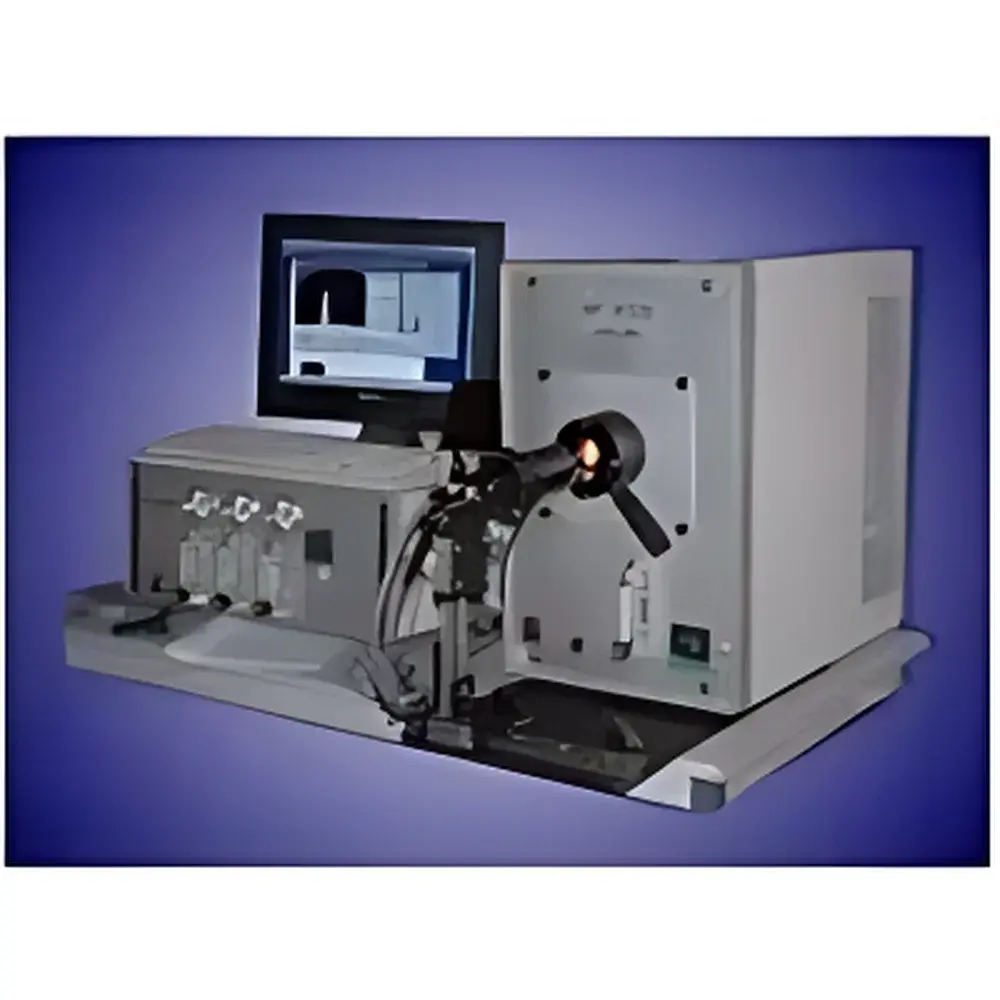
Sylab IF2000G Automatic Ash Fusion Temperature Tester
| Brand | Sylab |
|---|---|
| Origin | France |
| Model | IF2000G |
| Maximum Furnace Temperature | 1650 °C |
| Operating Temperature Range | 200–1550 °C |
| Heating Rate | 4–12 °C/min (programmable) |
| Temperature Accuracy | ±5 °C at 1064 °C (verified with 99.98% pure gold wire) |
| Image Resolution | 1280 × 1024 pixels |
| Frame Rate | up to 30 fps |
| Gas Flow Control | N₂, air, O₂/CO₂ (oxidizing), CO/CO₂ (reducing) |
| Sample Capacity | 4 × ASTM/ISO/AFNOR/EDF pyramidal samples (6×6×19 mm) OR 4 × DIN/CEN/Chinese cylindrical samples (3×3 mm) OR 2 × custom molds |
| Safety | Integrated CO sensor with audible alarm and automatic gas shutoff |
| Exhaust | 160 CFM, 4-inch (10.2 cm) duct interface |
| Power Supply | 215–253 V~, 50/60 Hz, single-phase, 30 A |
| Dimensions (W×D×H) | 60 × 80 × 40 cm |
| Net Weight | 70 kg |
| Compliance | ASTM D1857, ISO 540, CEN/TS 15104, AFNOR NF M 03-016, BS EN 606, AS 1038.12 |
Overview
The Sylab IF2000G Automatic Ash Fusion Temperature Tester is a fully automated, high-precision thermal analysis system engineered for standardized determination of ash fusion temperatures (AFT) in solid fuels and industrial minerals. Based on the internationally recognized visual observation method—defined by ASTM D1857, ISO 540, and CEN/TS 15104—the instrument employs controlled atmospheric heating combined with real-time digital imaging to objectively identify critical fusion stages: initial deformation (DT), softening (ST), hemispherical (HT), and fluid (FT) temperatures. Unlike manual or semi-automated systems, the IF2000G eliminates operator subjectivity by capturing high-resolution sequential images at user-defined temperature intervals (as fine as 4 °C), enabling reproducible quantification of morphological evolution—including height, width, roundness, angularity, and top geometry—through calibrated image analysis algorithms.
Key Features
- Fully autonomous operation: Once loaded, the system executes full AFT cycles without manual intervention—from furnace ramping and atmosphere switching to image acquisition, stage classification, and report generation.
- Programmable thermal profile control: Precise heating rates from 4 to 12 °C/min, with stability verified against the gold melting point (1064 °C ±5 °C) using certified reference material.
- Dual-atmosphere capability: Independent mass flow control for oxidizing (air, O₂/CO₂), reducing (CO/CO₂), inert (N₂), and low-oxygen environments—critical for simulating boiler slagging conditions and evaluating fuel behavior under varying combustion stoichiometries.
- High-fidelity imaging subsystem: 1280 × 1024 pixel CCD camera with adjustable focus and LED illumination, acquiring up to 30 frames per minute across the entire 200–1550 °C range.
- Multi-sample throughput: Supports simultaneous analysis of either four standardized pyramidal specimens (6×6×19 mm per ASTM/ISO/AFNOR/EDF) or four cylindrical pellets (3×3 mm per DIN/CEN/GB standards), or two custom molds.
- Integrated safety architecture: Real-time CO monitoring with acoustic alarm and automatic gas cutoff; robust exhaust system rated at 160 CFM via 4-inch duct interface with zero backpressure design.
Sample Compatibility & Compliance
The IF2000G accommodates diverse sample geometries and compositions relevant to coal quality assessment, biomass co-firing evaluation, metallurgical flux testing, and glass frit development. It supports ASTM D1857 (coal and coke), ISO 540:2022 (solid mineral fuels), CEN/TS 15104:2005 (biomass ash), AFNOR NF M 03-016 (French coal standard), BS EN 606 (UK coal specification), and AS 1038.12 (Australian coal testing). For biomass applications, the system complies with CEN/TS 15104 requirements for specimen preparation—including cubic (3×3×3 mm), cylindrical (3×3 mm), and pyramidal (up to 19 mm height) forms—and enables networked data export for centralized laboratory information management systems (LIMS).
Software & Data Management
The embedded Windows-based software provides end-to-end traceability: temperature-synchronized image capture, automated morphology classification (deformation, shrinkage, sphere, hemisphere, flow), and quantitative parameter extraction (aspect ratio, convex hull area, centroid displacement). All raw images, processed curves, and metadata are stored in an audit-ready relational database compliant with GLP principles. Export options include PDF reports (with annotated images, fusion curve plots, and tabulated DT/ST/HT/FT values), CSV datasets for statistical analysis, and AVI-format time-lapse animations reconstructed from 5 °C-interval snapshots. The system supports 21 CFR Part 11–compatible user authentication, electronic signatures, and immutable audit trails when configured in regulated environments.
Applications
- Coal-fired power plant operations: Predicting slagging and fouling tendencies through comparative AFT profiling under oxidizing vs. reducing atmospheres.
- Biomass co-combustion R&D: Assessing ash fusibility of wood chips, straw, and agricultural residues per CEN/TS 15104 to guide blending ratios and furnace modifications.
- Metallurgical process optimization: Evaluating flux efficiency and slag viscosity precursors in iron ore sintering and blast furnace feed design.
- Glass manufacturing: Characterizing batch component interactions and identifying eutectic formation thresholds in soda-lime and borosilicate formulations.
- Research laboratories: Supporting ASTM-compliant interlaboratory studies, method validation, and reference material certification programs.
FAQ
What standards does the IF2000G support for ash fusion testing?
ASTM D1857, ISO 540:2022, CEN/TS 15104:2005, AFNOR NF M 03-016, BS EN 606, AS 1038.12, and DIN 51068.
Can the system operate under reducing atmospheres?
Yes—it supports programmable switching between oxidizing (air, O₂/CO₂), reducing (CO/CO₂), and inert (N₂) gas environments with independent mass flow control.
How is measurement repeatability ensured?
Through gold-point calibration (1064 °C ±5 °C), closed-loop PID temperature control, and image-based morphology classification—eliminating observer bias inherent in manual methods.
Is the software compliant with regulatory data integrity requirements?
When deployed with role-based access control and enabled audit logging, it meets GLP documentation practices and supports 21 CFR Part 11 implementation for electronic records.
What is the maximum sample throughput per run?
Four pyramidal (6×6×19 mm) or four cylindrical (3×3 mm) specimens—or two custom molds—can be analyzed simultaneously within a single thermal cycle.







