
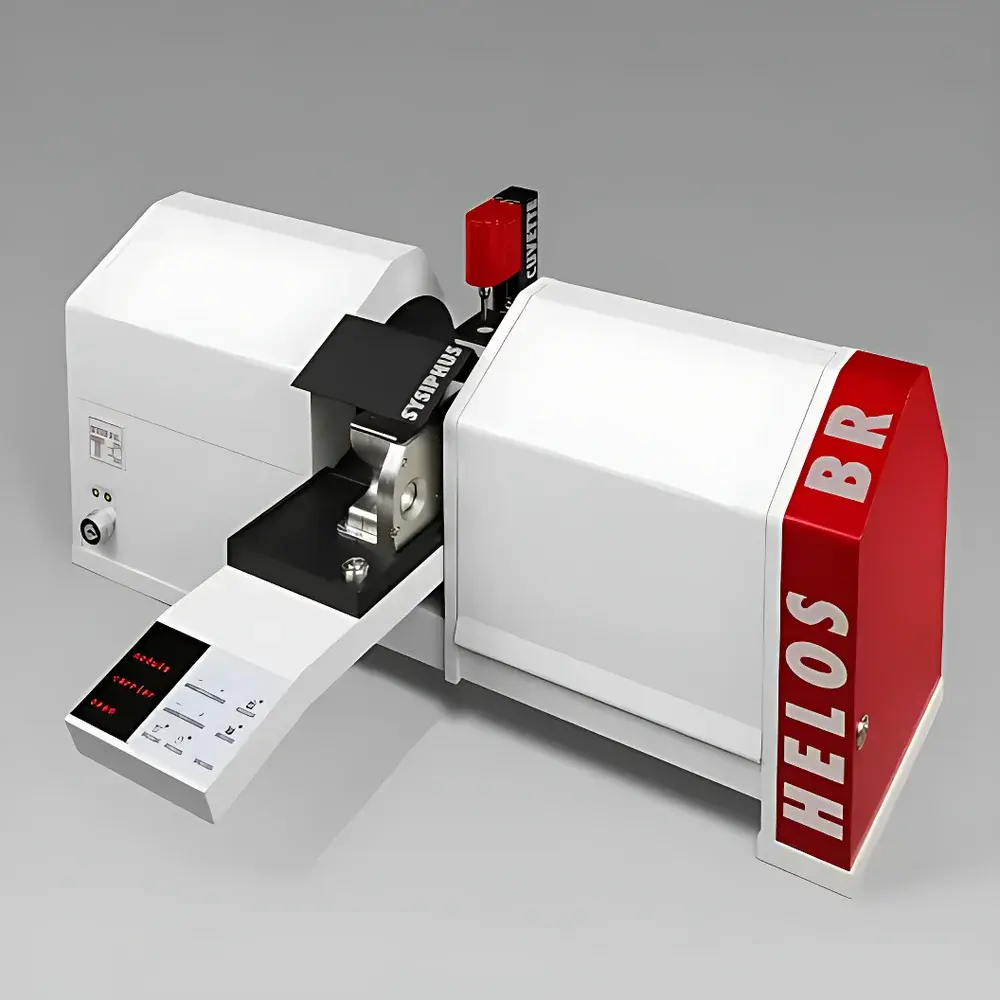
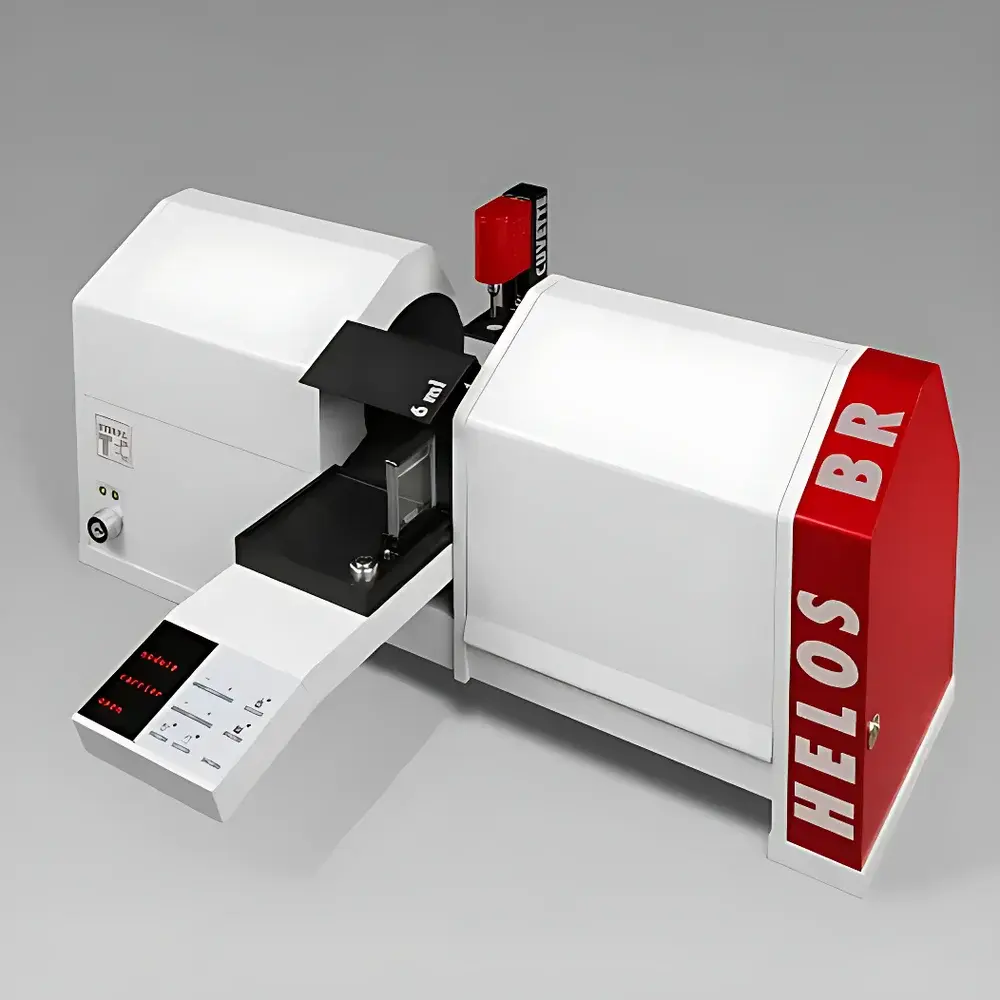
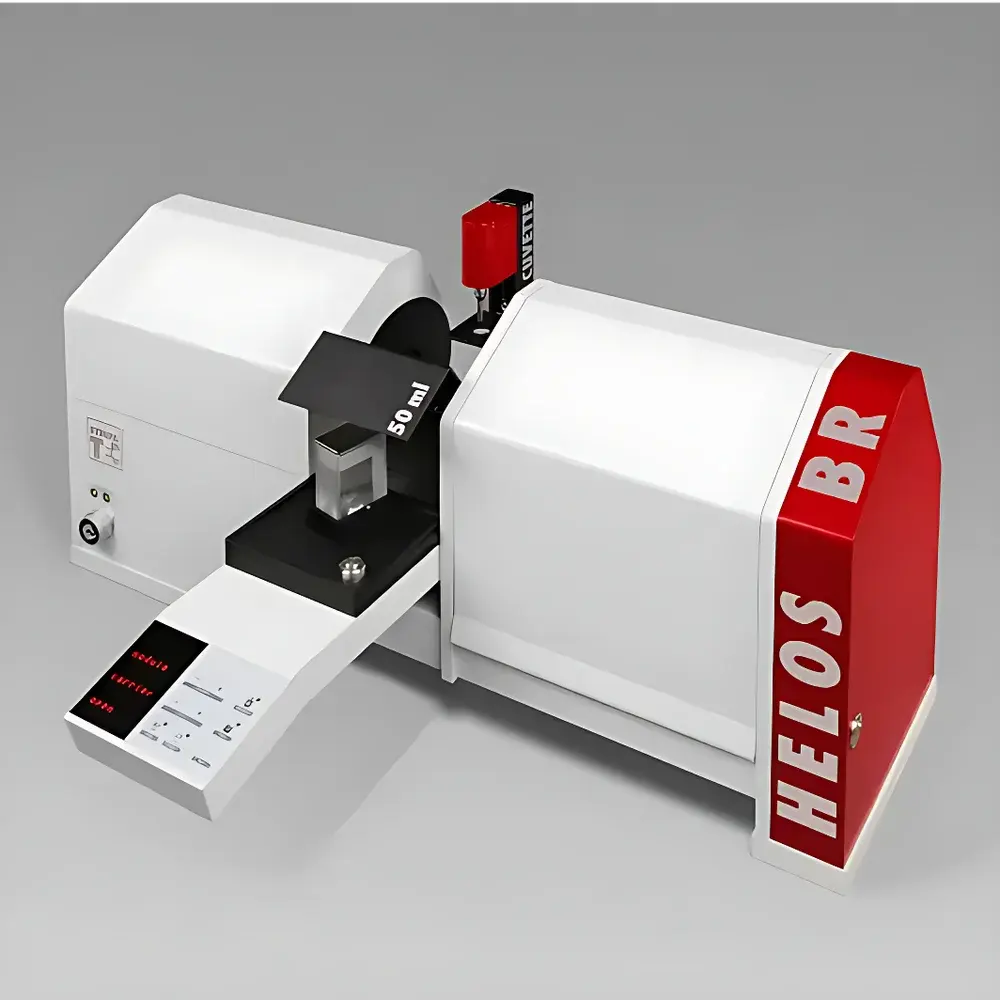
SYMPATEC HELOS & CUVETTE Corrosion-Resistant Micro-Sample Wet Dispersion Laser Diffraction Particle Size Analyzer
| Brand | SYMPATEC |
|---|---|
| Origin | Germany |
| Manufacturer Type | Direct Manufacturer |
| Origin Category | Imported |
| Model | HELOS & CUVETTE |
| Dispersion Method | Wet Dispersion |
| Instrument Type | Laboratory Laser Diffraction Analyzer |
| Measurement Range | 0.1–3500 µm |
| Repeatability | < 0.04% |
| Measurement Time | 10 s |
Overview
The SYMPATEC HELOS & CUVETTE is a modular, corrosion-resistant micro-sample wet dispersion laser diffraction particle size analyzer engineered for high-precision analysis of suspensions, emulsions, slurries, and other liquid-phase dispersions. It operates on the physical principle of Fraunhofer diffraction and Mie theory—fully compliant with ISO 13320:2020 (“Particle size analysis — Laser diffraction methods”)—enabling accurate, traceable quantification of particle size distribution (PSD) from 0.1 µm to 3500 µm. Unlike conventional flow-cell systems requiring large sample volumes and complex fluidic infrastructure, the HELOS & CUVETTE integrates a compact, benchtop-compatible optical platform with interchangeable quartz or stainless-steel cuvette-based dispersion modules. This architecture eliminates cross-contamination risk, minimizes solvent consumption, and preserves sample integrity—critical when handling toxic, reactive, high-value, or irreplaceable materials such as active pharmaceutical ingredients (APIs), battery cathode slurries, or specialty catalysts.
Key Features
- Corrosion-resistant quartz or electropolished stainless-steel sample cells compatible with aggressive media—including strong acids (e.g., HCl, HNO₃), alkalis (e.g., NaOH), and organic solvents (e.g., hexane, THF, NMP)
- Micro-volume operation: supports analysis of as little as 6 mL (CUVETTE 6) or up to 50 mL (CUVETTE 50 / SYSIPHUS), with full sample recovery post-measurement
- Integrated, adjustable-power ultrasonic disperser (20–100 W, frequency-stabilized at 40 kHz) for controlled deagglomeration without cavitation-induced particle damage
- Three interchangeable CUVETTE configurations: CUVETTE 6 (6 mL quartz, manual PTFE stir frame), CUVETTE 50 (50 mL quartz, motorized PTFE stir bar, variable speed), and SYSIPHUS (50 mL stainless steel, fully automated liquid recirculation)
- Optical path stability maintained via temperature-controlled HELOS sensor head (±0.1 °C), minimizing thermal drift during repeated measurements
- Modular design allows future expansion with optional accessories—including refractive index calibration kits, automated dilution modules, and GMP-compliant audit trail firmware
Sample Compatibility & Compliance
The HELOS & CUVETTE is validated for use with chemically heterogeneous and rheologically complex dispersions, including non-Newtonian suspensions, shear-thinning emulsions, and high-viscosity battery electrode slurries. Its inert quartz or passivated stainless-steel wetted surfaces meet USP , ASTM E2971-21 (for pharmaceutical excipient characterization), and ISO 8502-9 (for surface cleanliness assessment in electrochemical applications). All CUVETTE variants support GLP/GMP workflows: raw intensity data, instrument metadata (laser power, alignment status, temperature), and user-defined measurement parameters are timestamped and stored in vendor-neutral HDF5 format. Optional 21 CFR Part 11-compliant software enables electronic signatures, role-based access control, and immutable audit trails—essential for regulated QC laboratories in pharma, biotech, and advanced materials R&D.
Software & Data Management
Analysis is performed using SYMPATEC’s WINDOX 7 software—a Windows-based platform supporting real-time data acquisition, multi-angle scattering inversion, and ISO 9276-2-compliant PSD reporting (D10, D50, D90, span, relative width). The software includes batch processing mode for method-driven routine testing, statistical comparison tools (ANOVA, t-test overlays), and export options compliant with LIMS integration (CSV, XML, PDF/A-2). Raw scattering patterns are retained alongside processed results, enabling retrospective re-evaluation using updated optical models or refractive index inputs. All data files include embedded digital signatures and cryptographic hashes to ensure forensic integrity per ALCOA+ principles.
Applications
This system is routinely deployed in quality control and formulation development across multiple regulated sectors:
• Pharmaceutical manufacturing—characterization of nanosuspensions, liposomal drug carriers, and micronized APIs in organic solvents
• Lithium-ion battery R&D—particle size profiling of NMC, LFP, and silicon anode slurries in NMP or water-based binders
• Food science—stability assessment of dairy emulsions, starch dispersions, and functional ingredient suspensions
• Catalyst and pigment synthesis—monitoring of hydrolysis/precipitation kinetics under corrosive reaction conditions
• Environmental analytics—quantification of colloidal metal oxides or microplastics in aqueous extracts
FAQ
Can the HELOS & CUVETTE analyze samples containing hydrofluoric acid (HF)?
Yes—when configured with fused silica cuvettes and PTFE-sealed components, it is rated for intermittent exposure to ≤5% HF solutions at ambient temperature. Full compatibility documentation is provided per material safety data sheet (MSDS) Annex B.
Is calibration traceable to NIST standards?
Yes—each HELOS optical unit undergoes factory calibration using NIST-traceable polystyrene latex (PSL) standards (e.g., 100 nm, 1 µm, 10 µm); calibration certificates include uncertainty budgets per ISO/IEC 17025.
Does the system support automated cleaning protocols between runs?
The SYSIPHUS module includes programmable rinse cycles with configurable solvent sequences (e.g., solvent A → solvent B → nitrogen purge), logged with pressure and flow-rate telemetry.
What is the minimum detectable concentration for low-loading suspensions?
Detection limit depends on particle refractive index contrast and instrument alignment; typical lower limit is ~0.001 vol% for TiO₂ in water (n = 2.7), verified per ISO 13320 Annex D.
Can third-party software import raw scattering data?
Yes—WINDOX exports unprocessed detector array signals (.h5 binary format) with full metadata, enabling custom inversion algorithms in MATLAB, Python (SciPy), or R environments.



