
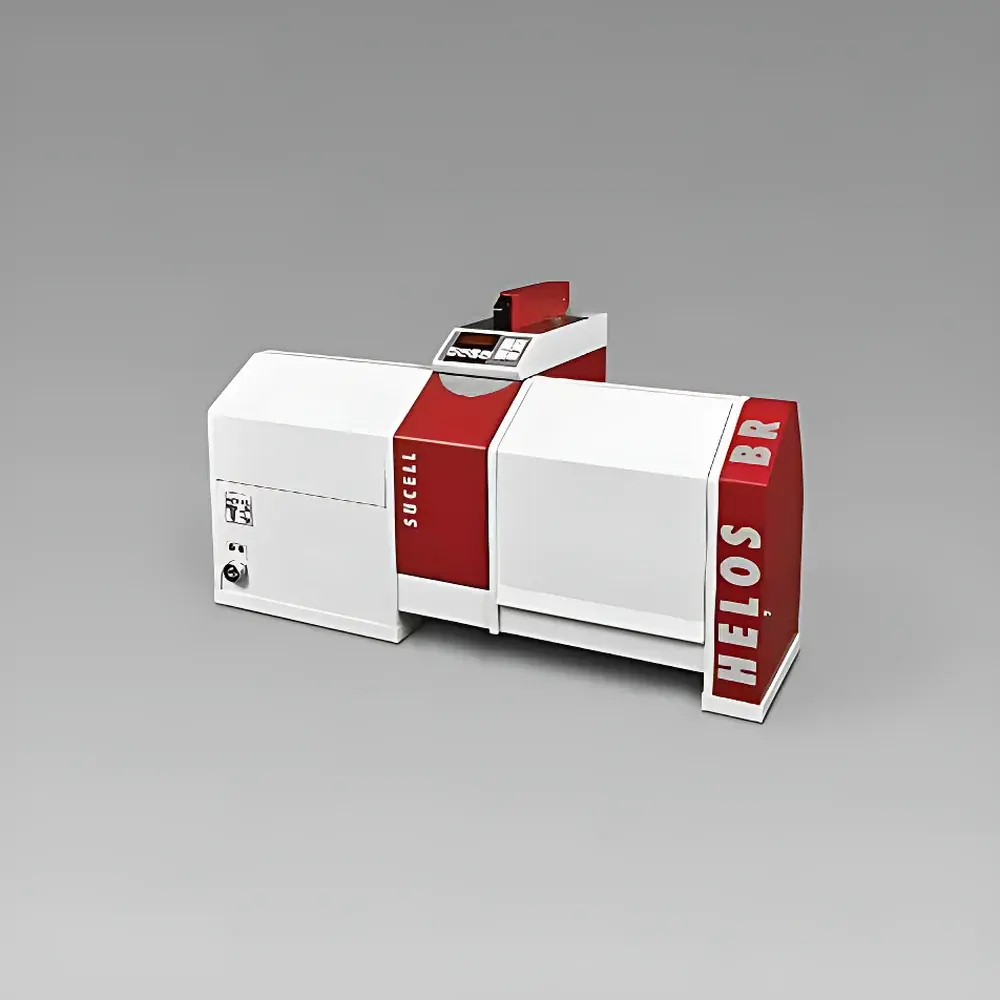
SYMPATEC HELOS & SUCELL Automated Wet-Dispersion Laser Diffraction Particle Size Analyzer
| Brand | SYMPATEC |
|---|---|
| Origin | Germany |
| Manufacturer | SYMPATEC GmbH |
| Type | Laboratory Laser Diffraction Analyzer |
| Measurement Range | 0.1–875 µm |
| Repeatability | <0.04% RSD |
| Measurement Time | 10 s |
| Dispersion Method | Fully Automated Wet Dispersion (Closed-Circuit Circulation) |
| Ultrasonication | 60 W, Adjustable Power & Duration |
| Mechanical Stirring | Dual Agitators with Variable Speed Control |
| Pump | Precision Peristaltic Circulation Pump, Flow Rate Adjustable |
| Sample Cell Volume | 500 mL (Optional SVA Micro Cell: 50 mL) |
| Compliance | FDA 21 CFR Part 11 Ready Software, GLP/GMP Support Enabled |
| Construction | Full Stainless Steel Housing & Fluid Path |
Overview
The SYMPATEC HELOS & SUCELL is a fully automated, laboratory-grade laser diffraction particle size analyzer engineered for high-precision, high-reproducibility characterization of particles suspended in liquid media. It operates on the fundamental physical principle of Fraunhofer diffraction and Mie theory—where incident laser light interacts with particles in suspension, generating angularly resolved scattering patterns that are captured by a multi-ring photodetector array. The intensity distribution across this detector is mathematically inverted using robust, non-negative least-squares algorithms to compute volumetric particle size distributions (PSD) across a dynamic range spanning 0.1 µm to 875 µm. Unlike manual or semi-automated systems, the HELOS & SUCELL integrates the HELOS optical platform with the SUCELL wet dispersion module into a single synchronized architecture—enabling unattended operation from sample introduction through measurement, data processing, and system cleaning.
Key Features
- Fully closed-loop wet dispersion system with automatic medium fill-level monitoring, inlet/outlet control, and programmable rinse cycles
- Integrated 60 W ultrasonic generator with user-defined amplitude and duration settings for controlled de-agglomeration
- Dual mechanical stirrers with independently adjustable rotational speeds (0–3000 rpm), ensuring homogeneous suspension without shear-induced degradation
- High-stability peristaltic circulation pump with flow rate programmability (0.1–5 L/min), optimized for low-viscosity to moderately viscous suspensions
- Self-cleaning protocol executed between measurements—including sequential solvent flush, ultrasonic bath activation, and air purge—to eliminate carryover and cross-contamination
- Stainless steel fluid path and instrument enclosure (AISI 316L), compliant with ISO 14644 cleanroom-compatible design standards and resistant to corrosion from organic solvents and aqueous electrolytes
- Modular optical platform: HELOS core supports future integration of dry dispersion (RODOS), spray (QUIXELL), or inline process modules without hardware replacement
Sample Compatibility & Compliance
The HELOS & SUCELL accommodates a broad spectrum of liquid-phase samples—including pharmaceutical suspensions (e.g., inhalation aerosols, injectables), battery cathode slurries, pigment dispersions, colloidal silica, emulsions, and mineral tailings slurries. Its 500 mL standard dispersion cell allows statistically representative sampling of heterogeneous suspensions; the optional SVA micro-cell (50 mL volume) enables analysis of precious or highly regulated formulations where sample conservation is critical. All wet components meet USP and EP 2.9.19 particulate matter testing prerequisites when configured with appropriate SOPs. The system’s software architecture conforms to FDA 21 CFR Part 11 requirements—including electronic signatures, audit trail logging, role-based access control, and immutable data archiving—making it suitable for regulated environments operating under GMP, GLP, or ISO/IEC 17025 quality management frameworks.
Software & Data Management
Operating via the Windows-based WINDOX 7 platform, the HELOS & SUCELL delivers intuitive workflow orchestration—from method setup and SOP-driven execution to real-time visualization and export-ready reporting. The software features embedded calibration traceability (NIST-traceable PSL standards), batch-wise statistical comparison tools (e.g., D10/D50/D90 trend analysis, %RSD calculation per parameter), and customizable report templates compliant with internal QA templates or external regulatory submissions. Advanced users may define custom dispersion protocols—including multi-stage sonication sequences, variable stirring ramp profiles, and adaptive pump speed modulation based on turbidity feedback. Raw scattering data (full 2D intensity matrix) and processed PSDs are stored in open-format HDF5 containers, enabling third-party algorithm validation and integration with LIMS or MES platforms via OPC UA or RESTful API extensions.
Applications
This system is routinely deployed in R&D and QC laboratories across multiple industries requiring rigorous particle size control. In pharmaceutical development, it quantifies aerodynamic particle size distribution (APSD) of pressurized metered-dose inhaler (pMDI) suspensions—directly informing deposition efficiency and bioavailability predictions. In lithium-ion battery manufacturing, it monitors slurry homogeneity and active material agglomeration prior to electrode coating. In coatings and ink formulation, it correlates PSD width (span) and fines content with gloss, rheology, and film defect formation. Additional use cases include sediment transport modeling in hydrogeology, catalyst support particle uniformity assessment in petrochemical refining, and nanoparticle stability evaluation in cosmetic emulsions under accelerated aging conditions.
FAQ
Does the HELOS & SUCELL support ISO 13320-compliant measurement protocols?
Yes—the optical configuration, detector geometry, and inversion algorithms are validated against ISO 13320 Annex B reference materials and include built-in verification routines for alignment, background subtraction, and signal-to-noise ratio thresholds.
Can the system be integrated into an automated lab environment?
Yes—it supports RS-232, Ethernet, and USB communication interfaces, and offers full SCPI command set compatibility for remote triggering, parameter setting, and data retrieval within robotic sample-handling workflows.
Is method transfer possible between HELOS & SUCELL and other SYMPATEC platforms?
Yes—WINDOX 7 ensures consistent data processing logic across all SYMPATEC analyzers; PSD results generated on HELOS & SUCELL are directly comparable to those from HELOS & RODOS or HELOS & QUIXELL when using identical optical models and calibration references.
What maintenance intervals are recommended for routine operation?
Optical alignment verification every 6 months; ultrasonic transducer performance check annually; peristaltic pump tubing replacement every 6–12 months depending on solvent aggressiveness and daily cycle count.
How is data integrity ensured during long-term deployment?
All measurement events are timestamped, digitally signed, and appended to a tamper-evident audit trail file. Raw data files are write-once, read-many (WORM) by default, and software updates require dual-role authorization to preserve historical comparability.



