
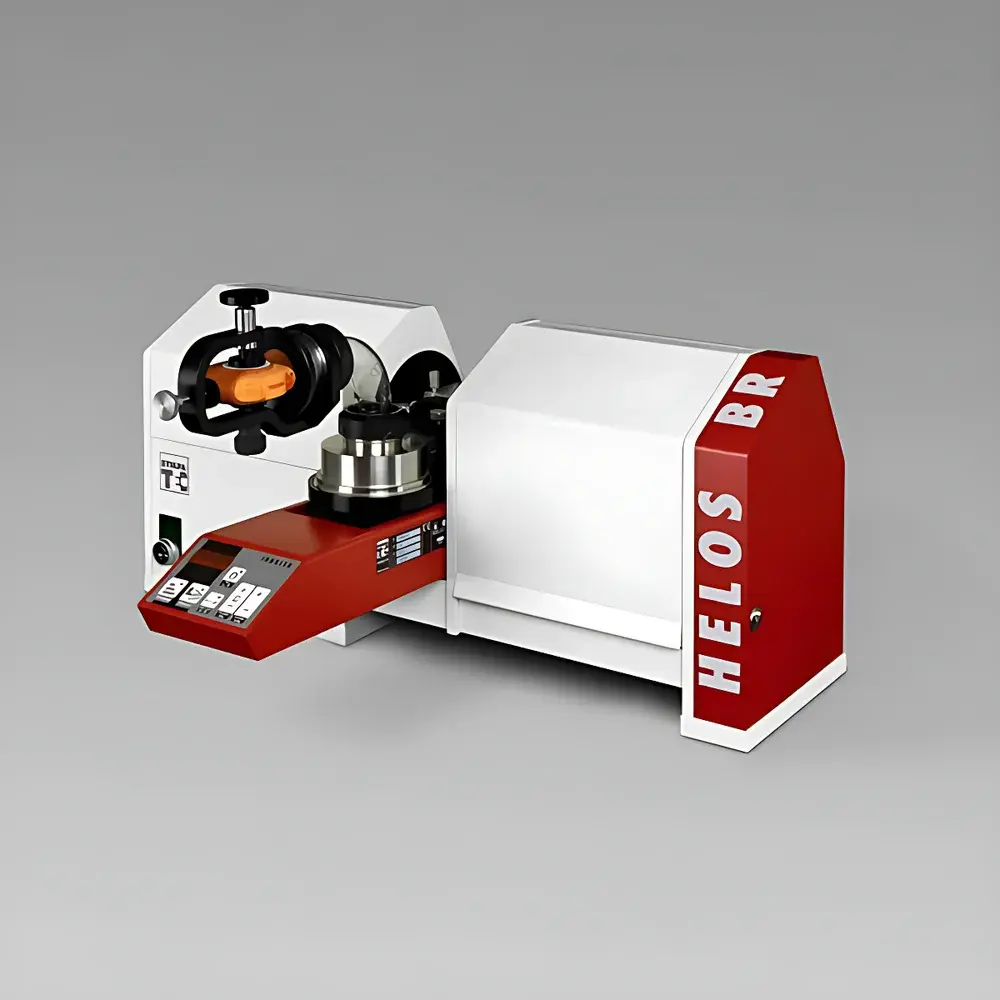
SYMPATEC HELOS&INHALER Inhalation Drug Particle Size Analyzer
| Brand | SYMPATEC |
|---|---|
| Origin | Germany |
| Manufacturer | SYMPATEC GmbH |
| Product Type | Laboratory Laser Diffraction Particle Size Analyzer |
| Measurement Principle | Laser Diffraction (Mie & Fraunhofer) |
| Measurement Range | 0.25–1750 µm |
| Repeatability | <0.3% RSD |
| Measurement Time | ≤10 s per run |
| Dispersion Method | Dry & Wet |
| Inlet Configuration | Forward-feeding sample port with custom-machined mounting fixtures |
| Throat Simulation | 90° glass elbow |
| DPI-specific Pre-Separator | For carrier-lactose/active pharmaceutical ingredient (API) separation |
| Flow Control | Venturi flowmeter (differential pressure-based, 0–200 L/min) |
| Fine Particle Collection | High-efficiency fine particle collector (up to 200 L/min) |
| Wash Bottle Module | Optional wet recovery unit (up to 60 L/min) |
| Vacuum Source | Regulated vacuum pump with needle valve for precise inspiratory flow simulation |
Overview
The SYMPATEC HELOS&INHALER is a purpose-built laser diffraction particle size analyzer engineered specifically for the physicochemical characterization of inhaled pharmaceutical formulations. Unlike generic laser diffraction systems, the HELOS&INHALER integrates an inhalation-specific aerosol handling module that replicates key elements of human respiratory physiology—including throat geometry, inspiratory airflow dynamics, and aerodynamic separation mechanisms. Its core optical platform leverages SYMPATEC’s proven HELOS high-resolution laser diffraction technology, operating on both Mie and Fraunhofer scattering theories to deliver accurate, traceable size distributions across a broad dynamic range (0.25–1750 µm). The system is designed for compliance with regulatory expectations for pharmaceutical development—supporting method validation per ICH Q5A(R2), USP , and ISO 20948 (aerosol particle size distribution for inhalers), and enabling data integrity alignment with FDA 21 CFR Part 11 requirements when paired with SYMPATEC’s WINDOX software.
Key Features
- Modular inhalation interface with forward-feeding sample port and precision-machined mounting fixtures—enabling direct, leak-free coupling to MDI actuators, DPI blisters, soft mist generators, and nebulizer outlets.
- 90° borosilicate glass elbow simulating upper airway geometry—mounted horizontally to replicate realistic particle impaction behavior during inhalation.
- DPI pre-separator module: selectively removes lactose carrier particles (>5 µm) while retaining respirable fine particles (FPF, typically <5 µm), allowing quantification of API mass fraction within the fine particle fraction.
- Venturi-based flowmeter with differential pressure transducers ensures stable, calibrated airflow from 10 to 200 L/min—critical for reproducible dose emission testing under simulated tidal breathing profiles.
- Fine particle collector capable of recovering sub-1 µm API with >95% efficiency at 200 L/min—enabling downstream chemical assay (e.g., HPLC) or morphological analysis (e.g., SEM).
- Optional wash bottle module for wet recovery of total emitted dose (TED) or coarse fractions—operational up to 60 L/min with adjustable liquid flow and collection volume.
- Integrated vacuum system with fine-adjustment needle valve for precise control of inspiratory flow rate and waveform shape—facilitating in vitro simulation of slow-deep, tidal, or forced vital capacity inhalation maneuvers.
Sample Compatibility & Compliance
The HELOS&INHALER supports dry powder inhalers (DPIs), pressurized metered-dose inhalers (pMDIs), soft mist inhalers (SMIs), and jet/ultrasonic nebulizers. It accommodates both single-actuation and multi-actuation protocols per Ph. Eur. 2.9.18 and USP . All wet-path components are constructed from chemically resistant borosilicate glass or PTFE-lined stainless steel to prevent adsorption or degradation of sensitive APIs. System validation documentation includes IQ/OQ/PQ templates aligned with GMP Annex 15 and ISO/IEC 17025. Data acquisition meets ALCOA+ principles when used with WINDOX 7.0 (with audit trail, electronic signatures, and role-based access control).
Software & Data Management
WINDOX 7.0 software provides full instrument control, real-time scatter pattern visualization, and automated calculation of critical metrics: Fine Particle Fraction (FPF%), Mass Median Aerodynamic Diameter (MMAD), Geometric Standard Deviation (GSD), and Emitted Dose (ED). Time-sliced analysis enables temporal resolution of plume dispersion—capturing burst release, decay kinetics, and dose uniformity across sequential actuations. Export formats include CSV, PDF reports compliant with 21 CFR Part 11, and XML for LIMS integration. Batch processing tools support statistical comparison across formulation variants, device generations, or environmental conditions (e.g., RH, temperature).
Applications
- Formulation development: Screening excipients, optimizing lactose blends, and evaluating co-processing effects on FPF.
- Device engineering: Quantifying plume geometry, actuator nozzle performance, and internal flow resistance impacts on aerosol generation.
- Quality control: Release testing of commercial batches against established size distribution specifications.
- Regulatory submission support: Generating data packages for ANDA, NDA, and MA applications per FDA, EMA, and PMDA guidelines.
- Method transfer: Bridging analytical workflows between R&D, QC, and CMC labs with identical hardware/software configurations.
- Combination studies: Coupling with cascade impactors (e.g., ACI, NGI) or chemical analyzers via standardized interfaces for orthogonal verification.
FAQ
Can the HELOS&INHALER be used for both dry and wet dispersion modes?
Yes—the system supports dry dispersion for DPIs and pMDIs via controlled airflow, and optional wet dispersion for suspension-based nebulizer formulations using the integrated wash bottle module.
Does it comply with pharmacopoeial standards for inhaler testing?
It is fully compatible with measurement protocols defined in USP , Ph. Eur. 2.9.18, and ISO 20948; however, final method validation must be performed by the user per their specific product and regulatory context.
How is data integrity ensured during routine operation?
WINDOX 7.0 implements full 21 CFR Part 11 functionality—including electronic signatures, immutable audit trails, automatic backup, and user permission tiers—ensuring compliance in regulated GxP environments.
Is customization available for non-standard inhaler geometries?
Yes—SYMPATEC offers custom fixture design, 3D-printed adapters, and OEM integration support to accommodate proprietary or next-generation delivery devices.
What maintenance is required to sustain measurement accuracy?
Annual optical calibration using NIST-traceable polystyrene latex standards and quarterly verification of flowmeter linearity and separator efficiency are recommended per SYMPATEC’s PQ protocol.



