
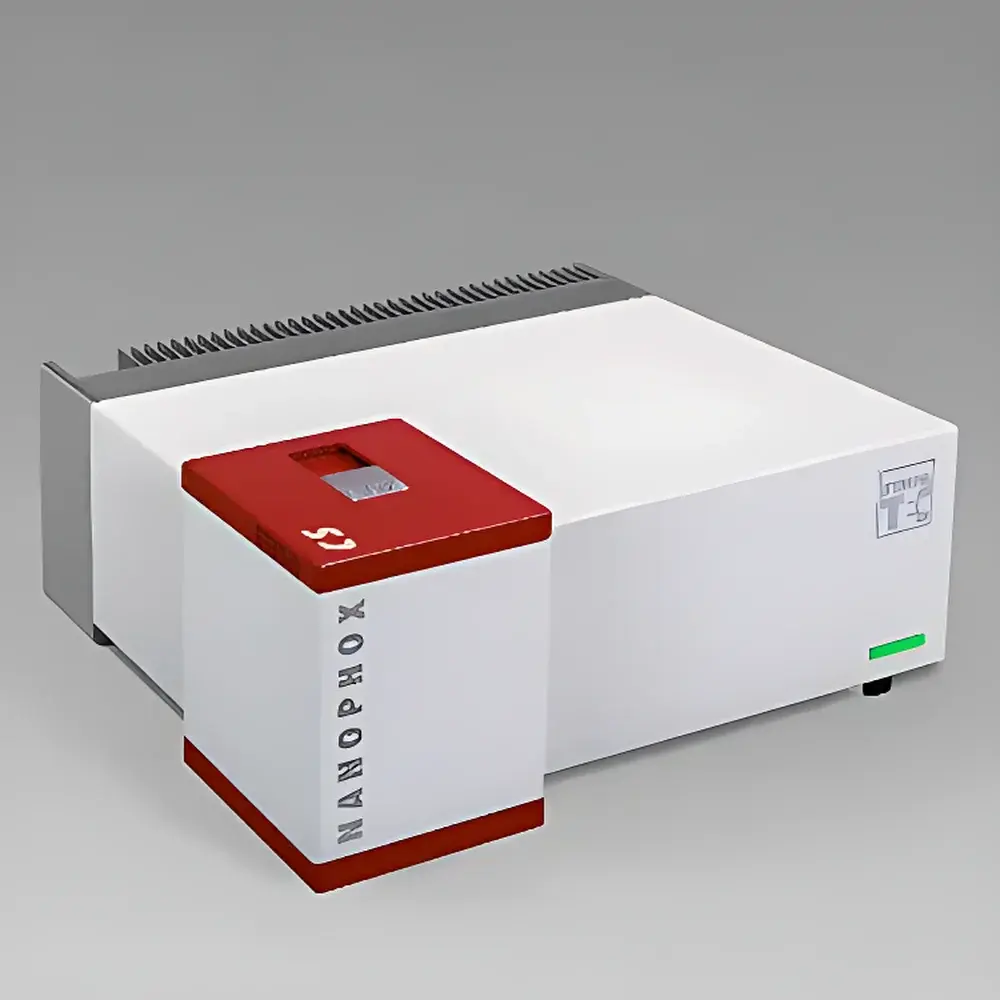
Sympatec NANOPHOX CS High-Concentration Nanoparticle Size Analyzer
| Brand | Sympatec |
|---|---|
| Origin | Germany |
| Manufacturer | Sympatec GmbH |
| Model | NANOPHOX CS |
| Particle Size Range | 0.5–10,000 nm |
| Repeatability | <2% |
| Temperature Control Range | 0–90 °C |
| Temperature Stability | ±0.1 °C |
| Measurement Principle | Polarization-Split Backscattering Photon Cross-Correlation Spectroscopy (PCCS) |
| Sample Concentration Range | 0.01–70 vol.% |
| Sample Volume | 50 µL–4 mL |
| Measurement Time | <1–3 min |
| Detection Method | PCCS & PCS dual-mode |
| Laser | 660 nm diode, Class 1, 30 mW (software-adjustable) |
| Correlator | Multi-channel, 30 ns minimum sampling time |
| Data Interface | TCP/IP |
Overview
The Sympatec NANOPHOX CS is a high-concentration nanoparticle size analyzer engineered for precise, label-free hydrodynamic diameter determination in undiluted or highly concentrated colloidal systems. Unlike conventional Dynamic Light Scattering (DLS) instruments relying solely on Photon Correlation Spectroscopy (PCS), the NANOPHOX CS implements Polarization-Split Backscattering Photon Cross-Correlation Spectroscopy (PCCS)—a patented dual-beam, dual-detector architecture that physically separates and isolates single-scattering events from multiply scattered photons. This fundamental optical design eliminates concentration-dependent bias inherent in standard DLS, enabling direct analysis of turbid, opaque, or highly loaded suspensions—such as protein aggregates, polymer dispersions, lipid nanoparticles, and industrial emulsions—without dilution-induced artifacts or stability perturbations.
Key Features
- True high-concentration capability: Validated measurement range from 0.01 vol.% up to 70 vol.% without sample dilution or centrifugation
- Dual-mode operation: Seamless switching between PCCS (for concentrated, scattering-dense systems) and conventional PCS (for dilute, low-viscosity samples) within a single instrument platform
- Polarization-split backscattering geometry: Maximizes signal-to-noise ratio while minimizing multiple scattering contributions through orthogonal polarization channel separation and spatial filtering
- Integrated Peltier temperature control: Precise thermal regulation from 0 °C to 90 °C with ±0.1 °C stability, programmable via software for kinetic studies and temperature ramping protocols
- Automated signal quality assessment: Real-time evaluation of correlation curve shape, baseline stability, and autocorrelation decay fidelity prior to data export
- Class 1 laser safety compliance: 660 nm diode laser (30 mW max, software-tunable) with fully enclosed beam path and interlocked housing per IEC 60825-1
- High-speed acquisition: Full correlation analysis completed in under 3 minutes, with minimum sampling interval of 30 ns and multi-channel digital correlator architecture
Sample Compatibility & Compliance
The NANOPHOX CS accommodates a broad spectrum of complex fluid matrices—including aqueous and non-aqueous suspensions, oil-in-water and water-in-oil emulsions, microemulsions, lyophilized reconstitutes, and fluorescent or chromophore-containing formulations—without requiring optical clearing or refractive index matching. Its robust optical design tolerates moderate absorbance and high turbidity. The system complies with ISO 22412:2017 (DLS-based particle sizing), ASTM E2490-21 (standard guide for nanoparticle size distribution measurements), and supports audit-trail-enabled workflows aligned with GLP and GMP environments. Data integrity is ensured via timestamped raw correlation files, user-accessible processing parameters, and full traceability of all instrumental settings—including laser power, temperature setpoint, and correlator configuration.
Software & Data Management
Control and analysis are performed using Sympatec’s WINDOX 6 software—a validated, Windows-based platform supporting FDA 21 CFR Part 11-compliant operation when configured with electronic signatures and role-based access control. WINDOX 6 provides real-time visualization of autocorrelation functions, automatic selection of fitting models (cumulant, CONTIN, NNLS), and export of intensity-, volume-, and number-weighted distributions. Batch processing, method templating, and automated report generation (PDF/CSV) streamline routine QC testing. Raw data files (.cor) are stored in open binary format for third-party reprocessing and long-term archival in accordance with ALCOA+ principles.
Applications
The NANOPHOX CS serves critical roles across pharmaceutical development (e.g., LNP characterization pre- and post-fill-finish, protein aggregation monitoring under stress conditions), food science (casein micelle sizing in raw milk, fat globule distribution in UHT-treated dairy), advanced materials (carbon black dispersion stability in battery slurries, quantum dot agglomeration kinetics), and cosmetics (polymer nanoparticle release profiles in emulsion bases). Its ability to quantify both mean hydrodynamic diameter and polydispersity index (PdI) independent of concentration enables reliable comparison across formulation variants and process steps—eliminating dilution-related variability that compromises batch-to-batch comparability.
FAQ
Can the NANOPHOX CS measure fluorescent or colored samples?
Yes—the 660 nm excitation wavelength minimizes interference from common fluorophores and visible dyes, and the polarization-split detection scheme suppresses background luminescence contributions.
Is calibration required before each measurement?
No—system alignment and optical calibration are factory-performed and stable over time; only routine verification using NIST-traceable polystyrene standards is recommended per ISO/IEC 17025 guidelines.
Does it support temperature-controlled kinetic studies?
Yes—the integrated Peltier stage allows programmable temperature ramps, isothermal holds, and real-time size monitoring during thermal stress tests.
How does PCCS differ fundamentally from traditional DLS?
PCCS uses two spatially separated, orthogonally polarized laser beams and cross-correlates their scattered intensities to isolate single-scattering events; conventional DLS measures autocorrelation of total scattered intensity, which becomes dominated by multiple scattering above ~0.1 vol.%.
Can data be exported for statistical process control (SPC)?
Yes—WINDOX 6 supports direct export of summary metrics (Z-average, PdI, intensity distribution moments) to CSV or database formats compatible with JMP, Minitab, and MES platforms.



