
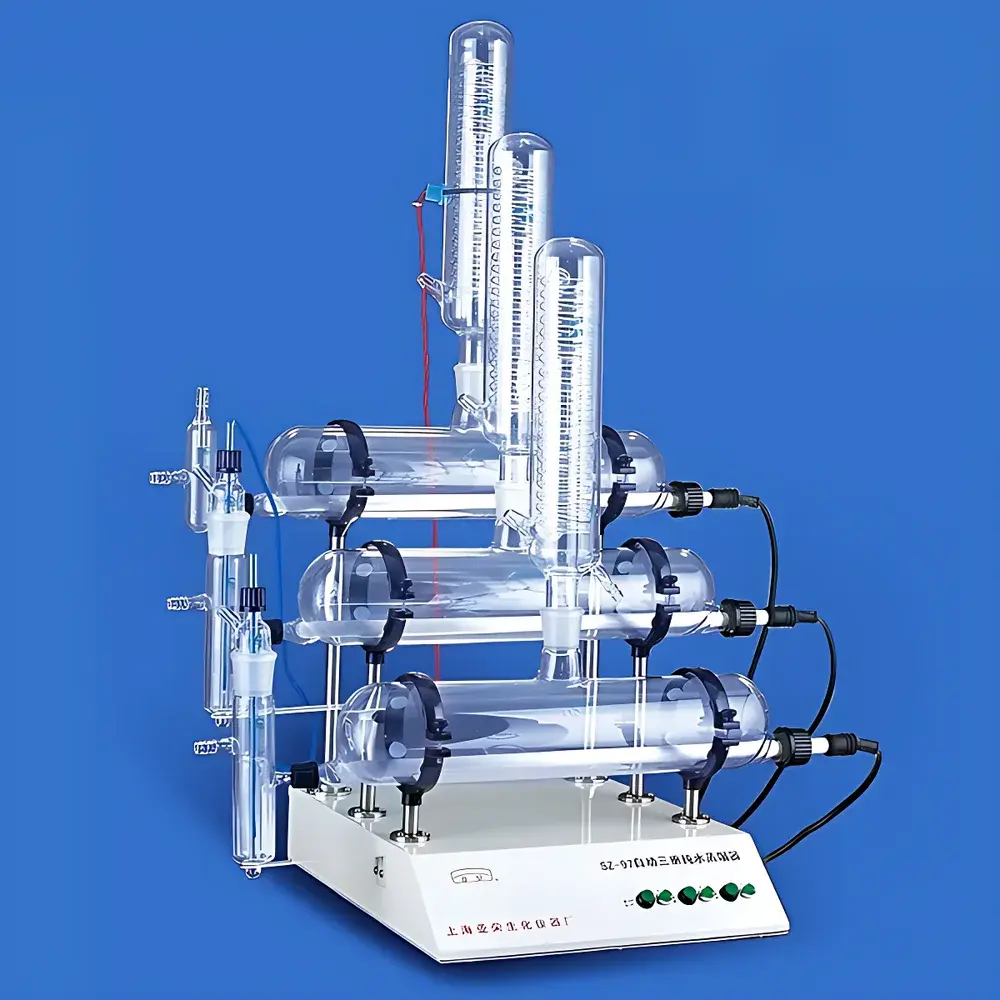
SZ-97 Automatic Triple-Pass Glass Distillation Apparatus by Yarong (Shanghai)
| Brand | Yarong |
|---|---|
| Origin | Shanghai, China |
| Manufacturer Type | Direct Manufacturer |
| Model | SZ-97 |
| Pricing | Available Upon Request |
Overview
The SZ-97 Automatic Triple-Pass Glass Distillation Apparatus is a benchtop laboratory water purification system engineered for consistent production of high-purity distilled water via sequential vaporization and condensation. Unlike single-stage distillers, the SZ-97 employs a three-stage thermal separation process—where raw feed water undergoes successive evaporation, condensation, and re-evaporation within an all-glass, borosilicate 3.3 construction path—to effectively remove non-volatile contaminants, trace metals, organic volatiles with higher boiling points, and ionic impurities. This triple-pass configuration significantly reduces carryover of entrained droplets and volatile organics compared to conventional single-pass units, yielding water meeting or exceeding ASTM D1193 Type II specifications for general laboratory use, including buffer preparation, media autoclaving, and instrumental rinse applications.
Key Features
- All-glass, seamless borosilicate 3.3 distillation pathway—chemically inert, low extractables, and resistant to thermal shock and alkaline corrosion.
- Automated operation with integrated temperature monitoring and overheat protection: digital thermostat controls primary heating element; secondary safety cutoff activates at preset upper limit to prevent dry-boiling.
- Triple-pass design implemented via gravity-fed cascading condensers—no external pumps or moving parts in the vapor path, minimizing maintenance and mechanical failure risk.
- Stainless steel outer housing with insulated chamber for energy efficiency and operator safety; front-access drain valve for easy residual water removal.
- Modular glassware assembly (evaporator flask, intermediate condenser, final condenser, collection vessel) enables visual process monitoring and simplified cleaning or replacement.
Sample Compatibility & Compliance
The SZ-97 accepts municipal tap water, deionized water, or pre-filtered groundwater as feedstock. It is not intended for seawater, highly turbid, or solvent-contaminated input. While the apparatus itself does not generate certified analytical-grade water (e.g., ASTM Type I), its output is routinely validated for Type II purity per ASTM D1193 and ISO 3696:1987 when operated under controlled feedwater conditions and maintained per manufacturer guidelines. The all-glass architecture complies with GLP requirements for trace-metal-free processing environments and supports audit-ready documentation when paired with lab-controlled logbooks (temperature records, run duration, batch volume). No electrical certifications (e.g., CE, UL) are embedded; users must verify local electrical safety compliance prior to installation.
Software & Data Management
The SZ-97 operates as a standalone analog-electromechanical system with no embedded microprocessor, firmware, or digital interface. Temperature regulation is achieved via bimetallic thermostat control; no software, data logging, or remote connectivity is provided. Process documentation—including start/stop time, observed boiling stability, condensate clarity, and daily yield—is manually recorded in laboratory notebooks or LIMS-integrated spreadsheets. For regulated environments requiring electronic audit trails (e.g., FDA 21 CFR Part 11), external calibrated temperature dataloggers and volume metering systems may be deployed in parallel to capture time-stamped operational metadata.
Applications
- Preparation of reagent-grade water for pH calibration standards, titrant dilution, and spectrophotometric blanking.
- Feed water for downstream purification stages—e.g., feeding reverse osmosis or ion exchange systems where low total oxidizable carbon (TOC) and silica content are critical.
- Steam generation for autoclaves and sterilizers where mineral scaling must be minimized.
- Production of rinse water for semiconductor wafer cleaning protocols requiring sub-ppb metal ion limits.
- Educational demonstrations of phase-change thermodynamics and separation efficiency in undergraduate chemistry and chemical engineering laboratories.
FAQ
What feed water quality is recommended for optimal performance?
Tap water with total dissolved solids (TDS) below 500 ppm and free chlorine concentration under 2 mg/L is preferred. Pre-filtration through activated carbon and sediment filters is strongly advised to extend glassware service life and reduce scaling.
Can the SZ-97 produce USP Purified Water or EP Water for Injection (WFI)?
No. The SZ-97 does not meet the microbial, endotoxin, or conductivity requirements defined in USP , Ph. Eur. 2.2.43, or FDA guidance for WFI. It is suitable only for non-sterile, non-pyrogenic Type II applications.
How often should the glass components be cleaned, and what cleaning agents are compatible?
Glassware should be rinsed immediately after each use and soaked weekly in warm 5% nitric acid (v/v), followed by thorough deionized water rinsing. Avoid hydrofluoric acid or strong alkalis that may etch borosilicate surfaces.
Is spare glassware available, and are replacements standardized?
Yes—Yarong supplies OEM-certified replacement flasks, condensers, and adapters under part numbers traceable to SZ-97 schematics. Dimensions conform to ISO 3585 for interchangeability with standard laboratory glassware.
Does the unit require cooling water, and what is the typical distillate flow rate?
Yes, it uses tap water for jacketed condenser cooling. Typical output ranges from 1.8–2.2 L/h depending on ambient inlet temperature, line pressure, and feedwater composition.



