
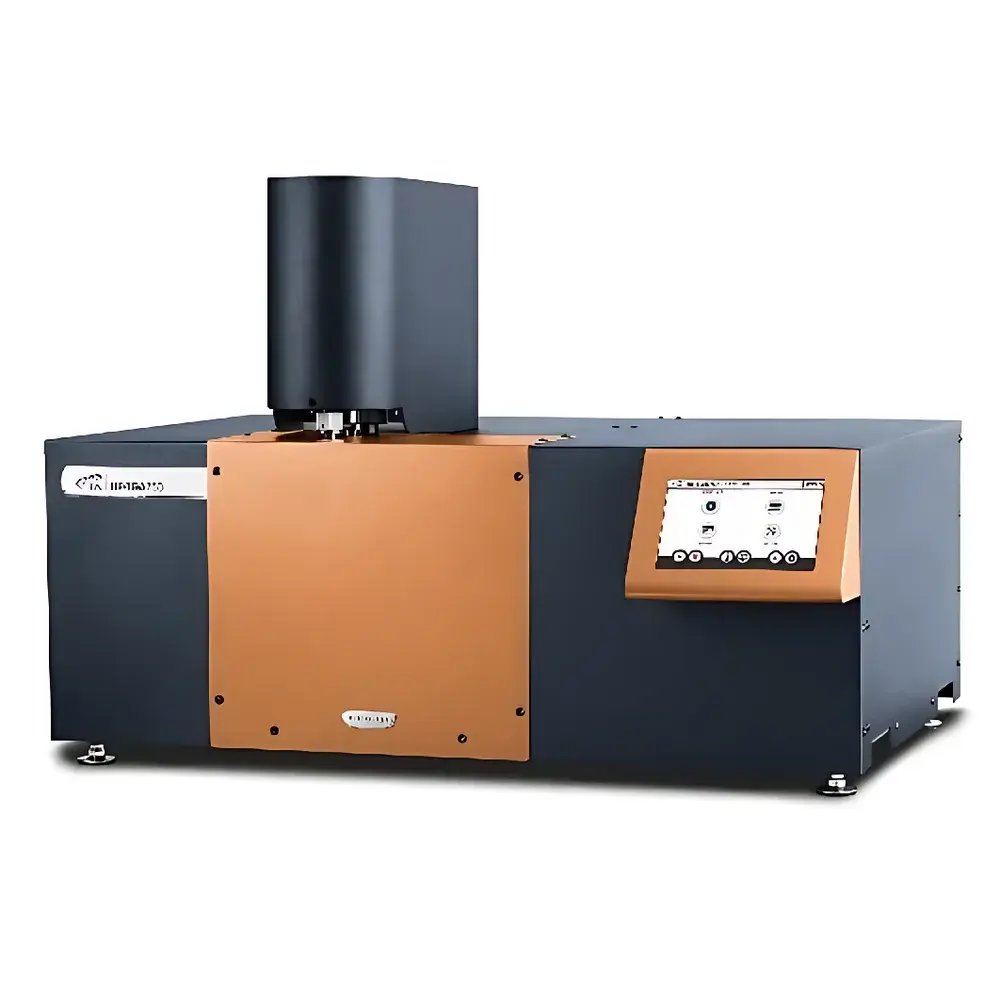
TA Instruments Discovery HP-TGA 75/750/7500 High-Pressure Thermogravimetric Analyzer
| Brand | TA Instruments |
|---|---|
| Origin | USA |
| Model | Discovery HP-TGA 75 / 750 / 7500 |
| Temperature Range | Up to 1100 °C |
| Balance Sensitivity | 0.1 µg |
| Operating Environment | Controlled High-Pressure Atmosphere (up to 75, 750, or 7500 psi) |
| Instrument Type | Benchtop Integrated High-Pressure TGA System |
| Compliance | Designed for GLP/GMP environments with audit-trail-capable software architecture |
Overview
The TA Instruments Discovery HP-TGA 75/750/7500 is a benchtop high-pressure thermogravimetric analyzer engineered for precision mass change measurement under rigorously controlled temperature and pressure conditions. Unlike conventional TGA systems operating at ambient or low-pressure inert atmospheres, this instrument integrates TA’s proprietary magnetic suspension balance technology—derived from Rubotherm’s proven design—to deliver exceptional stability and resolution in aggressive reactive environments. It operates on the fundamental principle of monitoring real-time sample mass variation as a function of temperature and pressure, enabling quantification of decomposition kinetics, oxidation behavior, volatilization profiles, and catalytic deactivation mechanisms under application-relevant process conditions. The system supports continuous operation from room temperature up to 1100 °C and pressures ranging from vacuum to 75 psi (HP-TGA 75), 750 psi (HP-TGA 750), or 7500 psi (HP-TGA 7500), making it suitable for simulating industrial thermal processing, subsurface geochemical reactions, high-pressure polymer degradation, and advanced catalytic conversion pathways.
Key Features
- Magnetic suspension microbalance with 0.1 µg resolution and long-term drift stability—eliminating mechanical contact and eliminating buoyancy correction errors inherent in conventional quartz spring or electromagnetic compensation balances.
- Fully integrated benchtop architecture with compact footprint (< 0.5 m²), modular gas delivery manifold, and pressure-rated furnace assembly rated for continuous operation at maximum specified pressure and temperature.
- Three standardized configurations (75/750/7500) optimized for distinct application tiers—from laboratory-scale catalyst screening to ultra-high-pressure hydrothermal stability testing of drilling fluids or nuclear fuel cladding materials.
- Hermetically sealed reaction chamber compatible with reactive gases (e.g., H₂, CO, CH₄, H₂O vapor, O₂, NH₃, H₂S) and corrosive media, supported by chemically resistant internal components (Inconel 718, sapphire viewports, Hastelloy C-276 fittings).
- Real-time pressure regulation via digital mass flow controllers and back-pressure regulators with ±0.1 % setpoint accuracy; integrated temperature-pressure interlock logic ensures safe thermal ramping under pressurized conditions.
Sample Compatibility & Compliance
The Discovery HP-TGA accommodates solid powders, granules, monolithic ceramics, thin films, and viscous liquids—including engine oils, molten salts, and polymer melts—within standard alumina, platinum, or tungsten crucibles (up to 250 mg capacity). Sample containment is validated per ASTM E1131 and ISO 11358 for quantitative TGA analysis. The system architecture supports compliance with FDA 21 CFR Part 11 requirements through optional secure user authentication, electronic signatures, and immutable audit trails within TRIOS software. Data integrity aligns with GLP and GMP documentation standards, including full metadata capture (pressure transducer calibration certificates, thermocouple traceability, balance verification logs). All pressure vessels conform to ASME BPVC Section VIII Division 1 certification protocols.
Software & Data Management
TRIOS Enterprise Software provides unified control of temperature ramping, pressure profiling, gas switching sequences, and real-time data acquisition at up to 10 Hz sampling rate. Synchronized output channels support concurrent interfacing with external analytical detectors—including quadrupole mass spectrometers (QMS), Fourier-transform infrared (FTIR) spectrometers, and gas chromatographs—for evolved gas analysis (EGA). Advanced kinetic modeling modules (e.g., Friedman, Ozawa-Flynn-Wall, ASTM E698) are embedded for activation energy determination directly from multi-heating-rate HP-TGA datasets. Raw data files (.tad) are stored in vendor-neutral HDF5 format with embedded metadata schema compliant with ISA-Tab and FAIR data principles. Export options include ASTM E1970-compliant CSV, PDF reports with digital signatures, and direct LIMS integration via OPC UA.
Applications
- Catalyst lifetime assessment under simulated reforming, hydrodesulfurization (HDS), or Fischer–Tropsch conditions—tracking coke formation, metal sintering, or sulfur poisoning via in situ mass loss and effluent gas composition.
- Thermal stability evaluation of aerospace-grade polymers and composites exposed to high-pressure steam or hypergolic propellants at elevated temperatures.
- Decomposition thermodynamics of metal-organic frameworks (MOFs) and battery electrode materials under controlled CO₂ or H₂ atmospheres relevant to carbon capture and hydrogen storage.
- Pyrolysis and gasification optimization of waste plastics and biomass feedstocks—determining optimal residence time, pressure-dependent char yield, and syngas composition shifts.
- Corrosion kinetics of pipeline steels and downhole alloys in supercritical CO₂/H₂S/H₂O mixtures mimicking deep-well environments.
FAQ
What pressure ranges are supported across the three HP-TGA models?
The Discovery HP-TGA 75 supports up to 75 psi, the HP-TGA 750 up to 750 psi, and the HP-TGA 7500 up to 7500 psi—each with dedicated pressure vessel design, safety interlocks, and transducer calibration.
Is the magnetic suspension balance recalibrated automatically during thermal ramps?
No—calibration is performed pre-run using certified reference masses; however, the system continuously monitors suspension current and compensates for thermal drift in real time without mechanical intervention.
Can the instrument operate under dynamic pressure modulation during a single experiment?
Yes—TRIOS software enables programmable pressure ramps synchronized with temperature profiles, allowing isothermal pressure sweeps or pressure-triggered hold steps.
Which regulatory standards does the system meet for pharmaceutical thermal analysis?
While not a dedicated USP instrument, its hardware and software architecture satisfy critical elements of ICH Q5C, Q1A(R2), and ASTM E2550 for stability-indicating thermal methods when deployed in validated workflows.
How is gas purity maintained during high-pressure reactive experiments?
All gas lines incorporate dual-stage filtration (particulate + moisture + hydrocarbon), inline oxygen analyzers (<10 ppb detection), and automated purge cycles prior to pressurization to ensure baseline integrity.



