
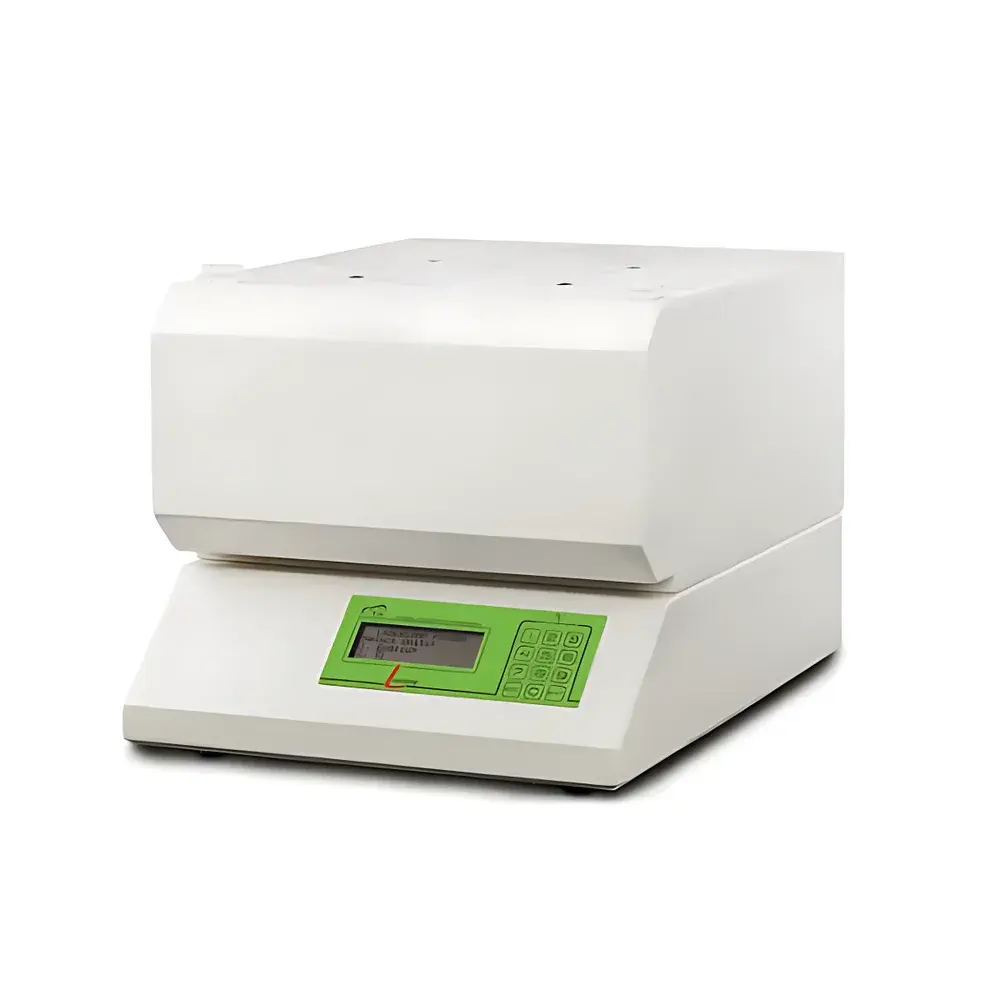
TA Instruments FOX 200 HT Thermal Conductivity Analyzer
| Brand | TA Instruments |
|---|---|
| Origin | USA |
| Model | FOX 200 HT |
| Measurement Principle | Heat Flow Meter (HFM) Method |
| Thermal Conductivity Range | 0.005–0.35 W/m·K |
| Repeatability | ±0.5% |
| Accuracy | ±1% |
| Temperature Range | −20 to 250 °C |
| Minimum Sample Thickness | 0.025 mm |
Overview
The TA Instruments FOX 200 HT Thermal Conductivity Analyzer is a precision-engineered heat flow meter (HFM) system designed for reliable, standardized measurement of thermal conductivity and thermal resistance in low-to-moderate conductivity solid materials. Based on the guarded hot plate principle adapted for rapid, high-throughput operation, the FOX 200 HT applies a steady-state temperature gradient across a sample sandwiched between two parallel plates — a heated upper platen and a temperature-controlled lower platen. Thermal flux is quantified using dual proprietary thin-film heat flux sensors embedded beneath the platens, enabling direct, real-time measurement of heat transfer rate without calibration drift. The instrument maintains rigorous thermal equilibrium via solid-state thermoelectric (Peltier) modules, delivering precise, programmable temperature control from −20 °C to 250 °C — a critical capability for evaluating temperature-dependent thermal behavior in insulating polymers, aerogels, foams, composites, and thin-film laminates.
Key Features
- Dual thin-film heat flux sensors with traceable calibration and long-term stability, eliminating reliance on reference standards during routine operation
- Integrated digital thickness measurement system with resolution down to 0.025 mm, automatically compensating for thermal contact resistance and ensuring accurate cross-sectional area calculation
- Thermoelectric (Peltier) heating and cooling architecture enables rapid thermal equilibration, reduced power consumption, and zero refrigerant usage — supporting both sub-ambient and elevated temperature testing
- Standalone mode with intuitive touchscreen interface for immediate measurements; optional PC-based control via WinTherm software for advanced method development and data archiving
- Modular design compatible with automated sample handling accessories, including robotic auto-samplers for unattended batch testing in QC laboratories
- Compliance-ready firmware with configurable audit trails, electronic signatures, and user-access levels aligned with FDA 21 CFR Part 11 and GLP/GMP documentation requirements
Sample Compatibility & Compliance
The FOX 200 HT is optimized for rigid, semi-rigid, and flexible low-conductivity solids with thicknesses ranging from 0.025 mm to 50 mm and lateral dimensions up to 300 × 300 mm. It routinely characterizes polymeric foams (PU, EPS, XPS), vacuum insulation panels (VIPs), fiber-based insulations, elastomeric sheets, and thin composite laminates used in aerospace, building science, and battery thermal management applications. All measurements adhere strictly to ASTM C518 “Standard Test Method for Steady-State Thermal Transmission Properties by Means of the Heat Flow Meter Apparatus” and ISO 8301 “Thermal Insulation — Determination of Steady-State Thermal Resistance and Related Properties — Heat Flow Meter Apparatus.” Instrument validation protocols include NIST-traceable reference material verification (e.g., SRM 1450c Fibrous Glass Board) and interlaboratory round-robin performance assessment per ISO/IEC 17025 guidelines.
Software & Data Management
WinTherm software serves as the central platform for method configuration, real-time monitoring, statistical analysis, and regulatory reporting. It supports customizable test sequences with multi-point temperature ramping, automatic pass/fail evaluation against specification limits, and export of raw sensor outputs, derived thermal conductivity values, and uncertainty budgets in CSV, PDF, and XML formats. Data integrity safeguards include time-stamped audit logs, role-based permissions, and encrypted database storage. For enterprise integration, WinTherm offers OPC UA connectivity and RESTful API endpoints to feed thermal property data directly into LIMS, MES, or PLM systems — facilitating closed-loop quality control and accelerated materials qualification workflows.
Applications
- Quality assurance of thermal insulation materials in construction and HVAC manufacturing
- R&D screening of next-generation battery pack thermal interface materials (TIMs) and phase change composites
- Temperature-dependent λ(T) characterization for automotive under-hood components and EV battery enclosures
- Validation of fire-retardant foam formulations per UL 94 and EN 13501-1 thermal performance criteria
- Comparative analysis of aerogel vs. fiberglass insulation efficacy across climatic zones
- Supporting ISO 527-2 and ASTM D638 mechanical-thermal correlation studies in polymer laboratories
FAQ
What standards does the FOX 200 HT comply with for thermal conductivity testing?
ASTM C518, ISO 8301, and ISO 10456 for hygrothermal property correlation. Optional validation packages support ASTM E1530 for comparative tracking of thermal resistance.
Can the instrument measure anisotropic materials such as layered composites?
Yes — directional thermal conductivity can be assessed by orienting samples to isolate in-plane versus through-thickness heat flow, provided layer alignment is controlled and interfacial contact resistance is minimized via standardized surface preparation.
Is thickness measurement fully automated and integrated into the thermal calculation?
Yes — the digital micrometer subsystem acquires thickness at multiple points pre-test and dynamically updates the thermal resistance equation in real time, eliminating manual entry errors and improving repeatability.
Does the system support GxP-regulated environments?
WinTherm software includes 21 CFR Part 11 compliance features: electronic signatures, audit trail review tools, and secure user authentication — validated for use in pharmaceutical packaging thermal barrier qualification and medical device insulation testing.
What maintenance is required for long-term sensor stability?
No routine recalibration is needed; the thin-film sensors are drift-compensated via dual-sensor differential architecture. Annual verification using NIST-traceable reference materials is recommended for ISO/IEC 17025 accreditation.



