
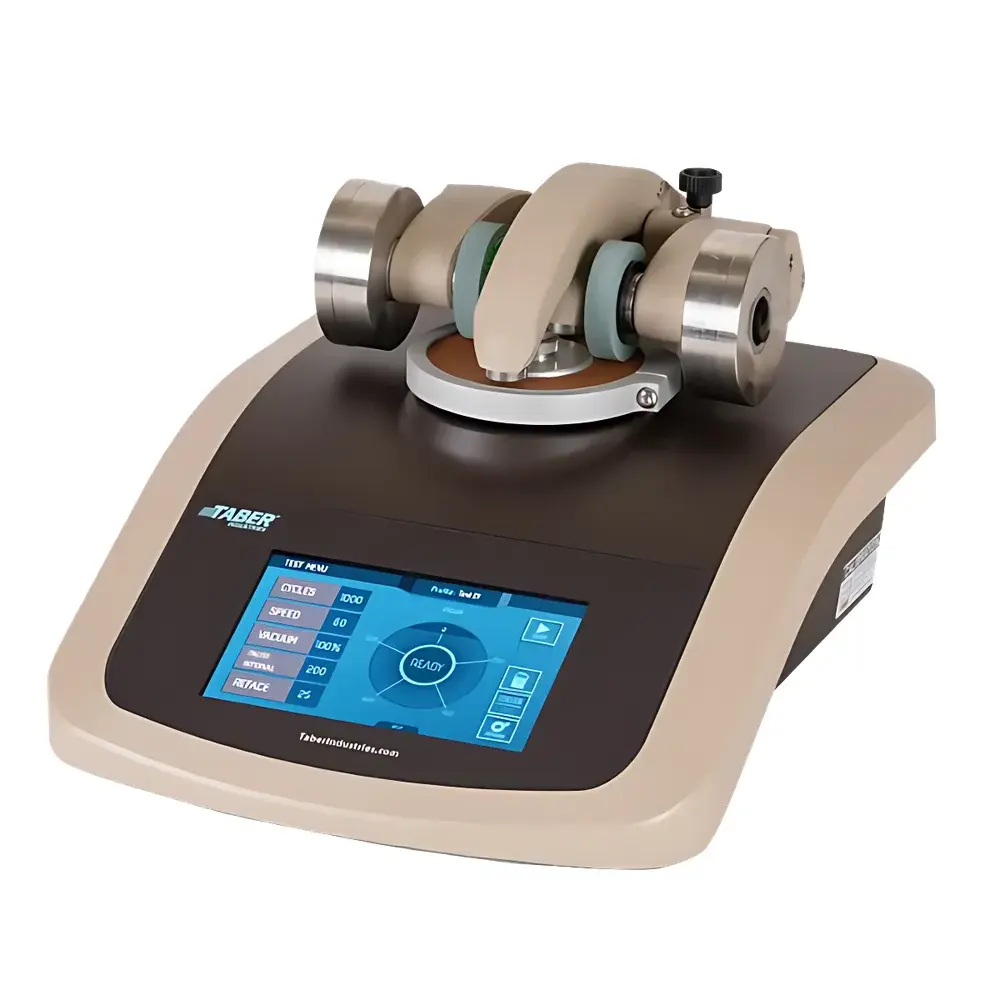
Taber Abrasion and Wear Resistance Tester M270
| Brand | SDL Atlas |
|---|---|
| Origin | USA |
| Manufacturer Type | Original Equipment Manufacturer (OEM) |
| Import Status | Imported |
| Model | M270 |
| Pricing | Available Upon Request |
Overview
The Taber Abrasion and Wear Resistance Tester M270 is an engineered precision instrument designed for quantitative evaluation of surface durability, abrasion resistance, and wear behavior of flexible sheet materials—including textiles, nonwovens, leather, coated fabrics, laminates, and synthetic membranes. Based on the standardized Taber rotary abrader principle—where two abrasive wheels rotate in opposite directions under controlled load while traversing concentric circular paths on a rotating test specimen—the M270 delivers reproducible, ASTM-compliant wear data essential for R&D validation, quality assurance, and specification compliance in textile manufacturing and technical fabric development.
Key Features
- Dual-head configuration with two independent sample turntables, enabling simultaneous testing of two specimens—either identical (for statistical replication) or dissimilar (for comparative wear analysis).
- Individual functional control keys for each turntable, allowing fully decoupled operation: start/stop, cycle count reset, and load application can be managed separately without cross-interference.
- Robust mechanical architecture with precision-machined aluminum housing, calibrated weight-loading system (standard 500 g, 1000 g, or custom loads per ASTM D3884/D4060), and interchangeable abrasive wheels (e.g., CS-10, CS-17, S-32, H-18) to match material hardness and test severity.
- Integrated digital counter with programmable cycle range (1–999,999 cycles) and automatic shutdown upon completion; real-time cycle display ensures traceability and repeatability across operator shifts.
- Compliance-ready design: meets mechanical and operational requirements of ISO 5470-1, ASTM D3884 (textiles), ASTM D4060 (plastics), TAPPI T476, and GB/T 21196.4—supporting audit trails required under GLP and internal QA protocols.
Sample Compatibility & Compliance
The M270 accommodates flat, flexible specimens up to 102 mm (4 in) in diameter and ≤6 mm in thickness, including woven and knitted fabrics, denim, upholstery textiles, geotextiles, medical barrier fabrics, and composite laminates. Specimen clamping employs a spring-loaded, center-aligned chuck system ensuring uniform radial tension and minimal slippage during extended wear cycles. All test parameters—including wheel type, applied load, rotation speed (typically 60 rpm ±5 rpm), and cycle count—are documented per test run to satisfy ISO/IEC 17025 documentation standards. The instrument supports method validation per AATCC TM117, ISO 12947-2, and customer-specific internal specifications.
Software & Data Management
While the M270 operates as a standalone electromechanical tester without embedded software, its analog/digital interface architecture allows seamless integration with external data acquisition systems via RS-232 or optional USB-to-serial adapters. Users may log cycle counts, elapsed time, and manual visual assessments (e.g., pilling grade, mass loss, color change ΔE) into LIMS or Excel-based QA databases. For laboratories requiring electronic records compliant with FDA 21 CFR Part 11, the M270 can be paired with validated third-party software platforms that provide user access control, audit trail generation, and electronic signature capability—ensuring full traceability from test initiation to final report.
Applications
- Quantifying pilling resistance of apparel and home textile fabrics under simulated garment wear conditions.
- Evaluating abrasion performance of technical textiles used in automotive interiors, protective clothing, and military gear.
- Validating durability claims for coated or laminated fabrics subjected to repeated flexing and rubbing (e.g., outdoor gear, inflatable structures).
- Supporting material selection during R&D by ranking candidate substrates based on mass loss, tensile strength retention, or surface morphology changes post-abrasion.
- Performing routine QC checks against ASTM D3884 pass/fail thresholds to ensure batch-to-batch consistency in high-volume production environments.
FAQ
What standards does the M270 comply with for textile abrasion testing?
ASTM D3884, ISO 12947-2, AATCC TM117, and ISO 5470-1 are the primary referenced standards; method adaptation for other materials (e.g., plastics per ASTM D4060) is supported via wheel and load selection.
Can the M270 test non-circular specimens?
No—the instrument requires circular specimens (diameter 102 mm) for proper centering and rotational symmetry; non-standard shapes must be cut to specification prior to mounting.
Is calibration certification included with shipment?
SDL Atlas provides factory calibration documentation with each unit; annual recalibration using NIST-traceable reference weights and cycle verification tools is recommended per ISO/IEC 17025 guidelines.
How is wear quantified after testing?
Quantitative metrics include mass loss (via analytical balance), visual rating per ASTM D3512 or ISO 12947-3, and optional surface profilometry or SEM imaging for microstructural analysis.
Does the M270 support automated data export?
Not natively—but with optional serial interface hardware and compatible third-party software, cycle data and timestamps can be exported to CSV or database formats for automated reporting workflows.






