
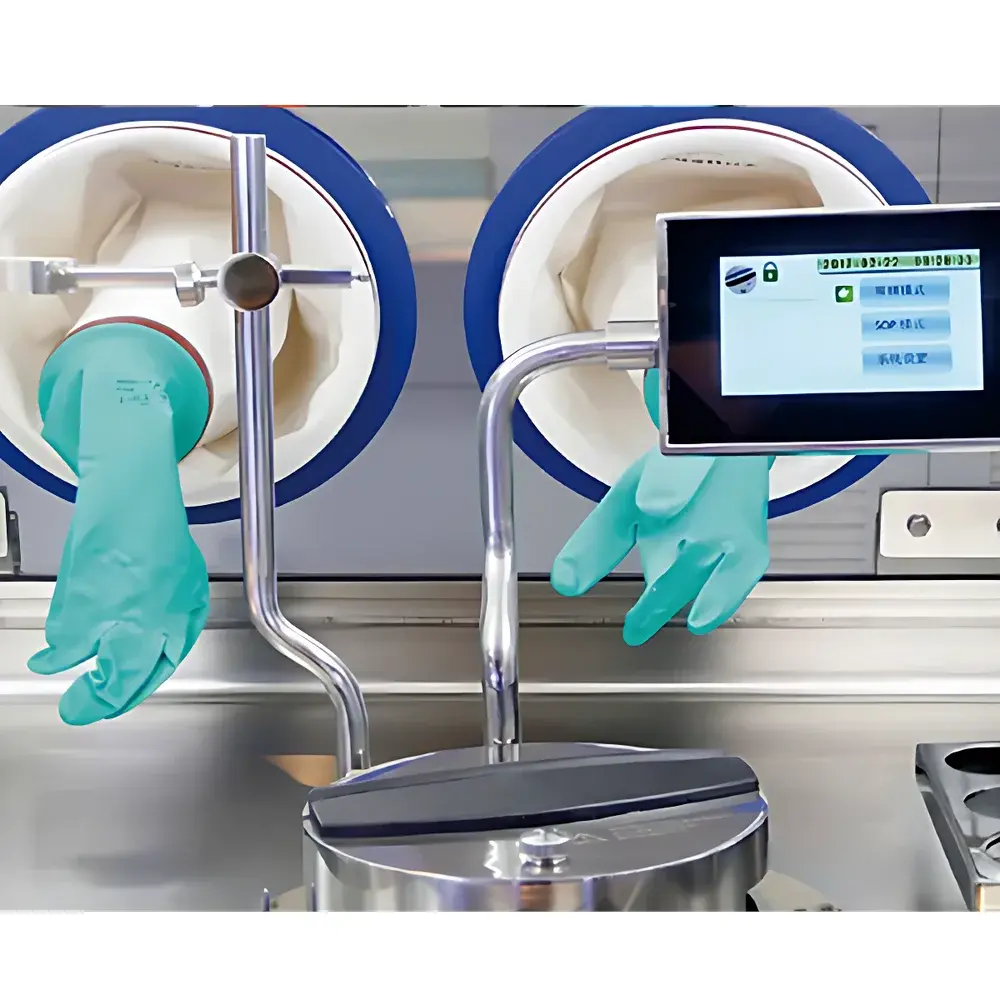
Tailin HTY-ASL01/02 ISO Integrated Microbial Collection System
| Brand | Tailin |
|---|---|
| Origin | Zhejiang, China |
| Manufacturer Type | Manufacturer |
| Product Category | Domestic |
| Model | HTY-ASL01/02 ISO |
| Power Supply | 95–260 VAC, 50–60 Hz |
| Rated Power | 120 W |
| Rotational Speed Range | 1–300 rpm |
| Weight | 19 kg |
| Suspension Assembly Height | 33 cm |
| Dimensions (W × D × H) | 22.5 × 40.0 × 1.2 cm |
| Timer Range | 1–999 s |
| SOP Storage Capacity | 300 protocols |
| Display | 4.3-inch color LCD touchscreen |
| Pressure Modes | Alarm Mode / Auto-Regulation Mode / Off Mode |
| Protection Features | Overcurrent, Overvoltage, Overload, and Stall Detection |
| Tubing Installation | Linear, Tool-Free |
| Clamp Mechanism | Motorized Automatic Clamp |
| Flow Control | Digital Pulse Rotary Knob with Speed Memory |
| Housing | Tempered Glass Touch Panel |
| Pump Head Safety Cover | Interlocked Physical Shield |
Overview
The Tailin HTY-ASL01/02 ISO Integrated Microbial Collection System is an engineered solution for membrane filtration-based sterility testing in pharmaceutical, biotechnology, and contract manufacturing organizations (CMOs). It operates on the principle of vacuum-assisted, positive-pressure-driven filtration through sterile 0.22 µm or 0.45 µm membrane filters—fully compliant with USP , Ph. Eur. 2.6.1, and ISO 11737-1 requirements. Unlike conventional peristaltic filtration units, this system integrates real-time pressure monitoring, closed-loop motor control, and deterministic SOP execution to eliminate operator-dependent variability in critical process parameters such as flow rate, vacuum level, and filtration duration. Designed for Class A/B cleanroom integration and GMP-aligned workflows, the HTY-ASL02 variant includes enhanced electromagnetic compatibility (EMC) shielding and extended audit trail logging to support FDA 21 CFR Part 11 compliance when paired with validated software.
Key Features
- Two operational modes: Standard mode for manual parameter entry and SOP mode for protocol-driven execution—ensuring method consistency across shifts and personnel.
- Digital pulse rotary knob with non-volatile speed memory: retains last-used rpm setting after power cycle, reducing setup time between consecutive tests.
- Linear tubing installation path with zero-torque alignment guides—minimizes tube deformation and ensures repeatable peristaltic compression across all pump head positions.
- Motorized automatic clamp actuation synchronized with pump start/stop cycles—eliminates manual clamping errors and guarantees immediate flow cessation during emergency stops.
- Four-layer electronic protection architecture: real-time monitoring of current draw, supply voltage, load torque, and rotor stall conditions—prevents pump head damage and filter rupture under high-viscosity or particulate-laden samples.
- Triple pressure management logic: configurable alarm thresholds, dynamic backpressure compensation, or full pressure bypass—adaptable to diverse media including oily suspensions, viscous ophthalmic solutions, and low-surface-tension biologics.
Sample Compatibility & Compliance
The HTY-ASL01/02 ISO supports filtration of aqueous, alcoholic, and moderately organic solvent-based preparations—including antibiotics, monoclonal antibodies, lyophilized reconstitutes, and radiopharmaceuticals—provided compatibility with standard PVDF, nylon, or mixed cellulose ester membranes. Its sealed pump housing meets IP54 ingress protection standards for controlled environment use. All firmware logic paths are traceable via timestamped event logs (including parameter changes, mode transitions, and fault codes), satisfying GLP documentation requirements per OECD Series on Principles of Good Laboratory Practice. The system’s mechanical design conforms to ISO 13485:2016 Annex C for medical device-associated instrumentation and supports validation protocols aligned with ASTM E2924-21 (Standard Guide for Validation of Sterility Test Methods).
Software & Data Management
When connected via USB-C or RS-232 interface to a validated PC host running Tailin’s ASL-Control Suite v3.2+, the instrument enables centralized SOP deployment, remote parameter locking, and export of CSV-formatted test records containing filter lot IDs, operator credentials, environmental sensor readings (if integrated), and raw pressure/time curves. Audit trails include user ID, action timestamp, pre-change and post-change values, and digital signature fields—meeting 21 CFR Part 11 Subpart C §11.10(a) and §11.300(b) for electronic records and signatures. No cloud connectivity is embedded; data residency remains fully on-premise unless explicitly configured by the end-user.
Applications
- Routine sterility testing of final drug products (injectables, ophthalmics, inhalation suspensions) per USP .
- Environmental monitoring filter processing in isolator and RABS systems.
- Media fill simulation validation studies requiring precise volumetric throughput control.
- Method transfer between QC labs using identical SOP binaries—ensuring inter-site result comparability.
- Training environments where SOP-guided operation reduces learning curve for new analysts without compromising regulatory readiness.
FAQ
Does the HTY-ASL02 support 21 CFR Part 11-compliant electronic signatures?
Yes—when used with ASL-Control Suite v3.2+ and configured with role-based access controls, digital certificate authentication, and immutable audit trails.
Can SOPs be edited directly on the instrument’s touchscreen?
No—SOPs must be authored and digitally signed on the host PC, then transferred via encrypted USB or serial link. The device only executes read-only copies.
Is the pump head autoclavable?
No—the pump head assembly is not designed for steam sterilization. Sterility is maintained via disposable, gamma-irradiated tubing sets and membrane cassettes.
What is the maximum allowable inlet pressure during filtration?
The system is rated for continuous operation at ≤0.3 bar gauge pressure; transient spikes up to 0.5 bar are tolerated for ≤5 seconds without triggering protective shutdown.
How frequently does the pressure sensor require calibration verification?
Per ISO/IEC 17025:2017 Clause 7.7.1, annual verification against NIST-traceable deadweight testers is recommended—documentation templates included in the IQ/OQ package.






