
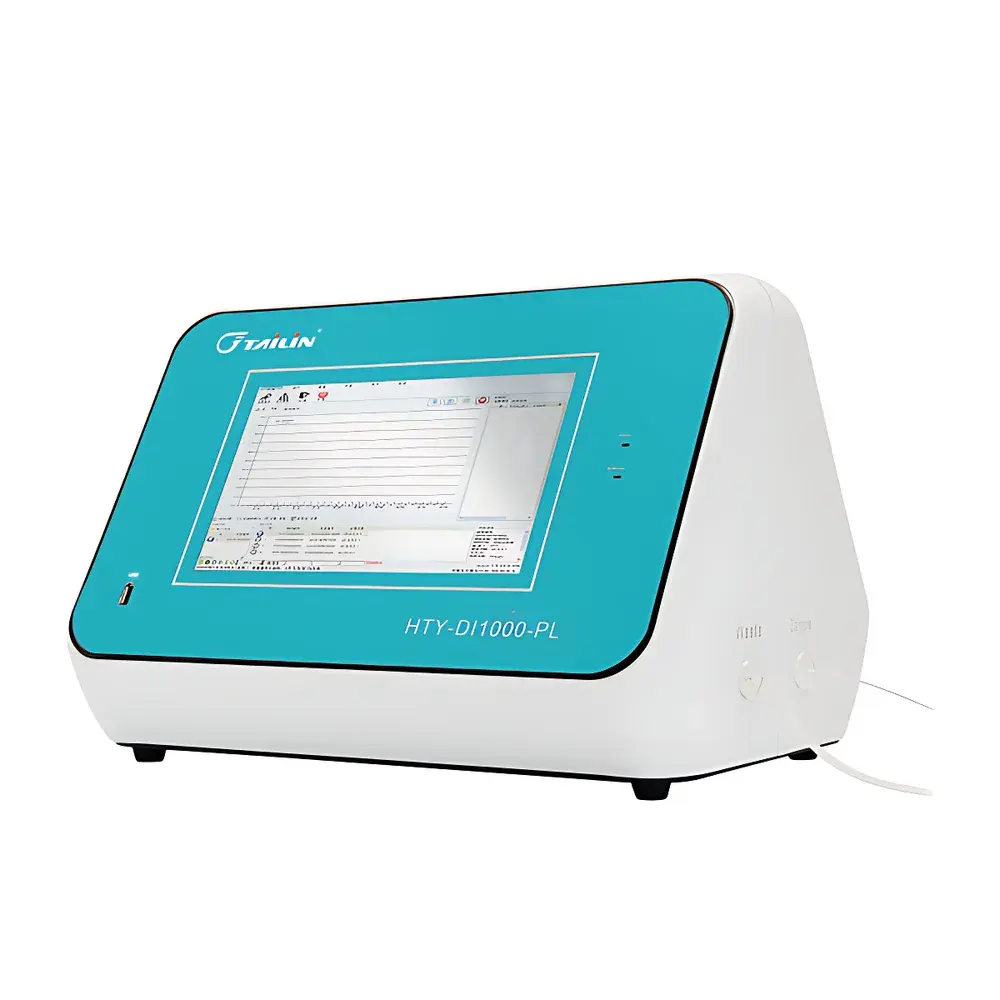
Tailin HTY-DI1000-PL Total Organic Carbon Analyzer
| Brand | Tailin |
|---|---|
| Origin | Zhejiang, China |
| Manufacturer Type | OEM Manufacturer |
| Instrument Type | Laboratory TOC Analyzer |
| Detection Principle | Direct Conductivity Detection |
| Oxidation Method | UV Photocatalytic Oxidation |
| Detection Range | 0.000–1000.0 µg/L |
| Repeatability | ≤2% (per JB/T 20178–2017) |
| Accuracy | ±5% (per JJG (Zhejiang) 98–2007) |
| Recommended Sample Conductivity | 0–5.1 µS/cm @ 25 °C |
| Analysis Time | 4 min |
| Sample Flow Rate | 0.5 mL/min |
| Dimensions | 400 × 300 × 300 mm |
| User Interface | Full-touchscreen LCD |
| Security | Multi-level password access control |
| Alarm Function | Audible alert upon exceeding user-defined TOC upper limit |
| Optional Accessory | Modular autosampler compatibility |
Overview
The Tailin HTY-DI1000-PL Total Organic Carbon Analyzer is a compact, laboratory-grade instrument engineered for precise quantification of organic carbon content in ultrapure water, pharmaceutical process water, and environmental aqueous samples. It operates on the principle of direct conductivity detection following complete oxidation of organic compounds to carbon dioxide. Unlike combustion-based TOC analyzers, the HTY-DI1000-PL employs low-pressure ultraviolet (UV) light at 185/254 nm to generate hydroxyl radicals that mineralize non-purgeable organic carbon (NPOC) into CO2. The resulting CO2 dissolves in deionized water, forming carbonic acid and inducing a measurable increase in solution conductivity—proportional to the original TOC concentration. This method eliminates dependence on catalysts, carrier gases, or high-temperature furnaces, reducing maintenance complexity and operational cost while maintaining compliance with pharmacopeial requirements for water quality verification.
Key Features
- UV photocatalytic oxidation system with dual-wavelength lamps (185 nm for radical generation and 254 nm for supplemental oxidation), ensuring >95% oxidation efficiency across diverse organic matrices without chemical reagents or gas supply.
- Integrated high-resolution conductivity cell with temperature compensation (±0.1 °C), calibrated against NIST-traceable KCl standards, enabling stable baseline performance under variable ambient conditions.
- Full-color capacitive touchscreen interface supporting intuitive navigation, real-time chromatogram visualization, and context-sensitive help overlays—designed for rapid method execution by QC technicians with minimal training.
- Role-based multi-tiered user authentication (administrator, operator, reviewer) aligned with FDA 21 CFR Part 11 and EU Annex 11 expectations for electronic record integrity and audit trail accountability.
- Configurable alarm logic with audible notification and automatic instrument hold upon exceeding pre-set TOC thresholds—preventing data corruption and protecting downstream instrumentation from contamination events.
- Modular architecture supporting seamless integration with optional autosamplers (HTY-AS series), including 40-, 60-, and 120-position configurations compliant with ISO 17025 sample handling workflows.
Sample Compatibility & Compliance
The HTY-DI1000-PL is validated for analysis of Type I–III purified water per USP General Chapter <643>, EP 2.2.44, and JP 2.05, as well as surface water, groundwater, and wastewater effluents within specified conductivity limits (0–5.1 µS/cm at 25 °C). Its oxidation efficiency has been verified using sucrose and 1,4-benzoquinone challenge solutions per ASTM D5907–22. Instrument performance meets the repeatability criterion (≤2% RSD, n=6) and accuracy specification (±5% bias vs. certified reference materials) defined in JB/T 20178–2017 and JJG (Zhejiang) 98–2007. All firmware and calibration logs are timestamped and digitally signed to support GLP/GMP audits and regulatory submissions.
Software & Data Management
Built-in Tailin TOC Control Suite v3.2 provides full lifecycle data management—from method creation and sequence definition to raw signal export (CSV, PDF, XML) and electronic signature capture. Audit trails record all user actions—including parameter edits, calibration events, and report approvals—with immutable timestamps and operator IDs. Data encryption (AES-256) and role-restricted database access ensure confidentiality in shared-lab environments. Exported datasets comply with LIMS interoperability standards (ASTM E1467–02) and include metadata fields required for ISO/IEC 17025 accreditation reporting.
Applications
- Pharmaceutical water system validation (PW, WFI, Pure Steam condensate)
- Biotechnology process water monitoring during upstream/downstream operations
- Environmental compliance testing for EPA Method 415.3 and ISO 8245
- Electronics-grade ultrapure water (UPW) qualification in semiconductor fabs
- Academic research on carbon cycling in aquatic ecosystems
- Regulatory release testing per USP <643>, EP 2.2.44, and Chinese Pharmacopoeia ChP 0861
FAQ
Does the HTY-DI1000-PL require external gas supply or catalyst replacement?
No. The UV photocatalytic oxidation module operates without ozone generators, platinum catalysts, or compressed air/nitrogen lines—reducing consumables and footprint.
Can the instrument be integrated into an existing LIMS or MES platform?
Yes. Native support for ASTM E1467-compliant data export and optional OPC UA server module enables bidirectional communication with major laboratory informatics systems.
Is the conductivity cell field-serviceable?
The cell is designed for user-level cleaning and recalibration using included standards; full replacement requires factory-certified service due to precision electrode alignment requirements.
What documentation is provided for regulatory submissions?
Instrument qualification packages include IQ/OQ protocols, traceable calibration certificates, software validation summary (SVS), and 21 CFR Part 11 readiness assessment report.
How frequently must the UV lamp be replaced?
Lamp lifetime is rated at ≥10,000 hours; the system monitors cumulative exposure and triggers maintenance alerts at 9,000-hour intervals.
Related Products







