
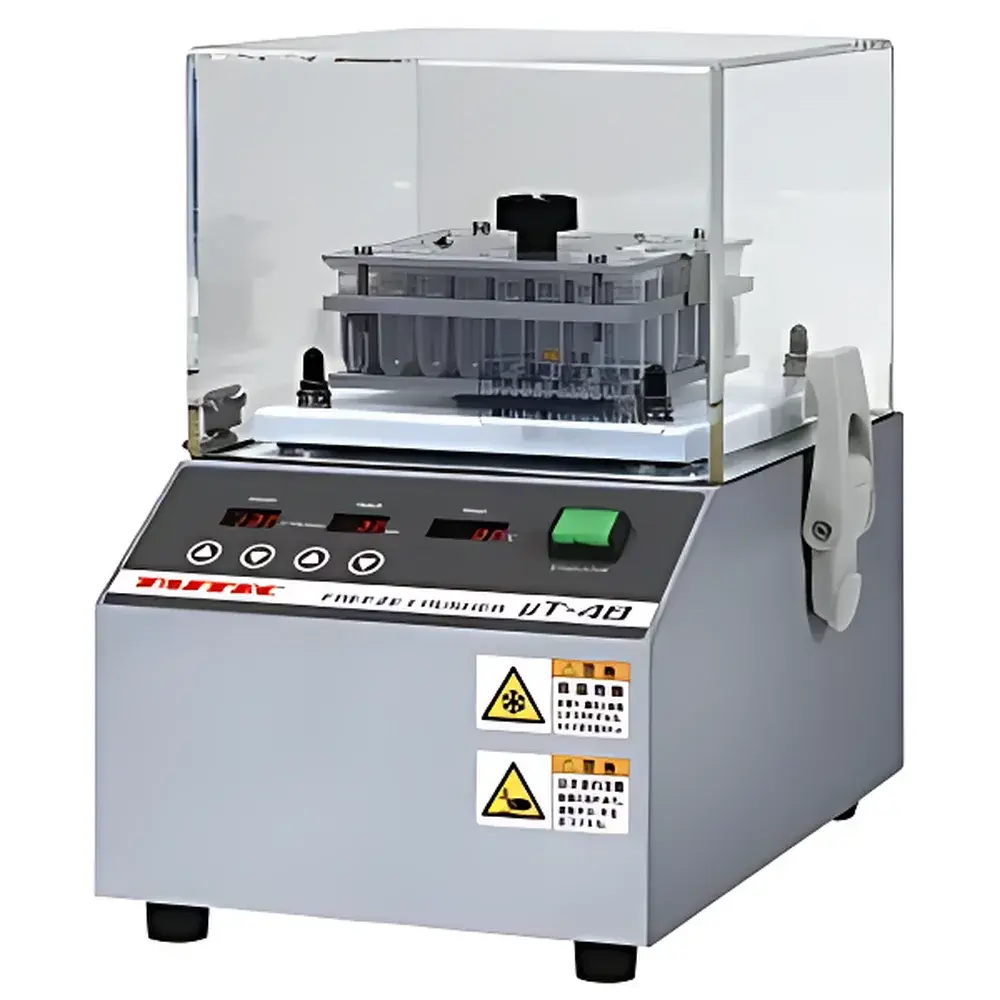
TAITEC uT-48 Cryogenic Ball Mill Homogenizer
| Brand | TAITEC |
|---|---|
| Origin | Japan |
| Model | uT-48 |
| Instrument Type | Cryogenic Ball Mill |
| Sample Compatibility | Frozen biological and hard materials (tissues, bone, teeth, polymers, rubber, asbestos) |
| Output Particle Size | < 0.01 mm |
| Oscillation Mode | Vertical reciprocating |
| Speed Range | 0–2500 rpm |
| Capacity | Up to 48 × 2.0 mL microcentrifuge tubes or 4 × stainless-steel heavy-duty vessels |
| Sample Load per Tube | 100–200 mg (microtubes), 1–2 g (stainless-steel vessels) |
| Timer | 1–999 s (digital display) |
| Temperature Monitoring | −196 °C to +50 °C (measured at tube holder base) |
| Safety Features | Lid interlock, rack mounting confirmation switch |
| Dimensions | 220 × 310 × 315 mm (W × D × H) |
| Weight | ~10 kg |
| Power Supply | AC 100 V |
Overview
The TAITEC uT-48 Cryogenic Ball Mill Homogenizer is an engineered solution for rapid, reproducible mechanical disruption of challenging biological and synthetic samples under cryogenic conditions. Unlike conventional bead mills or rotor-stator homogenizers, the uT-48 operates on a high-frequency vertical reciprocating oscillation principle—applying kinetic energy directly to sealed, liquid nitrogen–frozen samples contained in standard 2.0 mL microcentrifuge tubes or specialized stainless-steel vessels. This cryo-mechanical approach preserves thermolabile analytes—including nucleic acids, proteins, metabolites, and post-translational modifications—by maintaining sub-zero temperatures throughout lysis, thereby suppressing enzymatic degradation, oxidation, and structural denaturation. The system does not incorporate active cooling; instead, it leverages the thermal inertia of liquid nitrogen–frozen specimens to ensure integrity during brief (typically 10–60 s), high-impact fragmentation events. Its design aligns with core requirements of modern molecular biology, forensic toxicology, and materials science workflows where sample integrity, cross-contamination control, and throughput are critical.
Key Features
- Cryogenic-compatible architecture: Enables direct processing of LN2-frozen tissues (e.g., liver, brain, muscle), microbial pellets, bone, dental fragments, and synthetic polymers without thawing.
- High-throughput configuration: Supports simultaneous homogenization of up to 48 samples using the TH-0248T rack—ideal for RNA-seq library prep, proteomic cohort studies, or biobank-scale tissue banking.
- Modular vessel system: Interchangeable platforms accommodate either disposable polypropylene microtubes (recommended: Eppendorf Safe-Lock™) for low-biomass applications or robust stainless-steel vessels (TH-SPT kit) for high-hardness matrices like calcified tissue or engineering plastics.
- Precision speed control: Digital RPM adjustment (0–2500 rpm) with application-specific recommendations—1200 rpm for microtubes with metal grinding heads, 1000 rpm for stainless-steel vessels—to balance efficiency against tube fracture risk.
- Integrated safety monitoring: Dual hardware interlocks verify lid closure and rack seating prior to operation; real-time temperature sensing at the tube holder base provides traceable thermal context for each run.
- Minimal carryover design: Single-use consumables eliminate cleaning validation burdens and support GLP-compliant workflows requiring strict sample segregation.
Sample Compatibility & Compliance
The uT-48 is validated for heterogeneous sample classes including mammalian and plant tissues, yeast and fungal cell walls, dental enamel, cortical bone, silicone elastomers, thermoplastic resins, and asbestos-containing building materials. Its cryo-mechanical lysis protocol satisfies pre-analytical requirements outlined in ISO 20387:2018 (biobanking), ASTM D7292-17 (polymer fragmentation), and USP (cellular and gene therapy material processing). While the instrument itself does not generate electronic records compliant with FDA 21 CFR Part 11, its digital timer and temperature readout support manual audit trails required under GMP Annex 11 and ISO/IEC 17025 accreditation frameworks when paired with laboratory information management systems (LIMS).
Software & Data Management
The uT-48 operates via embedded firmware with no proprietary software dependency. All operational parameters—including speed setpoint, duration, and real-time holder-base temperature—are displayed on a front-panel LCD. For traceability, users manually log settings alongside sample IDs in bound lab notebooks or LIMS-integrated electronic batch records. Optional integration with time-stamped environmental monitoring systems (e.g., Vaisala viewLinc) allows correlation of ambient lab conditions with thermal stability during LN2 handling. No cloud connectivity or remote diagnostics are implemented, preserving data sovereignty in regulated environments.
Applications
- High-fidelity nucleic acid extraction from fibrous or lipid-rich tissues (e.g., adipose, heart, lung) without phenol-chloroform exposure.
- Preparation of uniform suspensions for single-cell ATAC-seq or spatial transcriptomics where cellular morphology must remain intact until lysis.
- Routine homogenization of forensic bone fragments for STR profiling and mitochondrial DNA analysis.
- Fragmentation of polymer composites for SEM-EDS elemental mapping or thermal gravimetric analysis (TGA).
- Disaggregation of cryopreserved organoids or tumor spheroids for downstream flow cytometry or mass cytometry (CyTOF).
- Processing of hazardous materials (e.g., asbestos, lead-based paint chips) within certified fume hoods using sealed stainless-steel vessels.
FAQ
Does the uT-48 include a built-in cooling system?
No. It relies on externally applied liquid nitrogen to pre-freeze samples; no compressor or Peltier element is integrated.
Can I process non-frozen samples?
Not recommended. The mechanical design and safety interlocks assume cryogenic rigidity; room-temperature soft tissues or gels may deform, leading to inconsistent lysis and potential tube failure.
What is the maximum recommended run time per cycle?
999 seconds (16.6 minutes), though most biological tissues achieve complete homogenization within 20–45 seconds at optimized speeds.
Is the TH-0248T rack autoclavable?
No. The aluminum alloy rack is designed for cryogenic thermal cycling; repeated steam sterilization compromises structural integrity and dimensional accuracy.
How is temperature monitored during operation?
A calibrated thermistor embedded in the tube holder base measures thermal transfer from the frozen sample array—not internal tube temperature—providing a conservative proxy for thermal stability.



