
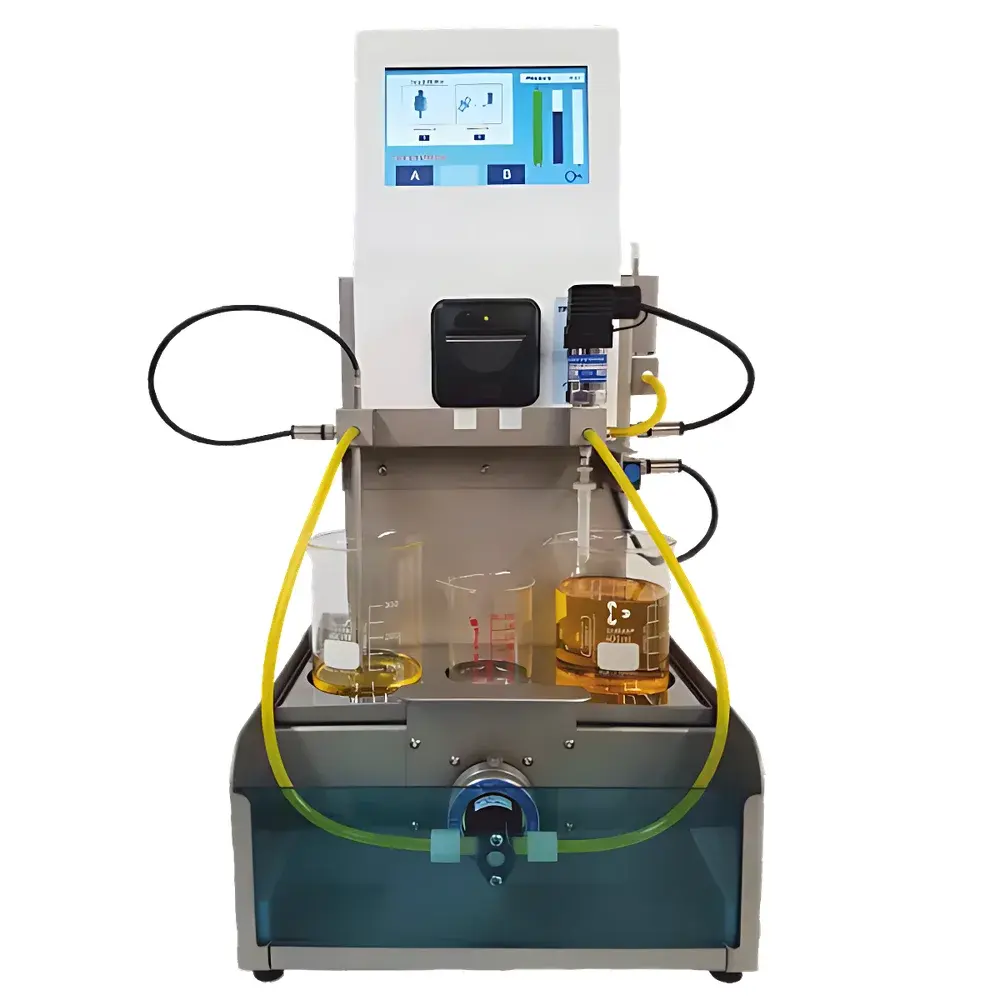
TAMSON TFBT Filter Blocking Tendency Tester
| Brand | TAMSON |
|---|---|
| Origin | Netherlands |
| Model | TFBT |
| Dimensions (L×W×H) | 280 × 350 × 620 mm |
| Weight | 11 kg |
| Power Supply | 85–264 VAC, 47–63 Hz, 40 W |
| Temperature Measurement | Range unspecified, Resolution 0.1 °C, Accuracy ±0.05 °C (IEC 751) |
| Pressure Measurement | Range 0–1500 mbar, Accuracy ±1 mbar, Nonlinearity 0.5 mbar |
| Volume Measurement | Range 0–300 mL, Linearity ±0.2 mL, Resolution ±0.5 mL |
| Timer Accuracy | ±0.001 s |
| FBT Index Range | 1.0–30 (lower values indicate better filterability) |
Overview
The TAMSON TFBT Filter Blocking Tendency Tester is a precision-engineered instrument designed to quantitatively assess the propensity of liquid fuels—particularly diesel, biodiesel blends, and heating oils—to cause filter plugging under standardized cold-condition testing protocols. It operates on the principle of controlled, timed filtration through a standardized stainless-steel mesh screen (typically 400 mesh, 38 µm nominal pore size) at a defined temperature (commonly −20 °C or −30 °C per ASTM D7501 or ISO 10307-2). The instrument measures the time required for a fixed volume (e.g., 50 mL) of sample to pass through the screen under constant vacuum pressure, then calculates and reports the Filter Blocking Tendency (FBT) index—a dimensionless value ranging from 1.0 to 30. Lower FBT values correspond to superior low-temperature filterability, indicating reduced risk of in-line filter clogging during real-world fuel system operation.
Key Features
- Full-color graphical touchscreen interface with intuitive, step-by-step visual guidance for test setup, execution, and result validation—eliminating operator-dependent interpretation errors.
- Electronically calibrated, high-stability vacuum regulation system ensuring consistent differential pressure across the test screen (±1 mbar accuracy, nonlinearity ≤0.5 mbar), critical for inter-laboratory reproducibility.
- Integrated thermal printer delivering immediate hardcopy output of FBT index, test parameters (temperature, volume, elapsed time), and timestamped metadata—supporting audit-ready documentation per GLP and ISO/IEC 17025 requirements.
- Optically transparent fluidic pathway constructed from chemically resistant borosilicate glass and PTFE-lined tubing, enabling full visual verification of sample integrity, bubble detection, and residue accumulation—essential for troubleshooting and method validation.
- USB 2.0 interface supporting direct data export to external PCs; optional companion software enables database archiving, trend analysis, statistical process control (SPC) charting, and automated report generation compliant with 21 CFR Part 11 audit trail requirements.
- Rugged benchtop architecture (11 kg mass, CE-marked enclosure) with wide-input universal power supply (85–264 VAC, 47–63 Hz), suitable for deployment in refinery labs, fuel additive development facilities, and third-party certification laboratories.
Sample Compatibility & Compliance
The TFBT is validated for use with middle distillate fuels meeting ASTM D975 (diesel), EN 590 (automotive diesel), EN 14214 (biodiesel), and ISO 8217 (marine distillates). Its design conforms to the physical and procedural constraints of ASTM D7501 “Standard Test Method for Determining Filter Blocking Tendency of Diesel Fuels” and ISO 10307-2 “Petroleum products — Determination of total sediment in diesel fuels — Part 2: Accelerated filter blocking tendency test”. All temperature sensors are calibrated to IEC 60751 (Pt100 Class A), and pressure transducers meet EN 61326-1 electromagnetic compatibility standards. The unit carries CE marking under the EU Machinery Directive 2006/42/EC and Low Voltage Directive 2014/35/EU.
Software & Data Management
The optional TFBT Control Suite (v3.x) runs on Windows 10/11 and provides secure user role management (administrator, analyst, reviewer), electronic signatures, and immutable audit trails for all test events—including parameter changes, calibration logs, and result approvals. Raw data (time-stamped pressure, temperature, volume, and timer signals) is stored in encrypted SQLite databases with SHA-256 hashing. Export formats include CSV (for LIMS integration), PDF/A-2 (archival reports), and XML (for enterprise SAP QM or TrackWise interfaces). Software validation documentation (IQ/OQ/PQ protocols) is available upon request to support regulated environments operating under FDA, EMA, or national petroleum regulatory frameworks.
Applications
- Quality assurance of finished diesel fuels prior to dispatch, verifying compliance with FBT limits stipulated in commercial contracts or regional specifications (e.g., <5.0 for premium winter-grade diesel in Northern Europe).
- Evaluation of cold-flow improver (CFI) additive efficacy by comparing FBT shifts before/after dosing—enabling dose optimization without full-scale engine testing.
- Stability monitoring of biodiesel blends (B5–B20) during storage, detecting early-stage oxidation-induced insoluble formation that precedes visible haze or sludge.
- Root-cause analysis of field-reported filter plugging incidents by correlating lab-measured FBT with fuel composition data (e.g., monoacylglycerol content, oxidation stability per Rancimat).
- Method transfer between central R&D labs and contract testing facilities, leveraging identical hardware/software configurations to ensure data equivalence across geographies.
FAQ
What is the significance of the FBT index range (1.0–30)?
The FBT index is empirically derived from filtration kinetics. An index of 1.0 indicates near-instantaneous passage (20 signal severe filterability impairment—often associated with wax crystallization, microbial growth, or cross-linked oxidation polymers. The scale is nonlinear and method-specific; comparisons must be confined to ASTM D7501-compliant instruments.
Can the TFBT be used for gasoline or jet fuel?
No. The test methodology, screen geometry, and vacuum profile are optimized exclusively for middle distillates. Gasoline volatility and jet fuel’s stringent particulate limits require fundamentally different test designs (e.g., ASTM D2276 for aviation turbine fuel particulate contamination).
How often does the stainless-steel test screen require replacement?
Per ASTM D7501, the screen is single-use per test. Reuse introduces memory effects and compromises result validity. TAMSON supplies certified, pre-validated screens traceable to NIST SRM 2810.
Is temperature calibration performed automatically?
Yes. The instrument executes a self-calibration sequence at power-on using its embedded Pt100 sensor and internal reference resistor network, logging results to non-volatile memory. Manual recalibration via external dry-block calibrator is supported annually or after mechanical shock.
Related Products






