
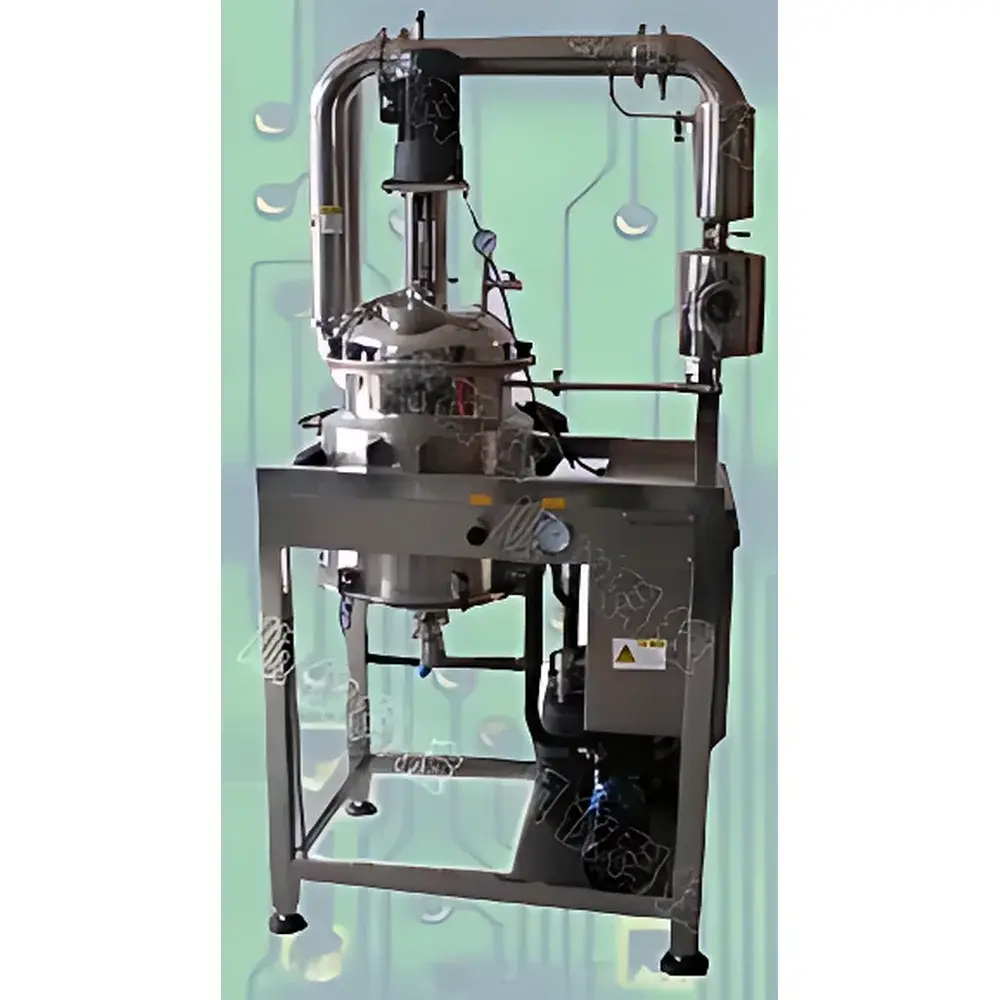
EX-TE Series Miniature Multifunctional Extraction Vessel
| Origin | Shanghai, China |
|---|---|
| Manufacturer Type | Authorized Distributor |
| Origin Category | Domestic (China) |
| Model | EX-TE |
| Pricing | Available Upon Request |
| Vessel Capacities | 3 L, 5 L, 10 L, 30 L, 50 L, 100 L |
| Heating Power | 3–15 kW |
| Agitation Power | 0.09–0.5 kW |
| Design Pressure (Inner Vessel) | 0.09 MPa |
| Design Pressure (Jacket) | 0.3–0.4 MPa |
| Temperature Control | Dual-point (Extraction & Jacket) |
| Safety Features | Low-level liquid protection, real-time temperature monitoring |
| Optional Ultrasound Module | Frequency range 15–60 kHz (focused transducer array, frame-type agitator integration) |
Overview
The EX-TE Series Miniature Multifunctional Extraction Vessel is an engineered platform for laboratory-scale solid–liquid extraction under controlled thermal, mechanical, and optionally ultrasonic conditions. Designed around a jacketed, pressure-rated vessel architecture with integrated heating and agitation, it supports diverse extraction modalities—including atmospheric decoction, hot reflux, percolation, hydrodistillation of volatile oils, and solvent recovery—across pharmaceutical, nutraceutical, food science, and fine chemical research workflows. Its core principle relies on precise thermal management (via internal + jacketed heating), uniform mass transfer (enabled by frame-type agitator geometry), and, when equipped, focused ultrasonic energy delivery to enhance cell wall disruption and solute diffusion kinetics without thermal degradation. The system operates within defined mechanical limits (inner vessel design pressure: 0.09 MPa; jacket: 0.3–0.4 MPa), ensuring safe operation during elevated-temperature or vacuum-assisted protocols.
Key Features
- Modular capacity range: Six standardized variants (EX-TE-03 to EX-TE-100) covering 3–100 L effective working volume, enabling scalability from screening to pilot-stage process development.
- Integrated dual-zone temperature control: Independent regulation and real-time digital display of both extraction medium temperature and jacket heating temperature—critical for optimizing thermolabile compound recovery.
- Self-contained thermal system: Internal resistive heating elements combined with jacketed steam or thermal oil circulation eliminate dependency on external heat sources while ensuring radial and axial temperature uniformity.
- Triple-layer insulation: Optimized thermal retention minimizes energy loss and improves process reproducibility across extended extraction cycles.
- Open-top structural design: Facilitates rapid loading/unloading of heterogeneous solids (e.g., dried herbs, biomass, granules) and simplifies cleaning validation in GLP-compliant environments.
- Intelligent safety interlocks: Automatic cut-off upon detection of low liquid level prevents dry-firing of heaters; pressure-relief compliance aligns with PED 2014/68/EU Annex I essential safety requirements.
- Expandable architecture: Standardized mounting interfaces and communication protocols support synchronized multi-unit operation (up to 20 vessels), enabling parallel experimental design or DOE-based parameter mapping.
Sample Compatibility & Compliance
The EX-TE series accommodates a broad spectrum of solid matrices—including powdered botanicals, crushed plant tissues, protein-rich animal feedstocks, starch suspensions, and synthetic polymer blends—as well as miscible and immiscible solvents (water, ethanol, methanol, ethyl acetate, hexane). All wetted components are constructed from ASTM A240 316L stainless steel, certified to ISO 8502-3 for surface cleanliness and compatible with USP extractables/leachables testing protocols. The vessel’s pressure containment design adheres to ASME BPVC Section VIII Division 1 guidelines for low-pressure vessels. For laboratories operating under FDA 21 CFR Part 11 or EU Annex 11 requirements, optional audit-trail-enabled controllers (IEC 62304 Class B compliant firmware) are available to document setpoint changes, alarm events, and operational timestamps.
Software & Data Management
Standard configuration includes a programmable logic controller (PLC) with HMI touchscreen interface supporting up to 99 user-defined extraction programs. Each program stores target parameters—including extraction temperature (±0.5 °C accuracy), duration (0–99 h 59 min), agitation speed (0–120 rpm), vacuum level (optional module, range: –0.09 to 0 MPa gauge), and pH monitoring (via calibrated probe input). Data logging occurs at 1-second intervals and exports to CSV via USB or Ethernet. Optional LabVIEW-compatible OPC UA server enables integration into enterprise LIMS or MES platforms. All logged data retains immutable timestamps and operator ID tags—supporting ALCOA+ principles (Attributable, Legible, Contemporaneous, Original, Accurate, Complete, Consistent, Enduring, Available).
Applications
- Phytochemical isolation: Optimization of flavonoid, alkaloid, and polysaccharide yields from Salvia miltiorrhiza, Ginkgo biloba, and Scutellaria baicalensis under variable temperature/pH/vacuum conditions.
- Thermolabile API extraction: Cold-assisted ultrasound-enhanced recovery of peptides and enzymes from microbial fermentation broths without denaturation.
- Solvent recycling validation: Closed-loop distillation studies for ethanol or isopropanol recovery efficiency quantification (mass balance tracking supported).
- Process analytical technology (PAT) development: Real-time correlation of online pH, temperature, and turbidity signals with HPLC-UV assay results for kinetic modeling.
- Food-grade pigment extraction: Anthocyanin recovery from berry pomace using pH-shifted aqueous ethanol, monitored via in-situ colorimetric feedback.
- GMP-relevant method transfer: Bridging lab-scale EX-TE data to pilot-scale jacketed reactors through dimensionless number scaling (Re, Fr, Nu).
FAQ
What pressure ratings apply to the EX-TE vessel and its jacket?
The inner vessel is rated for a maximum design pressure of 0.09 MPa (gauge); the heating jacket is rated for 0.3–0.4 MPa (gauge), permitting steam or high-temperature thermal fluid operation.
Is the ultrasound module compatible with all EX-TE models?
Yes—the ultrasonic transducer assembly (focused 15–60 kHz, adjustable amplitude) is mechanically and electrically integrated across all six capacity variants, with power scaling matched to vessel geometry and agitation profile.
Can the system operate under vacuum?
Vacuum capability is available as an add-on module (–0.09 MPa gauge), including vacuum-rated seals, reinforced sight glasses, and condensate trap integration for solvent recovery applications.
How is calibration traceability maintained for temperature and pressure sensors?
All sensors ship with NIST-traceable calibration certificates; field recalibration ports and documented SOPs support ISO/IEC 17025-compliant maintenance schedules.
Does the controller support remote monitoring or networked alarms?
Standard Ethernet (TCP/IP) and optional Wi-Fi connectivity enable remote viewing via web browser; SNMP v3 alerts can be routed to centralized IT infrastructure for predictive maintenance logging.



