
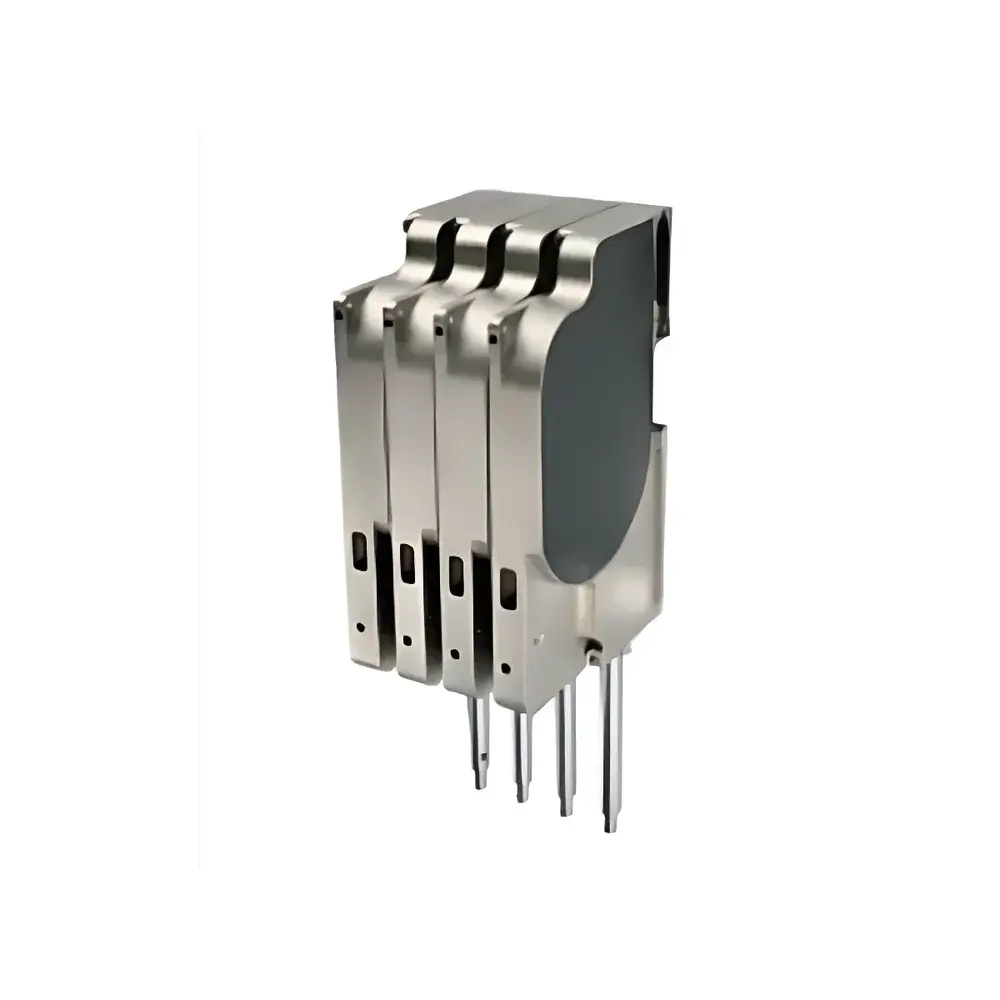
Tecan Cavro ADP 2 Advanced Pneumatic Dispensing Pump
| Brand | Tecan Cavro |
|---|---|
| Origin | Malaysia |
| Model | Cavro ADP 2 |
| Instrument Type | Micro-syringe Pump |
| Dispensing Range | 5–1000 µL |
| Minimum Increment | 25 nL per step (40,000 steps for 1000 µL) |
| Tip Compatibility | Tecan LiHa disposable tips (10, 50, 200, 1000 µL |
| Liquid Level Detection | Capacitive and pressure-based |
| Communication Interface | RS485 / CAN bus |
| Integrated Diagnostic Algorithms | Bubble detection, clot detection, air aspiration, insufficient liquid volume |
| Tip Handling | Automated tip pickup/ejection with real-time tip status monitoring |
| Cross-contamination | Eliminated via single-use tip architecture |
Overview
The Tecan Cavro ADP 2 is an advanced pneumatic dispensing pump engineered for high-precision, low-volume liquid handling in automated laboratory workflows. Unlike traditional stepper-motor-driven syringe pumps, the ADP 2 employs a closed-loop pneumatic actuation system that delivers consistent force-independent displacement—enabling reproducible dispensing across variable fluid viscosities and backpressures. Its core architecture integrates real-time pressure transduction, capacitive sensing, and adaptive algorithmic interpretation of fluidic events, making it suitable for demanding applications in genomics, diagnostics, and high-throughput screening where volumetric fidelity below 1 µL must be maintained over thousands of cycles. Designed as a drop-in replacement and functional upgrade to legacy Cavro ADP platforms, the ADP 2 retains mechanical and electrical compatibility with existing Tecan Freedom EVO and Fluent liquid handling workstations while introducing enhanced diagnostic rigor and operational transparency.
Key Features
- Pneumatic actuation with closed-loop pressure feedback ensures sub-microliter accuracy and repeatability independent of syringe geometry or fluid density.
- Capacitive liquid level detection (CLD) combined with differential pressure sensing enables robust identification of meniscus position, bubble presence, clot formation, and insufficient aspiration volume—even in opaque or foaming samples.
- Intelligent tip state monitoring verifies physical attachment, seal integrity, and ejection completion prior to each dispense cycle, preventing missteps in multi-tip parallel operations.
- Guided parameter configuration interface reduces setup errors by contextualizing flow rate, acceleration, and dwell time settings relative to selected tip volume and fluid properties.
- RS485 and CAN bus interfaces support deterministic, low-latency integration into distributed control systems compliant with IEC 61131-3 PLC environments and Tecan’s native CScript/Method Editor frameworks.
- Full audit trail support—including timestamped event logs for tip pickup, aspiration, dispense, and fault conditions—is structured to align with GLP and 21 CFR Part 11 data integrity requirements when deployed with validated software stacks.
Sample Compatibility & Compliance
The ADP 2 accommodates a defined range of Tecan LiHa disposable tips (10 µL, 50 µL, 200 µL, and 1000 µL), available with or without hydrophobic filters to address aerosol containment needs in PCR or cell culture applications. Its pressure-tolerant design supports operation with aqueous buffers, glycerol-rich reagents (up to 50% v/v), and low-surface-tension solvents commonly used in assay development. The pump meets IEC 61326-1 (EMC) and IEC 61010-1 (safety) standards for laboratory equipment. When integrated into systems validated under ISO/IEC 17025 or FDA QSR, its deterministic behavior and traceable event logging facilitate compliance with analytical method transfer protocols referenced in USP and ISO 20914.
Software & Data Management
The ADP 2 operates under firmware version 3.2+ and communicates via standardized command sets documented in Tecan’s Hardware Integration Guide (HIG v4.1). It supports both synchronous and asynchronous execution modes, allowing precise coordination with deck movement, heater-cooler activation, or spectrophotometric read cycles. All diagnostic outputs—including raw pressure waveforms, capacitance delta values, and tip contact resistance—are accessible via extended register mapping for custom analytics or machine learning–based anomaly detection. Exported log files adhere to CSV and HDF5 formats, enabling direct ingestion into LIMS platforms compliant with ASTM E1578 or Allotrope Data Format (ADF) specifications.
Applications
- Low-volume reagent dispensing in NGS library preparation (e.g., enzyme master mixes, adapter ligation cocktails).
- Cell-based assay setup requiring picoliter-level precision in inhibitor titration or cytokine gradient generation.
- Automated calibration curve preparation for mass spectrometry internal standards using serial dilution schemes.
- Diagnostic kit manufacturing where lot-to-lot consistency of control line deposition must meet ISO 13485 traceability mandates.
- Microfluidic device priming and interface conditioning in organ-on-chip platforms with non-Newtonian biofluid simulants.
FAQ
Does the ADP 2 require recalibration after tip type changes?
No. The pump automatically loads tip-specific compensation profiles stored in non-volatile memory upon tip barcode scan or manual selection.
Can the ADP 2 be operated standalone without a host workstation?
Yes—via optional front-panel interface module (FIM-ADP2), enabling local parameter entry, manual trigger, and real-time diagnostic display.
Is pressure-based liquid level detection affected by temperature drift?
Compensated via integrated thermistor and factory-characterized thermal offset tables; no user intervention required within 15–30°C ambient range.
What validation documentation is supplied with the ADP 2?
Includes Factory Acceptance Test (FAT) report, pressure sensor calibration certificate (NIST-traceable), and firmware verification summary aligned with GAMP 5 Category 3 classification.
How does the ADP 2 handle viscous fluids above 20 cP?
Adaptive aspiration algorithms dynamically adjust dwell time and ramp rate based on real-time backpressure feedback, maintaining target volume accuracy within ±0.8% CV at 100 µL across 5–25 cP range.



