
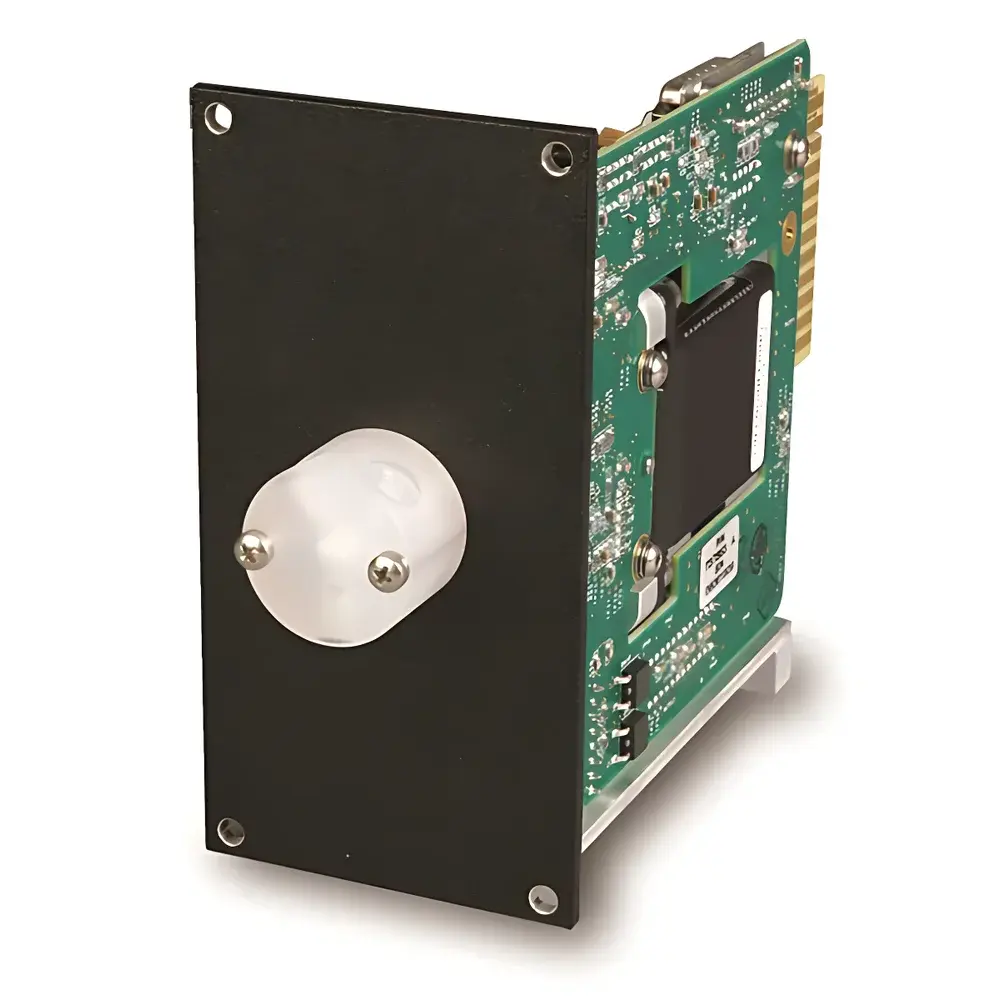
Tecan Cavro Smart Valve Plus (SVP) Multi-Position Rotary Selector Valve
| Brand | Tecan Cavro |
|---|---|
| Origin | Malaysia |
| Model | Cavro Smart Valve Plus |
| Valve Positions | User-Configurable (up to 20 ports) |
| Dispensing Accuracy | <1% CV |
| Dispensing Range | 1 µL – 50 mL |
| Control Interface | RS-232 / RS-485 / CAN bus |
| Power Supply | 24 VDC ±10%, 850 mA |
| Dimensions | 52.9 × 25 × 50 mm |
| Operating Temperature | 5–40 °C |
| Operating Humidity | 20–95% RH (non-condensing at 40 °C) |
| Fluidic Connections | 1/4-28 UNF or M6 threaded fittings |
| Valve Head Options | 3-, 4-, 6-, 9-, and 20-port configurations |
| Compliance | Designed for integration into IVD, clinical chemistry, and GLP-compliant automated liquid handling systems |
Overview
The Tecan Cavro Smart Valve Plus (SVP) is a high-integrity, multi-position rotary selector valve engineered for precise, repeatable fluid routing in automated laboratory instrumentation. Based on proven coaxial rotary valve architecture, the SVP operates via a motor-driven ceramic or polymer rotor that seals against a stationary stator plate—enabling positive displacement flow control without dead volume accumulation or cross-contamination between channels. Its design adheres to fundamental principles of low-shear, laminar-flow path management, making it suitable for applications demanding strict reagent integrity, minimal carryover (1 million cycles), and compatibility with aggressive chemistries (e.g., organic solvents, acids, bases) are critical.
Key Features
- Modular port configuration: Supports user-defined valve heads—from 3-port to 20-port layouts—enabling flexible assay routing without hardware redesign.
- Ceramic or chemically resistant polymer rotor options: Ensures compatibility with corrosive reagents, high-pH buffers, and sterilization protocols (autoclave-compatible variants available).
- Integrated motion control electronics: On-board microcontroller handles step resolution, acceleration profiling, and position verification—reducing host system firmware complexity.
- Multi-protocol digital interface: Native support for RS-232, RS-485, and CAN bus enables seamless integration into distributed control architectures common in ISO 13485-certified IVD platforms.
- Compact footprint (52.9 × 25 × 50 mm): Optimized for space-constrained instrument bays while maintaining full 24 VDC operational headroom and thermal derating up to 40 °C ambient.
- Low-power operation (850 mA @ 24 VDC): Designed for energy-efficient embedded systems and battery-backed mobile diagnostic devices.
Sample Compatibility & Compliance
The SVP accommodates aqueous, viscous, and mildly abrasive liquids—including whole blood, plasma, serum, PCR master mixes, and detergent-based wash buffers—without degradation of sealing integrity. Rotor/stator surface finishes meet ISO 8502-3 cleanliness standards for medical device fluid paths. All wetted materials comply with USP Class VI biocompatibility requirements and EU Regulation (EC) No 1935/2004 for food contact. When integrated into final instruments, the valve supports traceability per FDA 21 CFR Part 11 (with appropriate host software audit trail implementation) and aligns with IEC 61010-1 safety directives for laboratory equipment. Its construction meets RoHS 2 and REACH substance restrictions, and documentation packages include material declarations and manufacturing traceability records.
Software & Data Management
The SVP communicates via ASCII command sets over serial or CAN interfaces, enabling direct command-line control or abstraction through higher-level drivers (e.g., LabVIEW VIs, Python pySerial libraries, or C++ SDKs provided by Tecan). Position confirmation feedback, error codes (e.g., stall detection, timeout), and internal temperature monitoring are reportable in real time. For regulated environments, integration partners implement electronic logbooks with timestamped valve actuation events, operator IDs, and parameter settings—fulfilling ALCOA+ data integrity principles. Firmware updates are performed via bootloader mode using standard UART, supporting version-controlled field maintenance without hardware replacement.
Applications
- Automated clinical chemistry analyzers requiring sequential reagent addition and dilution steps.
- OEM liquid handling modules for nucleic acid extraction, ELISA, and immunoassay platforms.
- On-board calibration fluid selection in point-of-care diagnostic instruments.
- Multi-solvent delivery in HPLC autosampler manifolds and LC-MS sample introduction systems.
- Reagent conditioning loops in environmental water testing systems compliant with EPA Method 300.0 and ISO 15586.
- High-throughput screening (HTS) workstations performing compound dilution series with sub-microliter precision.
FAQ
What is the maximum recommended operating pressure for the SVP?
The valve is rated for continuous operation up to 100 psi (6.9 bar) with standard polymer rotors; ceramic variants support up to 150 psi (10.3 bar) depending on port geometry and seal configuration.
Can the SVP be sterilized in place (SIP)?
Yes—ceramic-head configurations withstand repeated steam sterilization (121 °C, 15 psi, 20 min) when installed with compatible PTFE or Kalrez® seals; validation reports are available upon request.
Is positional repeatability affected by temperature drift?
No—the integrated encoder and closed-loop stepping ensure ±0.1° angular accuracy across the full 5–40 °C operating range, with no recalibration required between thermal cycles.
How is carryover quantified and minimized?
Carryover is validated per CLSI EP10-A3 guidelines using fluorescent tracer assays; typical values are <0.005% for aqueous media and <0.01% for glycerol-rich solutions following one air-wash cycle.
Does Tecan provide API documentation for third-party software integration?
Yes—comprehensive command reference manuals, protocol examples, and driver source code (C/C++, Python, LabVIEW) are included in the OEM Integration Kit, licensed under Tecan’s Standard Terms for Embedded Use.



