
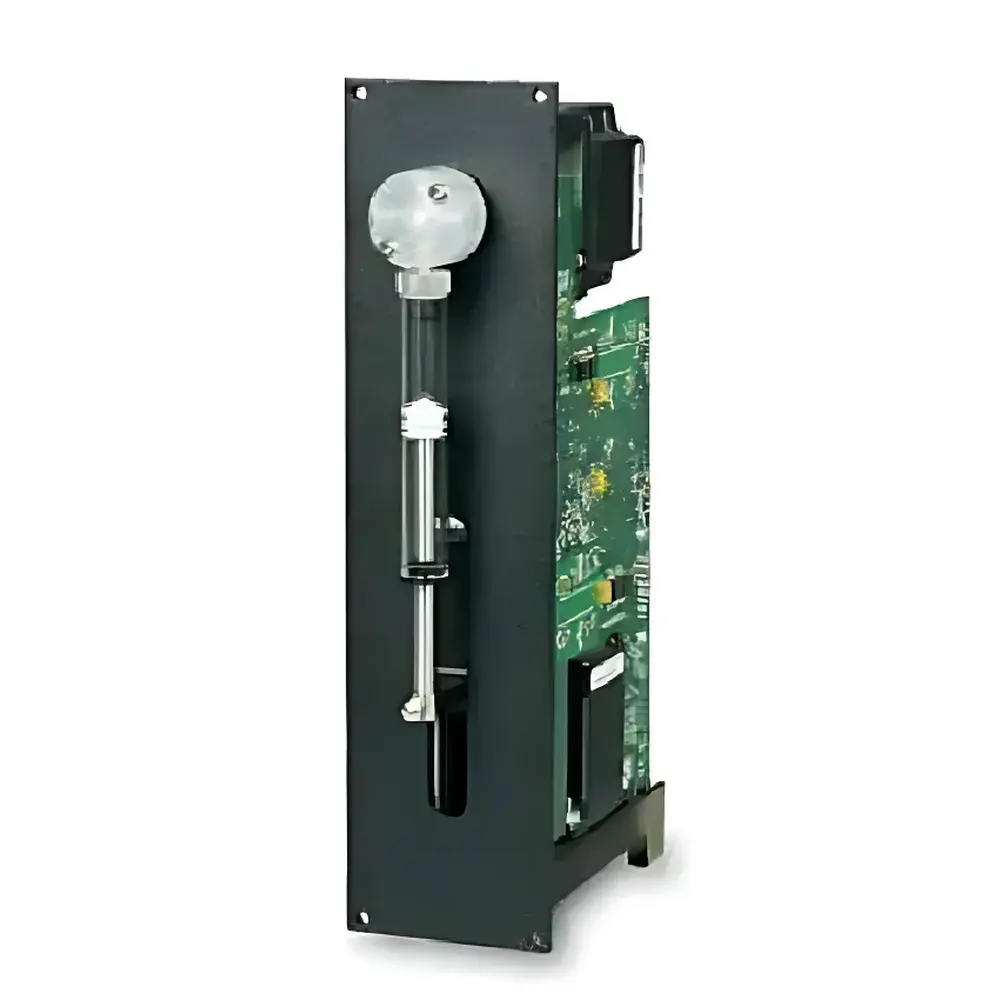
Tecan Cavro XLP 6000 Syringe Pump
| Brand | Tecan Cavro |
|---|---|
| Origin | Malaysia |
| Model | Cavro XLP 6000 Pump |
| Pump Type | Precision Microfluidic Syringe Pump |
| Stepping Resolution | 6,000 full steps (48,000 microsteps) |
| Valve Options | Non-distributing 3-way |
| Syringe Volume Range | 50 µL to 50 mL |
| Plunger Stroke | 60 mm |
| Communication Interfaces | RS-232, RS-485, CAN bus |
| Flow Accuracy | < ±0.25% of full scale |
| Flow Repeatability | < ±0.05% of full scale |
| Compliance | Designed for integration into ISO/IEC 17025-compliant laboratories and GLP/GMP environments requiring audit-trail-capable fluid handling |
Overview
The Tecan Cavro XLP 6000 Syringe Pump is a high-precision, programmable microfluidic actuation system engineered for reproducible, low-volume liquid handling in automated laboratory workflows. Based on stepper motor-driven linear motion and calibrated syringe displacement, the XLP 6000 operates on the principle of positive displacement—translating discrete angular motor increments into precise volumetric delivery or aspiration. Its architecture supports both standalone operation and seamless integration into larger OEM instruments or multi-module liquid handling platforms. Designed for applications demanding sub-microliter accuracy and long-term stability—such as HPLC sample injection, capillary electrophoresis interfacing, microreactor feeding, and assay reagent dispensing—the pump delivers consistent performance across its full 50 µL–50 mL syringe range. The 60 mm plunger stroke enables extended run times without syringe replacement, while the dual-mode stepping (6,000 full steps / 48,000 microsteps) ensures fine-grained control over flow dynamics, including ramped acceleration profiles and dwell-controlled pauses.
Key Features
- High-resolution motion control with 48,000 microsteps per revolution, enabling smooth, low-pulsation flow even at nanoliter-per-minute rates
- Modular valve manifold support: ceramic valves rated for >1 million cycles (3-, 6-, 9-, and 12-port configurations), plus chemically resistant plastic manifolds for cost-sensitive or disposable-integration scenarios
- Wide syringe compatibility—from 50 µL glass microsyringes to 50 mL polypropylene barrels—validated per ISO 8536-4 and ASTM D3418 standards
- Industrial-grade communication stack: native RS-232, RS-485, and CAN bus protocols with deterministic timing, supporting real-time synchronization in distributed automation networks
- Robust mechanical design with stainless-steel lead screw and preloaded anti-backlash nut assembly, minimizing hysteresis and thermal drift over extended duty cycles
- Firmware-upgradable controller with non-volatile parameter storage, enabling persistent calibration retention across power cycles
Sample Compatibility & Compliance
The XLP 6000 accommodates a broad spectrum of liquid classes—including aqueous buffers, organic solvents (e.g., acetonitrile, DMSO), viscous glycerol solutions (< 500 mPa·s), and low-surface-tension fluorinated fluids—when paired with appropriate syringe materials (glass, PTFE-coated metal, or chemically inert polymers). All ceramic valve variants meet USP Class VI biocompatibility requirements and are compatible with sterilization via autoclaving (up to 121°C, 20 min) or ethylene oxide exposure. The pump’s firmware architecture supports time-stamped event logging and user-access-level configuration locks, facilitating compliance with FDA 21 CFR Part 11 when deployed in regulated QC/QA environments. Documentation packages include IQ/OQ templates aligned with ISO/IEC 17025 and EU GMP Annex 15 validation frameworks.
Software & Data Management
The XLP 6000 communicates via ASCII-based command sets compliant with SCPI (Standard Commands for Programmable Instruments), allowing direct integration with LabVIEW, Python (pySerial), MATLAB, or custom C++ instrument drivers. Tecan provides the Cavro Command Line Interface (CLI) utility for rapid prototyping and script-based sequence generation—including multi-syringe coordination, conditional branching based on sensor feedback (e.g., pressure or conductivity triggers), and real-time flow rate modulation. Audit trail functionality records all parameter changes, execution timestamps, and error codes to internal flash memory—exportable via serial dump for traceability in GLP audits. No proprietary runtime or subscription licensing is required.
Applications
- Automated sample introduction for LC-MS, GC-FID, and ICP-MS systems requiring pulse-free, gradient-compatible infusion
- Controlled reagent addition in kinetic enzyme assays and microfluidic organ-on-chip perfusion studies
- Calibration standard delivery in environmental testing labs adhering to EPA Method 524/525 protocols
- OEM integration into point-of-care diagnostic analyzers where space-constrained, low-power fluidics are critical
- Long-duration dosing experiments in preclinical pharmacology (e.g., intravenous infusion modeling in rodent telemetry setups)
FAQ
What syringe sizes are certified for use with the XLP 6000?
The pump is validated for glass syringes from 50 µL to 5 mL and polymer syringes from 1 mL to 50 mL. Custom calibration files are available for non-standard barrels upon request.
Can the XLP 6000 operate in closed-loop mode with external pressure feedback?
No—it is an open-loop stepper-driven system. However, third-party pressure sensors can be integrated via TTL or analog I/O lines using optional digital I/O modules.
Is firmware update capability accessible to end users?
Yes. Firmware updates are delivered as signed hex files and applied via RS-232 using Tecan’s documented bootloader protocol—no hardware programmer required.
Does the pump support bidirectional flow (push/pull) with a single syringe?
Yes. Direction reversal is executed in under 20 ms with programmable acceleration limits to prevent syringe barrel detachment or seal extrusion.
What is the maximum allowable backpressure for continuous operation?
Rated for sustained operation up to 10 bar with 500 µL glass syringes and ceramic 6-way valves; derating applies above 50 °C ambient temperature per ISO 8536-4 Annex B.



