
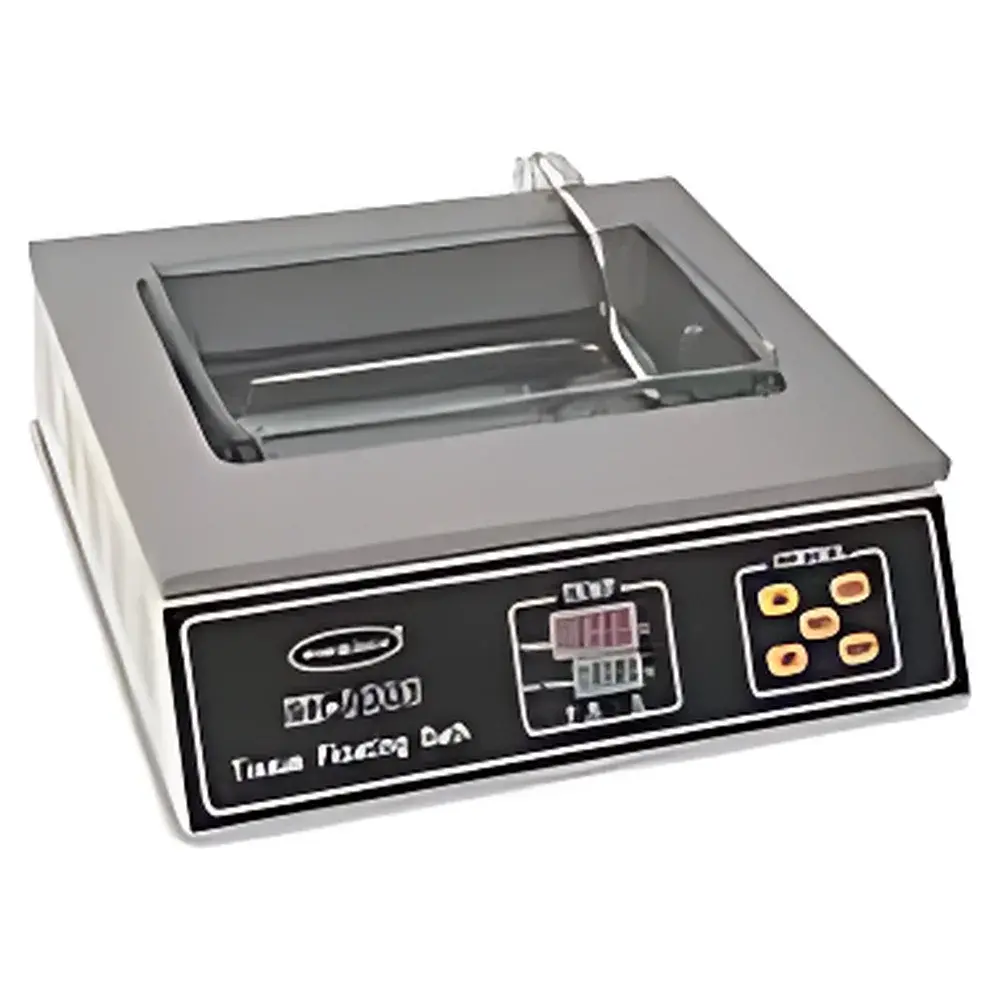
Ted Pella 28156 Tissue Floatation Water Bath
| Brand | Ted Pella |
|---|---|
| Origin | USA |
| Model | 28156 |
| Overall Dimensions | 35 W × 35 D × 11.4 H cm |
| Interior Basin | 25.4 W × 16.5 D × 5.1 H cm |
| Max Operating Temperature | 103°F (39.4°C) |
| Temp Accuracy | ±1°C |
| Net Weight | 8.5 kg |
| LED Illumination | Side-mounted, glare-free, switchable |
| Temperature Probe | Stainless steel, flip-down, thermostatic auto-shutoff |
Overview
The Ted Pella 28156 Tissue Floatation Water Bath is a purpose-engineered thermal platform designed specifically for histological tissue section handling during the flotation stage of paraffin-embedded microtomy. It operates on precise conductive heating principles, maintaining a stable, uniform water temperature across the entire basin surface to ensure optimal tissue ribbon expansion and adhesion prior to microscope slide mounting. Unlike generic laboratory water baths, this unit integrates microprocessor-based PID temperature regulation with a low-profile, modular architecture that minimizes thermal drift and enhances long-term operational repeatability—critical for standardized histopathology workflows in clinical diagnostics and academic research laboratories.
Key Features
- Microprocessor-Controlled PID Temperature Regulation: Enables setpoint accuracy within ±1°C across the full operating range (ambient to 39.4°C), with real-time dual-display of both set and actual temperature via high-contrast LED readouts.
- Removable Rectangular Glass Basin: Constructed from borosilicate glass for chemical resistance and optical clarity; dimensions (25.4 × 16.5 × 5.1 cm) accommodate standard tissue ribbons and facilitate rapid cleaning between batches.
- Side-Mounted LED Illumination System: Provides diffuse, shadow-free lateral lighting against a matte black basin background—optimized for visual assessment of tissue morphology, crease resolution, and water surface tension behavior without specular glare.
- Flip-Down Stainless Steel Temperature Probe: Features an integrated thermostatic sensor that automatically deactivates heating when lifted and resumes control upon reinsertion—reducing energy consumption and mitigating accidental probe damage during basin servicing.
- Low-Profile Ergonomic Design: Overall footprint (35 × 35 × 11.4 cm) enables seamless integration into laminar flow hoods or adjacent to microtomes; compact height supports seated operator posture and reduces benchtop clutter.
Sample Compatibility & Compliance
The 28156 is validated for use with paraffin-embedded tissue sections (typically 3–7 µm thick), frozen sections requiring gentle thawing, and polymer-coated slides. Its glass basin surface exhibits minimal interaction with aqueous mounting media and standard histological buffers (e.g., phosphate-buffered saline, distilled water). While not certified to ISO/IEC 17025 or FDA 21 CFR Part 11 as a standalone device, its temperature stability and reproducibility support compliance with CAP (College of American Pathologists) and CLIA (Clinical Laboratory Improvement Amendments) requirements for controlled pre-analytical processing steps. Routine calibration using NIST-traceable thermometers satisfies GLP documentation needs for laboratory quality systems.
Software & Data Management
This analog-digital hybrid instrument does not include embedded data logging or network connectivity. Temperature parameters are manually entered via tactile push-button interface, and no firmware updates or software drivers are required. All operational settings—including LED activation state and temperature setpoint—are retained through power cycling. For laboratories implementing electronic lab notebooks (ELNs) or LIMS integration, manual entry of bath conditions (time, setpoint, observed stability) is recommended as part of SOP-defined pre-slide preparation documentation per ISO 15189 Annex A.5.2.
Applications
- Controlled flotation of paraffin-embedded tissue ribbons prior to adhesive slide mounting
- Optimization of section adherence in immunohistochemistry (IHC) and in situ hybridization (ISH) protocols
- Standardized water bath temperature validation across multi-site histology cores
- Training platform for histotechnician certification programs emphasizing thermal consistency and visual assessment criteria
- Supporting ASTM E2917-21 (Standard Practice for Calibration of Thermal Analyzers) through reference-point verification at fixed temperatures
FAQ
What is the maximum safe operating temperature for continuous use?
The unit is rated for sustained operation up to 39.4°C (103°F); exceeding this limit may compromise seal integrity and accelerate evaporation-induced mineral deposition.
Can the glass basin be autoclaved?
No—the basin is not autoclavable due to thermal stress limitations of the bonded LED housing and control module proximity; manual cleaning with mild detergent and deionized water is recommended.
Is the temperature probe replaceable in the field?
Yes; the stainless steel probe assembly (Ted Pella P/N 28156-PROBE) is a user-serviceable component with standardized M4 mounting and direct plug-in connection.
Does this unit meet UL or CE safety standards?
It complies with UL 61010-1 (2nd Ed.) for laboratory electrical equipment and carries the cULus mark for North American markets; CE marking is not applicable as it is distributed exclusively for use in the United States and Canada.
How often should temperature calibration be performed?
Per CAP checklist ANP.21350, calibration verification using a traceable reference thermometer is required before each shift when used in diagnostic histology; quarterly full calibration is advised for research-only applications.



