
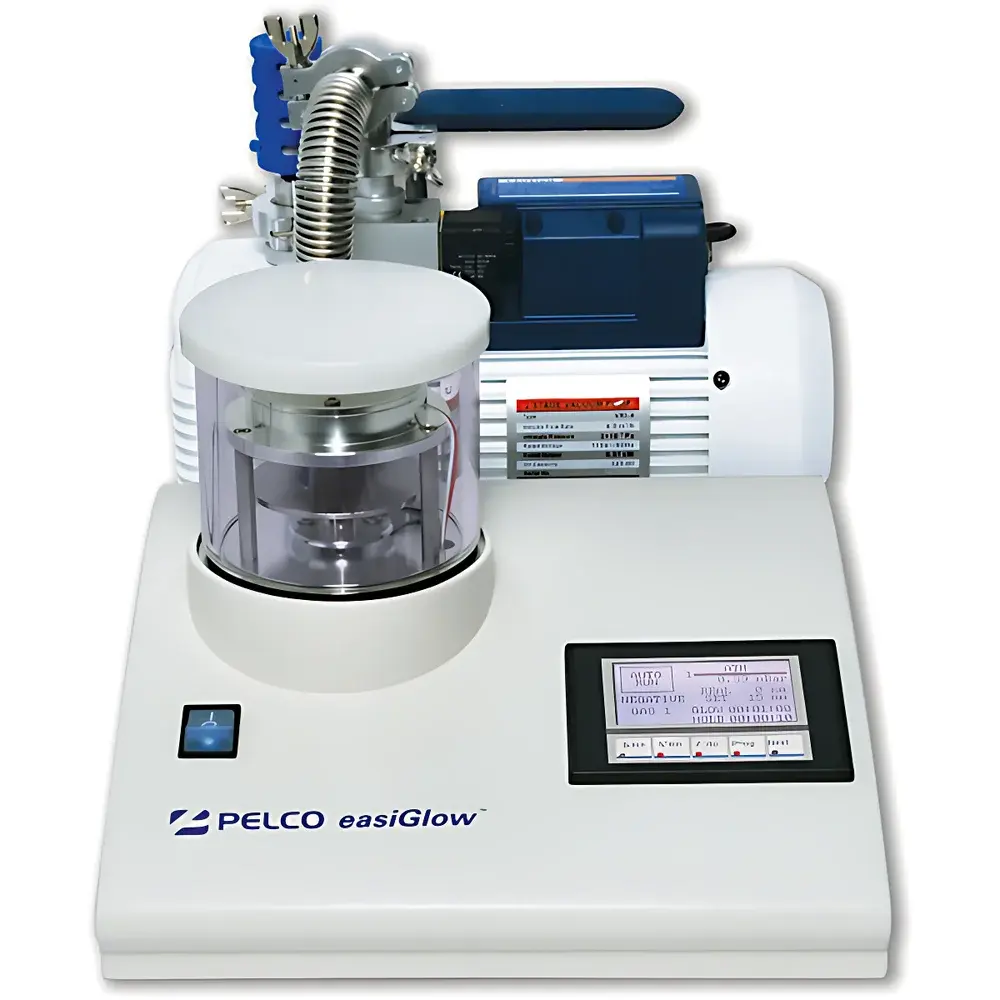
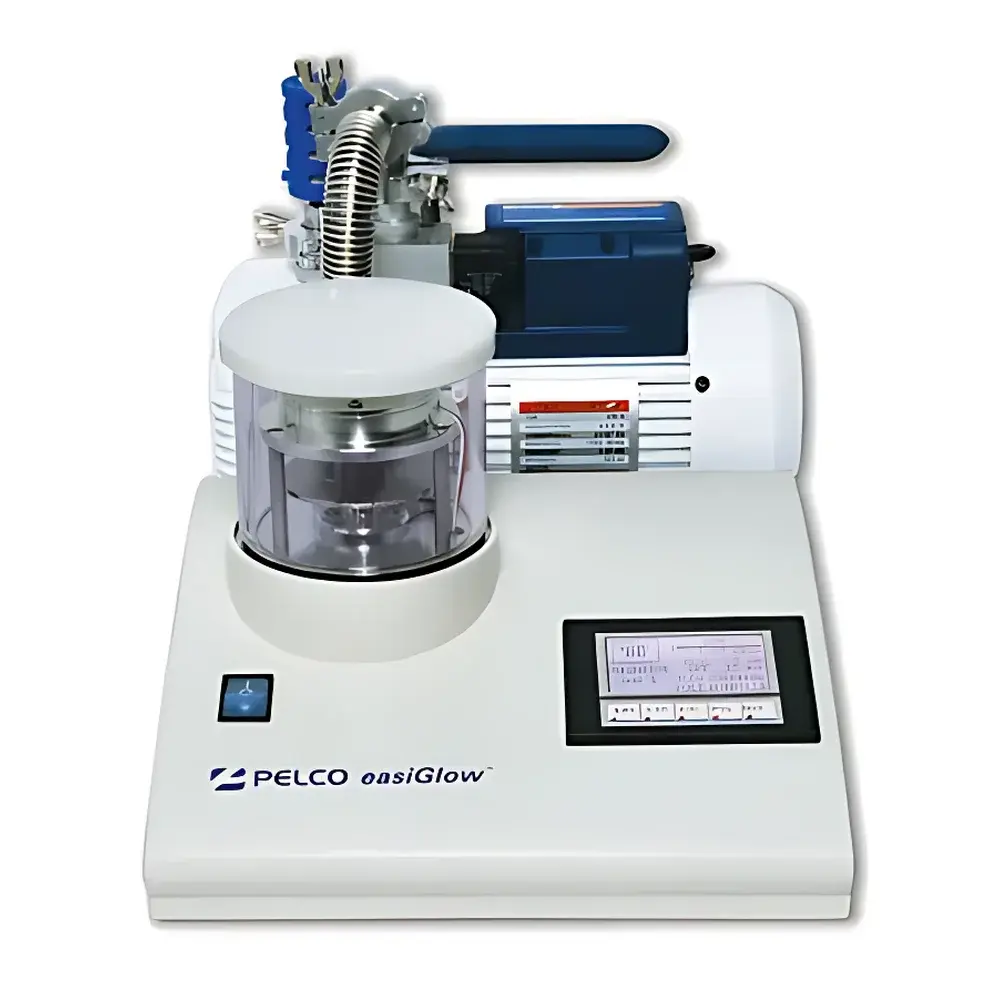
Ted Pella easiGlow™ 91000 Glow Discharge Cleaning System
| Brand | Ted Pella |
|---|---|
| Origin | USA |
| Manufacturer Type | Authorized Distributor |
| Origin Category | Imported |
| Model | easiGlow™ 91000 |
| Plasma Current | 0–30 mA |
| Power | 30 W |
| Electrode Polarity | Reversible (Anode/Cathode) |
| Sample Stage Diameter | 75 mm |
| Stage Height Adjustment | 1–25 mm |
| Delay Time | 0–14,400 s |
| Treatment Time | 0–900 s |
| Chamber Dimensions | 120 × 100 mm (L × W) |
| Gas Inlets | Two 6 mm ports |
| Vacuum Control | Electromechanical proportional valve with Pirani gauge |
| Operating Vacuum Range | 0.20–1.1 mbar |
| Ultimate Vacuum (with GD4 pump) | 0.03 mbar |
| Pump Speed (GD4) | 2.5 m³/hr |
| Touchscreen Display | 3-inch LED-backlit capacitive touchscreen with five dedicated function keys |
| Programmability | Four user-defined automated protocols |
| Safety Interlocks | Dual hardware + software vacuum interlock |
| Dimensions (main unit) | 305 × 292 × 230 mm (L × W × H) |
| Weight (main unit) | 6.26 kg |
| Optional GD4 Vacuum Pump Dimensions | 337 × 138 × 244 mm |
| GD4 Weight | 11 kg |
| Power Supply | 230 V, 50 Hz, 10 A |
Overview
The Ted Pella easiGlow™ 91000 Glow Discharge Cleaning System is a precision-engineered plasma surface treatment instrument designed specifically for transmission electron microscopy (TEM) sample preparation workflows. It operates on the principle of low-pressure DC glow discharge plasma generation—ionizing inert or reactive gases (e.g., air, argon, oxygen, or ammonia) within a controlled vacuum environment to modify the surface energy and charge state of TEM support films and grids. This process enables reliable conversion of hydrophobic carbon films into uniformly hydrophilic, negatively charged surfaces—critical for achieving even aqueous dispersion of biological macromolecules, nanoparticles, or colloidal suspensions during grid blotting and vitrification. The system’s robust architecture, repeatable plasma parameters, and intuitive operational logic make it suitable for both routine high-throughput TEM labs and research environments requiring strict protocol adherence and audit-ready documentation.
Key Features
- Precision electromechanical proportional vacuum control eliminates manual needle-valve adjustment, ensuring consistent pressure setpoints across runs (operating range: 0.20–1.1 mbar).
- Reversible electrode polarity (anode/cathode configuration) supports dual-mode surface functionalization—enabling both hydrophilic (negative surface charge) and hydrophobic (positive charge) treatments without hardware modification.
- Integrated 3-inch capacitive touchscreen with five dedicated soft-keys provides direct access to system status, real-time vacuum readout, and parameter editing—no external PC required for basic operation.
- Dual independent gas inlets accommodate sequential or mixed-gas treatments; optional gas mixing manifold available for advanced surface chemistry studies.
- Stepwise venting algorithm prevents mechanical stress on fragile TEM grids during chamber repressurization, minimizing risk of grid warping or film delamination.
- Four programmable treatment protocols store delay time (0–14,400 s), plasma duration (0–900 s), current setpoint (0–30 mA), and polarity—supporting GLP-compliant SOP execution.
- Hardware- and software-enforced vacuum interlocks prevent high-voltage activation unless chamber pressure falls below safe threshold (≤1.1 mbar), meeting IEC 61010-1 safety requirements.
Sample Compatibility & Compliance
The easiGlow™ 91000 accommodates standard 3.05 mm TEM grids (copper, nickel, gold) and 25 × 75 mm glass slides mounted on its adjustable 75 mm diameter stage (height range: 1–25 mm). Its chamber geometry (120 × 100 mm) permits simultaneous treatment of multiple grids or custom substrates up to 100 mm in width. The system complies with ISO 13485-aligned manufacturing practices and meets electromagnetic compatibility (EMC) standards per EN 61326-1. When operated with validated protocols, it supports adherence to ASTM E2857 (standard guide for TEM specimen preparation) and contributes to data integrity under FDA 21 CFR Part 11 when integrated with compliant LIMS or ELN platforms via optional RS-232/USB logging.
Software & Data Management
While standalone operation requires no computer, the easiGlow™ 91000 supports ASCII-formatted serial output (RS-232 or USB virtual COM port) for timestamped logging of vacuum level, current, treatment start/stop times, and selected program ID. This raw telemetry enables traceable record-keeping compatible with laboratory quality management systems (QMS). Optional PC-based configuration software (available separately) allows remote protocol editing, firmware updates, and export of treatment logs in CSV format—facilitating retrospective analysis and audit trail generation per GLP/GMP expectations.
Applications
- Hydrophilization of carbon-coated TEM grids prior to negative staining or cryo-EM grid preparation.
- Surface activation of silicon nitride or graphene oxide membranes for enhanced biomolecular adhesion.
- Controlled oxidation of polymer films (e.g., Formvar, cellulose acetate) to tune wettability and reduce charging artifacts.
- Removal of organic contaminants from metal TEM grids using oxygen plasma etching.
- Pre-treatment of AFM cantilevers or microfluidic device surfaces to improve coating uniformity.
- Reproducible generation of defined surface charge states for colloidal stability studies in nanomaterial characterization.
FAQ
What gases are compatible with the easiGlow™ 91000?
Air, argon, oxygen, nitrogen, and ammonia are routinely used; gas purity ≥99.995% is recommended to avoid contamination and ensure stable plasma ignition.
Can the system be used for sterilization or bulk material etching?
No—it is optimized for low-power, surface-specific plasma modification of thin films and TEM substrates; not intended for microbial decontamination or deep etch applications.
Is vacuum pump included in the base configuration?
No—the GD4 two-stage rotary vane pump is an optional accessory; the main unit includes only the chamber, electrodes, power supply, and controller.
How is reproducibility ensured across different operators?
By eliminating manual vacuum adjustment and enforcing fixed plasma parameters via stored protocols, inter-operator variability is reduced to <±2% in contact angle shift (measured on reference carbon films).
Does the system support regulatory compliance for pharmaceutical TEM workflows?
Yes—when deployed with documented SOPs, calibrated vacuum sensors, and electronic log exports, it satisfies key elements of USP , ICH Q5E, and FDA guidance on analytical instrument qualification for biologics characterization.



