
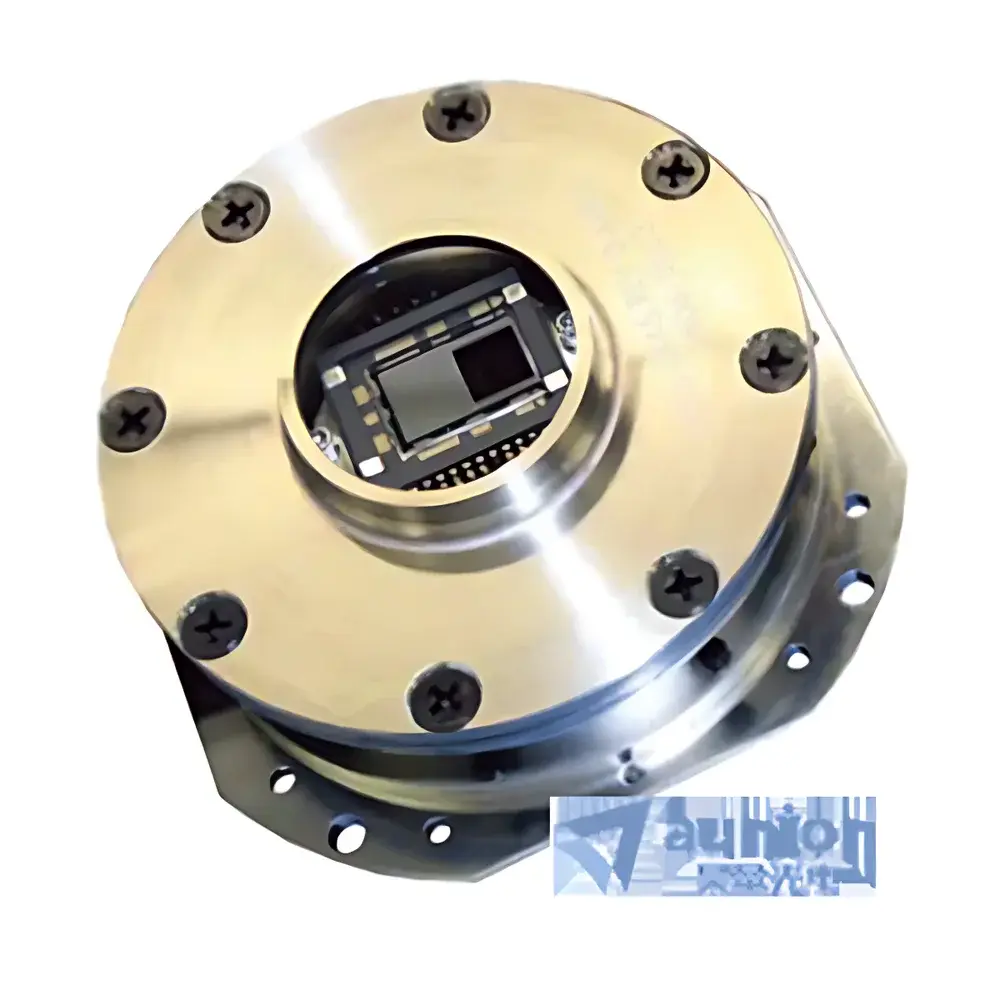
Teledyne Princeton Instruments ProEM Series Electron-Multiplying CCD Camera
| Brand | Teledyne Princeton Instruments |
|---|---|
| Model | ProEM Series |
| Sensor Type | Back-Illuminated EMCCD |
| Effective Pixels | 1024 × 1024 (1.05 MP) |
| Pixel Size | 10 µm |
| Quantum Efficiency | >95% (UV–NIR, via eXcelon™3 technology) |
| Cooling | Vacuum-cooled to –90 °C |
| Readout Speed | Up to 20 kHz spectral rate |
| Frame Rate | Up to 34 fps (full frame) or >3 kHz (spectral mode) |
| Architecture | Frame-transfer |
| EM Gain Calibration | Integrated OptiCAL reference source |
| Software | LightField v8+ with LabVIEW®/MATLAB® integration and PICAM SDK support |
| Compliance | Designed for GLP/GMP-aligned workflows |
Overview
The Teledyne Princeton Instruments ProEM Series is a high-performance, back-illuminated electron-multiplying charge-coupled device (EMCCD) camera engineered for quantitative low-light scientific imaging and spectroscopy. Based on the proprietary eXcelon™3 deep-depletion sensor architecture, the ProEM delivers exceptional quantum efficiency (>95%) across ultraviolet (200 nm) to near-infrared (1100 nm) wavelengths while suppressing etaloning—interference fringes inherent to thick, back-illuminated silicon sensors. Its frame-transfer design eliminates mechanical shutter requirements, enabling true continuous acquisition for time-resolved luminescence, single-molecule tracking, and high-speed spectral dynamics. Operating at cryogenic temperatures down to –90 °C under ultra-high vacuum, the ProEM achieves sub-0.002 e⁻/pix/s dark current at –70 °C—critical for long-exposure applications such as Raman hyperspectral mapping and photon-starved fluorescence correlation spectroscopy.
Key Features
- Back-illuminated eXcelon™3 EMCCD sensor with >95% peak QE from UV to NIR
- Vacuum-sealed, thermoelectrically cooled housing achieving stable –90 °C sensor temperature
- Frame-transfer architecture supporting shutterless operation and high duty-cycle acquisition
- Real-time EM gain calibration via integrated OptiCAL reference light source—ensuring gain stability over instrument lifetime
- High-speed readout: up to 20 kHz spectral line rate; full-frame imaging at 34 fps or >3 kHz in spectral binning mode
- 1024 × 1024 pixel array with 10 µm pitch, optimized for resolution–sensitivity trade-off in spectroscopic and widefield applications
- On-chip overscan and bias correction delivering single-count baseline stability
Sample Compatibility & Compliance
The ProEM Series is compatible with standard C-mount and F-mount optical interfaces, and integrates natively with Princeton Instruments’ Acton spectrographs, IsoPlane imaging spectrometers, and third-party optical benches via industry-standard flange specifications (e.g., SM1, SM2). It supports vacuum-, purged-, and ambient-operated sample environments through configurable window options (UV-fused silica, MgF₂, or AR-coated BK7). From a regulatory standpoint, LightField software—when configured with optional audit trail and electronic signature modules—enables compliance with FDA 21 CFR Part 11, ISO/IEC 17025, and GLP/GMP documentation requirements. The camera’s deterministic gain response, calibrated dark current profiles, and traceable factory characterization data support metrological traceability per ISO/IEC 17025 Annex A.5.
Software & Data Management
ProEM cameras are fully controlled by LightField v8+, a modular, scriptable acquisition and analysis platform. LightField provides hardware-synchronized triggering, real-time mathematical operations (e.g., pixel-wise SNR mapping, spectral centroid tracking), and direct export to HDF5, TIFF, and CSV formats. Its native LabVIEW® and MATLAB® APIs enable seamless integration into automated test systems and custom analysis pipelines. For OEM integration, the PICAM Software Development Kit (SDK) offers low-level C/C++/Python access without abstraction-layer latency—ideal for time-critical applications requiring deterministic exposure timing and buffer management. All firmware and calibration metadata (including gain maps, dark frames, and QE curves) are embedded in image headers and preserved across software versions.
Applications
- Ultra-low-light fluorescence microscopy: single-molecule localization (SMLM), TIRF, and FLIM
- Hyperspectral Raman imaging of biological tissues, 2D materials, and pharmaceutical formulations
- Astronomical adaptive optics wavefront sensing and lucky imaging
- Time-resolved photoluminescence decay analysis in semiconductor defect characterization
- Plasmonic nanoparticle scattering kinetics and super-resolution correlation spectroscopy
- Quantitative chemiluminescence detection in microfluidic assay platforms
FAQ
What cooling performance does the ProEM achieve, and how is thermal stability maintained?
The ProEM utilizes a multi-stage thermoelectric cooler within a hermetically sealed vacuum chamber to reach and hold –90 °C sensor temperature. Temperature is monitored via dual platinum RTDs and regulated with ±0.05 °C stability over 24 hours—ensuring reproducible dark current and EM gain behavior across multi-day experiments.
How is EM gain calibrated, and how often must it be repeated?
OptiCAL—a built-in pulsed LED reference source—enables one-button, in-situ EM gain calibration. Calibration is recommended before critical experiments or after extended idle periods (>72 h); once performed, gain maps remain valid for ≥6 months under stable thermal conditions.
Does the ProEM support synchronized multi-camera or multi-device triggering?
Yes. LightField supports hardware-level TTL and LVDS triggering with sub-microsecond jitter. Multiple ProEM units—or combinations with spectrographs, lasers, or shutters—can be synchronized via external trigger distribution or master-slave clocking modes.
Can raw sensor data be accessed without LightField processing?
Absolutely. PICAM SDK provides direct memory-mapped access to uncorrected pixel values (including overscan regions), enabling custom flat-field, dark, and gain correction routines outside LightField’s pipeline.
Is the ProEM suitable for quantitative intensity measurements?
Yes. Factory-characterized linearity (±0.5% over 99% of full well), certified QE curves, and EM gain calibration ensure photometric accuracy traceable to NIST standards—making it appropriate for absolute photon flux quantification in peer-reviewed publications and regulatory submissions.




