
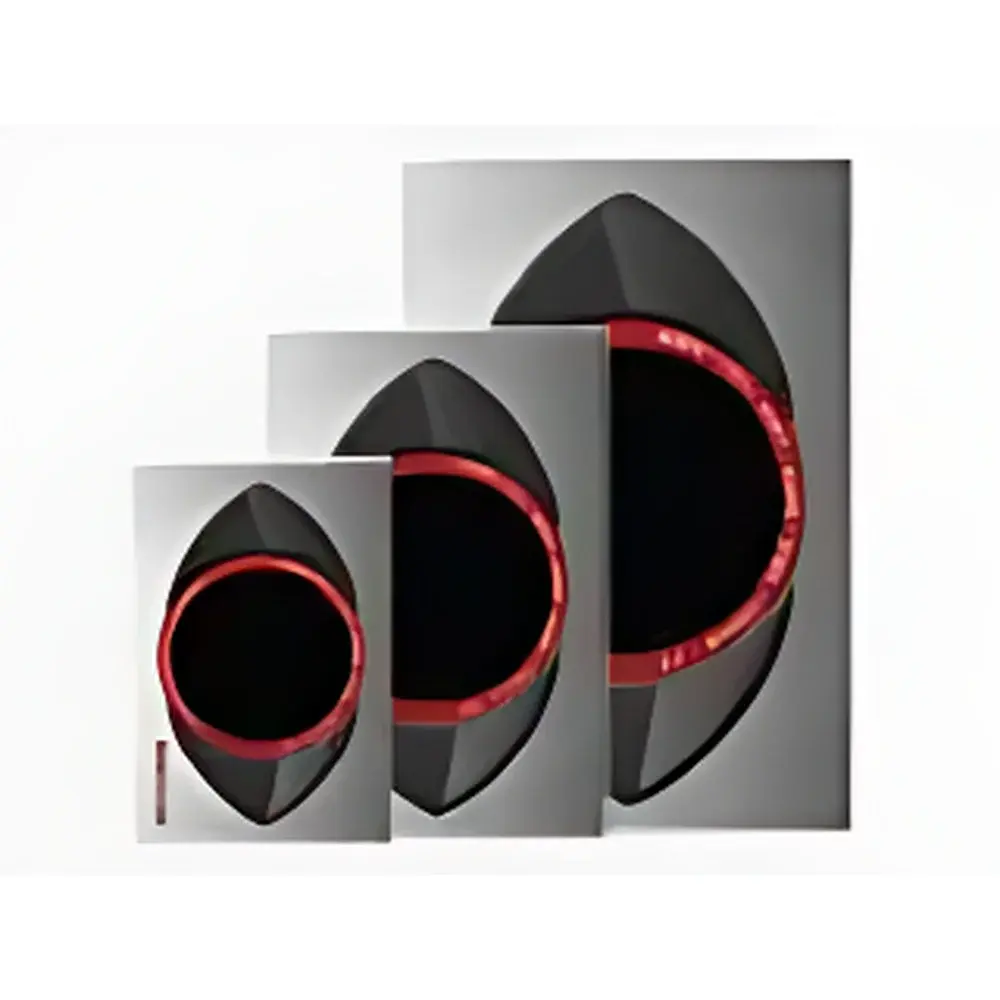
TeraCard THz Visualization Card by NeTHIS
| Brand | NeTHIS |
|---|---|
| Origin | France |
| Model | TC-XX |
| Spectral Range | 0.1–3000 µm |
| Sensitive Diameter | 40 mm / 50 mm / 70 mm |
| Minimum Detectable Irradiance | 100 µW/cm² |
| Optical Damage Threshold | 1 W/cm² |
| Dimensions (TC-40/TC-50/TC-70) | 85×54 mm / 120×80 mm / 120×80 mm |
| Core Component | Semiconductor-based optothermal conversion element |
Overview
The TeraCard THz Visualization Card is a passive, real-time optical diagnostic tool engineered for the safe and intuitive visualization of electromagnetic radiation across an exceptionally broad spectral range—from deep ultraviolet (0.1 µm) through visible and near-infrared to far-infrared and terahertz (up to 3000 µm). Unlike active imaging systems requiring power, cooling, or complex optics, the TeraCard operates on a solid-state optothermal principle: incident radiation is absorbed by a proprietary semiconductor-sensitive layer, inducing localized thermal expansion that modulates surface reflectivity. This transient contrast change is directly observable under ambient lighting or with standard visible-light documentation equipment—enabling immediate beam profiling, alignment verification, and qualitative intensity mapping without signal processing latency or calibration drift.
Key Features
- Ultra-broadband spectral response (0.1–3000 µm), covering UV, VIS, NIR, MIR, FIR, and THz bands in a single compact card
- Passive operation—no external power, batteries, or electronics required; inherently immune to electromagnetic interference (EMI)
- Three standardized aperture sizes (TC-40: Ø40 mm; TC-50: Ø50 mm; TC-70: Ø70 mm) optimized for divergent beams, collimated sources, and large-area illumination
- High optical damage threshold (1 W/cm² continuous wave) and low minimum detectable irradiance (100 µW/cm²), supporting both high-power alignment tasks and low-intensity thermal emission studies
- Compatible with standard laser safety eyewear—no spectral filtering or attenuation compromises visibility or safety compliance
- Rugged, portable form factor (85×54 mm for TC-40; 120×80 mm for TC-50/TC-70) with chemically stable, non-hygroscopic substrate suitable for cleanroom and field-deployable use
Sample Compatibility & Compliance
The TeraCard is compatible with all coherent and incoherent radiation sources emitting within its spectral window—including femtosecond Ti:sapphire lasers, quantum cascade lasers (QCLs), CO₂ lasers, globar sources, blackbody emitters, and synchrotron broadband pulses. Its material composition and thermal response profile conform to ISO 11551 (laser-induced damage testing methodology) and meet the physical robustness requirements outlined in IEC 60825-1 for Class 1 optical viewing aids. While not a measurement standard per se, the card’s consistent thermal response enables semi-quantitative comparative assessments traceable to calibrated radiometers. It is routinely employed in GLP-compliant alignment workflows where documentation of beam presence, shape, and positional stability is required prior to instrument qualification (e.g., FTIR spectrometer alignment, THz time-domain spectroscopy pump-probe path setup).
Software & Data Management
As a purely analog visualization medium, the TeraCard requires no software drivers, firmware updates, or proprietary interfaces. Beam images captured via DSLR, smartphone, or microscope-mounted cameras can be integrated into existing laboratory documentation systems—including LIMS, ELN platforms (e.g., LabArchives, Benchling), and PDF-based SOP archives—without format conversion or metadata injection constraints. When used in conjunction with calibrated reference sources, image brightness histograms may be correlated with irradiance maps using open-source tools (e.g., Python + OpenCV), supporting audit-ready records compliant with FDA 21 CFR Part 11 when paired with electronic signature workflows.
Applications
- Laser beam alignment and spatial mode verification in ultrafast, mid-IR, and THz optical tables
- Qualitative thermal emission mapping from microscale heaters, MEMS devices, or biological samples under controlled IR illumination
- Blackbody radiation visualization in vacuum chamber environments (e.g., cryostat windows, furnace viewports)
- Multispectral source characterization during system integration—cross-verifying output from broadband LEDs, supercontinuum sources, or plasma lamps
- Educational demonstrations of electromagnetic spectrum continuity and thermal detection principles in physics and photonics curricula
- Field diagnostics of industrial IR heating systems, semiconductor wafer annealing tools, and non-destructive testing (NDT) sources
FAQ
Is the TeraCard calibrated for quantitative radiometric measurements?
No—the TeraCard provides qualitative, real-time visual feedback. For quantitative irradiance values, it must be used alongside a NIST-traceable radiometer or thermopile sensor.
Can it be used inside vacuum or inert-gas environments?
Yes—its solid-state construction and absence of outgassing materials make it suitable for UHV (<10⁻⁷ mbar) and glovebox applications.
Does spectral sensitivity vary across the 0.1–3000 µm range?
Yes—peak responsivity occurs between 1–100 µm (mid-to-far IR); UV and THz ends exhibit reduced but usable contrast. Refer to NeTHIS TC-series spectral responsivity curves (available upon request).
How should the card be cleaned after exposure to contaminants?
Gently wipe with lint-free optical tissue moistened with isopropanol; avoid abrasives or ultrasonic cleaning, which may degrade the semiconductor absorption layer.
Is there a recommended minimum working distance for optimal beam visualization?
For collimated beams, 10–50 cm provides optimal contrast-to-noise ratio; for divergent sources, position the card at the beam waist location determined by knife-edge or scanning-slit analysis.




