
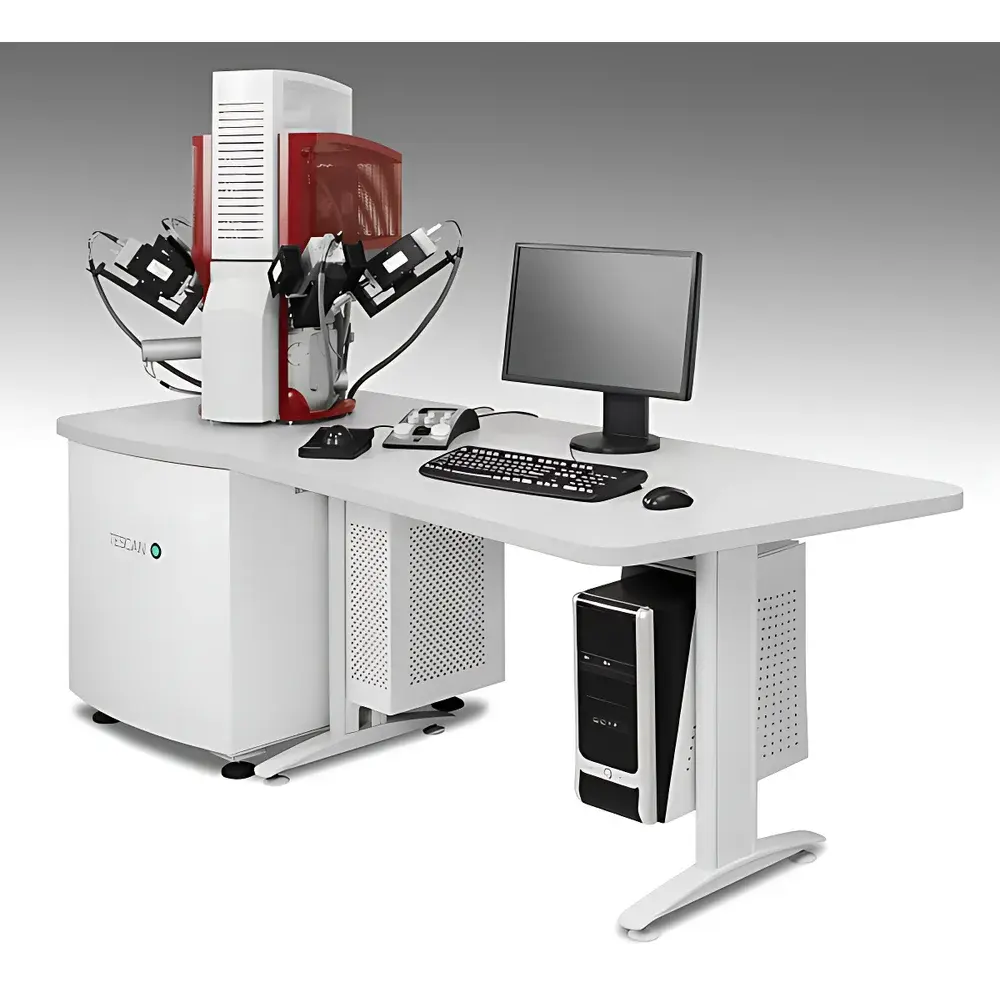
TESCAN TIMA-X FEG LM Integrated Mineral Analyzer
| Brand | TESCAN |
|---|---|
| Origin | Czech Republic |
| Manufacturer Type | Original Equipment Manufacturer (OEM) |
| Instrument Category | Imported |
| Model | TIMA-X FEG LMU/LMH |
| Electron Source | Cold Field Emission Gun (CFEG) |
| Secondary Electron Resolution | 1.2 nm @ 30 kV |
| Magnification Range | 1× to 1,000,000× |
| Accelerating Voltage | 0.2–30 kV |
| Backscattered Electron Resolution | 2.0 nm @ 15 kV |
| EDX Detector Configuration | Up to 4 Peltier-cooled Silicon Drift Detectors (SDD) |
| Sample Chamber | Large-volume, motorized multi-position stage accommodating up to seven 30 mm-diameter samples |
| Vacuum Mode | High Vacuum (standard), Low Vacuum (optional) |
| Platform Base | MIRA FEG SEM platform with differential pumping and gun isolation valve |
Overview
The TESCAN TIMA-X FEG LM is a purpose-built, fully integrated mineralogical analysis system engineered for quantitative, automated characterization of geological and metallurgical materials at the micrometer-to-submicron scale. Built upon the high-stability MIRA field-emission scanning electron microscope platform, the TIMA-X FEG LM combines cold field emission electron optics with a deeply embedded energy-dispersive X-ray spectroscopy (EDX) architecture to deliver simultaneous high-resolution imaging and rapid, full-spectrum elemental mapping. Its operational principle relies on raster-scanned electron beam interaction with polished or bulk mineral specimens, generating secondary electrons (SE), backscattered electrons (BSE), and characteristic X-rays—each channel calibrated and synchronized in real time. This enables pixel-registered compositional segmentation, phase identification, liberation analysis, and textural quantification without manual intervention. Designed specifically for mining, ore processing, resource evaluation, and critical raw materials exploration—including rare earth elements (REEs) and precious metals—the system operates under rigorous industrial metrology requirements and supports traceable, auditable workflows compliant with GLP and ISO/IEC 17025 frameworks.
Key Features
- Native integration of up to four Peltier-cooled silicon drift detectors (SDDs), enabling high-count-rate, low-noise spectral acquisition across the full energy range (0.1–20 keV)
- MIRA FEG platform with cold field emission source, delivering exceptional beam stability, sub-nanometer resolution (1.2 nm SE @ 30 kV), and long-term emission consistency
- Motorized multi-sample stage with built-in BSE/EDX calibration standards (Mn, Cu, SiO₂, C, Au) and Faraday cup for absolute current measurement and signal normalization
- Adaptive dwell-time control per pixel or region-of-interest, optimizing acquisition speed versus spectral quality for heterogeneous mineral assemblages
- Dual-mode vacuum architecture: high-vacuum operation (≤1×10⁻⁶ Pa) for maximum resolution and low-vacuum capability (optional) for uncoated or moderately conductive samples
- Modular software architecture supporting offline reprocessing, batch analysis, and customizable classification rules based on chemical composition, morphology, and spatial context
Sample Compatibility & Compliance
The TIMA-X FEG LM accommodates a broad spectrum of geological specimens—including polished thin sections (up to 30 mm diameter), drill core fragments, ore concentrates, slag, tailings, and synthetic reference materials. The large-chamber design permits flexible mounting of irregular or oversized samples using custom fixtures. All hardware and software components comply with CE marking directives and electromagnetic compatibility (EMC) standards. Data acquisition protocols support audit trails, user authentication, and electronic signatures aligned with FDA 21 CFR Part 11 requirements when configured with validated software modules. Routine performance verification follows ASTM E1508 (quantitative microanalysis) and ISO 16577 (electron probe microanalysis), ensuring traceability to international reference materials such as NIST SRM 2100 series.
Software & Data Management
TIMA Suite software provides end-to-end workflow automation—from automated stage navigation and focus/stigmation routines to real-time spectral deconvolution and phase classification. It includes dedicated modules for mineral liberation analysis (MLA), grain boundary detection, porosity quantification, and particle size distribution (PSD) derived from segmented BSE/EDX maps. All acquired spectra are stored in vendor-neutral HDF5 format, enabling interoperability with third-party tools (e.g., Python-based PyMCA, DTSA-II). Raw data archives include metadata tags for instrument parameters, calibration history, operator ID, timestamp, and environmental conditions. Version-controlled method templates ensure reproducibility across shifts and laboratories, while encrypted database backups meet ISO 27001-aligned information security policies.
Applications
- Quantitative mineralogical reporting for feasibility studies and reserve estimation
- Liberation and association analysis of sulfide, oxide, and silicate minerals in base metal ores
- Process mineralogy support for flotation circuit optimization and grinding media selection
- Critical raw materials assessment—including REE-bearing phases (e.g., monazite, xenotime), PGE-rich sulfides, and lithium-bearing spodumene
- Tailings characterization for environmental risk assessment and reprocessing potential
- Geometallurgical modeling through correlation of textural parameters with metallurgical response
FAQ
What distinguishes TIMA-X FEG LM from conventional SEM-EDX systems?
Its hardware-level synchronization between electron optics and multiple SDDs eliminates sequential acquisition delays, enabling true parallel imaging and spectroscopy at pixel rates exceeding 100 kHz.
Can the system analyze uncoated or non-conductive samples?
Yes—when equipped with optional low-vacuum mode and charge compensation, it accommodates semi-conductive or insulating geological materials without sputter coating.
Is remote operation and monitoring supported?
Full remote access is enabled via secure TLS-encrypted VNC or browser-based interface, including live camera feed, real-time map preview, and queue management.
How is calibration maintained over extended operation?
Automated daily calibration routines verify detector gain, dead time, and peak shape using on-stage reference standards; all calibrations are logged with digital signatures and version stamps.
Does TIMA Suite support integration with LIMS or enterprise databases?
Yes—through configurable ODBC/JDBC connectors and RESTful API endpoints, enabling bidirectional data exchange with laboratory information management systems and ERP platforms.




