
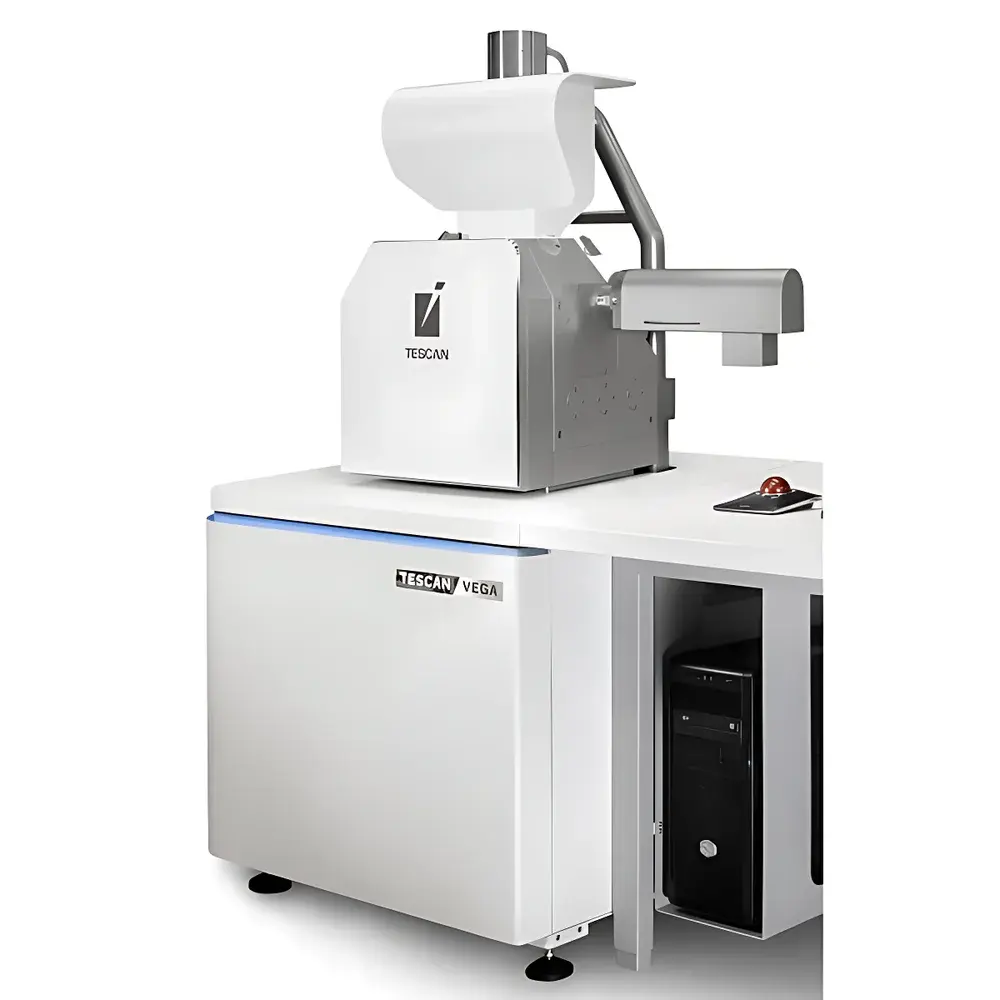
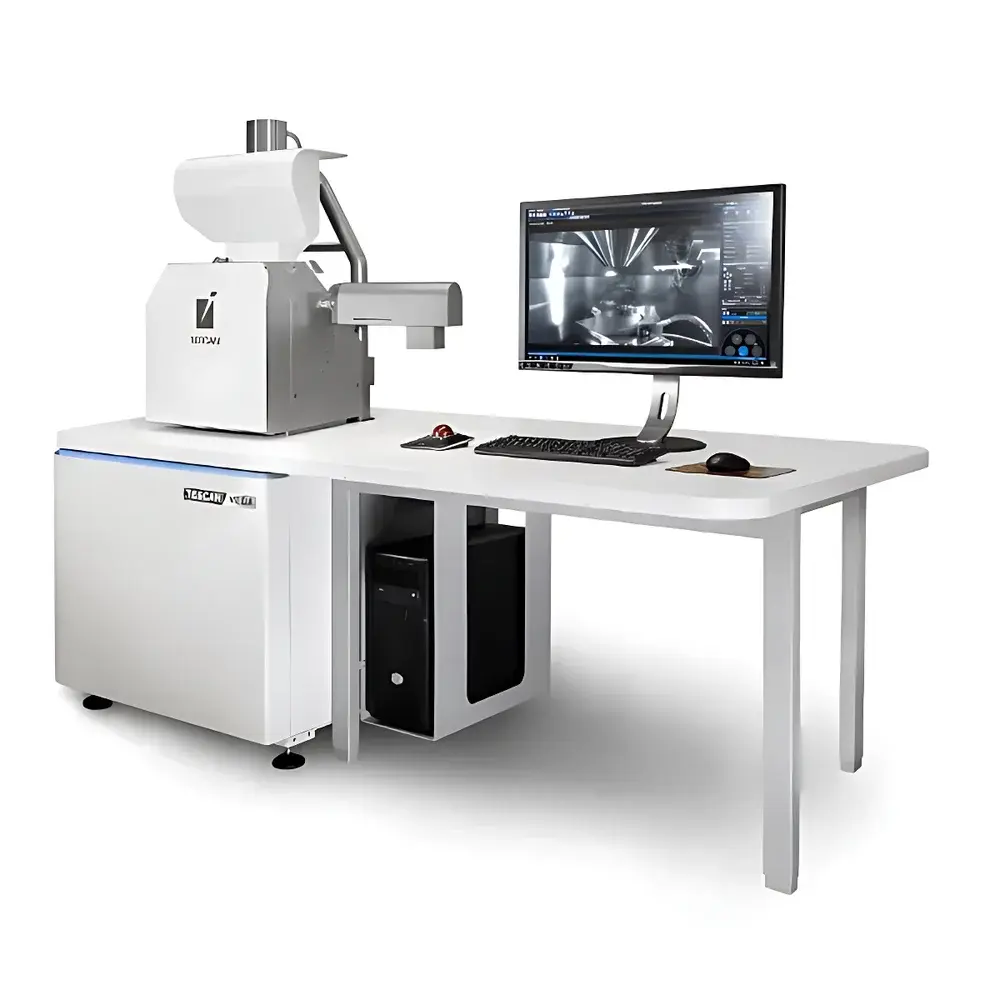
TESCAN VEGA Scanning Electron Microscope (SEM)
| Brand | TESCAN |
|---|---|
| Origin | Czech Republic |
| Model | TESCAN-VEGA |
| Instrument Type | Floor-standing Conventional SEM |
| Electron Source | Tungsten Filament |
| Secondary Electron Resolution | 3.0 nm @ 30 kV |
| Magnification Range | 2× to 1,000,000× |
| Accelerating Voltage | 200 V – 30 kV (continuously adjustable) |
| Backscattered Electron Resolution | 3.5 nm @ 30 kV |
Overview
The TESCAN VEGA Scanning Electron Microscope (SEM) is a fourth-generation tungsten-filament SEM engineered for high-resolution surface imaging and integrated microanalysis in routine and research laboratories. Operating on the principle of raster-scanned electron beam interaction with solid specimens, the VEGA generates topographic, compositional, and crystallographic contrast via secondary electrons (SE), backscattered electrons (BSE), and characteristic X-rays. Designed for robustness, ease of operation, and analytical versatility, it serves as a foundational tool for nanoscale characterization across materials science, life sciences, geosciences, and industrial quality assurance. Its modular architecture supports future expansion while maintaining compliance with standard laboratory infrastructure requirements.
Key Features
- Integrated Essence™ Software Platform: Unifies real-time SEM imaging and energy-dispersive X-ray spectroscopy (EDS) analysis within a single graphical interface—enabling simultaneous morphological observation and elemental mapping without workflow interruption.
- In-Flight Beam Tracing™ Technology: Eliminates mechanical apertures and dynamically optimizes beam alignment and focus during acquisition—reducing setup time and improving reproducibility of imaging and analytical conditions.
- Wide Field Optics™: Delivers true optical-level navigation down to 2× magnification, allowing rapid specimen positioning and region-of-interest selection without auxiliary optical cameras or manual stage repositioning.
- SingleVac™ Mode: Standard low-vacuum functionality permits direct imaging of non-conductive, hydrated, or beam-sensitive samples—including polymers, biological tissues, and uncoated geological specimens—without sputter coating.
- 3D Beam Technology: Enables acquisition of stereoscopic image pairs with synchronized tilt control, facilitating intuitive depth perception and quantitative surface topography reconstruction.
- Essence™ 3D Collision Avoidance Module: Provides real-time spatial visualization of detector positions, stage coordinates, and chamber geometry—preventing physical interference during automated stage movement or multi-detector configurations.
- Vacuum Buffer Unit: Reduces mechanical pump runtime by up to 70% through intelligent vacuum staging, lowering power consumption and extending pump service intervals—supporting ISO 50001-aligned lab sustainability goals.
Sample Compatibility & Compliance
The VEGA accommodates diverse sample geometries—up to 200 mm in diameter and 100 mm in height—with motorized 5-axis eucentric stage control. Its SingleVac™ mode ensures stable imaging of insulating materials (e.g., ceramics, composites, paper, textiles) and delicate biological specimens under pressures up to 130 Pa. The system complies with IEC 61000-6-3 (EMC emissions) and IEC 61000-6-2 (immunity), and supports audit-ready documentation for GLP and GMP environments when configured with optional 21 CFR Part 11-compliant software modules. Routine calibration adheres to ASTM E1558 and ISO 16700 standards for SEM resolution verification.
Software & Data Management
Essence™ provides a unified environment for instrument control, image acquisition, spectral processing (EDS), and report generation. All operations—including beam alignment, stage navigation, detector switching, and quantitative analysis—are fully scriptable via Python API. Raw data (images, spectra, maps) are stored in vendor-neutral formats (TIFF, HDF5, .emsa) compatible with third-party analysis suites such as DTSA-II, HyperSpy, and Thermo Scientific Pathfinder. Audit trails record user actions, parameter changes, and acquisition timestamps—essential for regulatory submissions and internal QA/QC traceability.
Applications
- Materials Science: Fractography of metals and alloys; dispersion analysis in polymer nanocomposites; porosity quantification in cementitious matrices; fiber morphology in textiles and wood pulp.
- Life Sciences: Cellular ultrastructure imaging in fixed tissue sections; particle uptake studies in drug delivery systems; pollen grain surface topology; biofilm architecture on medical implants.
- Earth Sciences: Mineral phase identification and textural classification in thin sections; fossil microstructure preservation assessment; slag and fly ash particle morphology for recycling feasibility studies.
- Industrial QA/QC: Contamination root-cause analysis in semiconductor packaging; coating thickness uniformity verification; wear debris characterization in lubricants; solder joint integrity inspection.
FAQ
What vacuum modes does the TESCAN VEGA support?
The VEGA operates in high vacuum (HV) mode for maximum resolution on conductive samples and SingleVac™ low-vacuum mode (up to 130 Pa) for uncoated, non-conductive, or hydrated specimens.
Is EDS integration mandatory or optional?
EDS is available as a fully integrated module via the Essence™ platform—but hardware installation is optional and configured per user requirement at time of order.
Can the VEGA perform automated particle analysis?
Yes—when equipped with optional Particle Metric™ software, the system executes standardized workflows for size, shape, and composition-based particle classification per ISO 13322-2 and ASTM E1245 guidelines.
Does the system support remote operation and monitoring?
Essence™ includes secure remote desktop access and web-based status dashboards—enabling off-site instrument monitoring, diagnostics, and collaborative session sharing across institutional networks.
What maintenance intervals are recommended for the tungsten filament?
Typical filament lifetime ranges from 100–200 hours depending on operating voltage and vacuum conditions; replacement is performed in <15 minutes without breaking vacuum on most configurations.





