
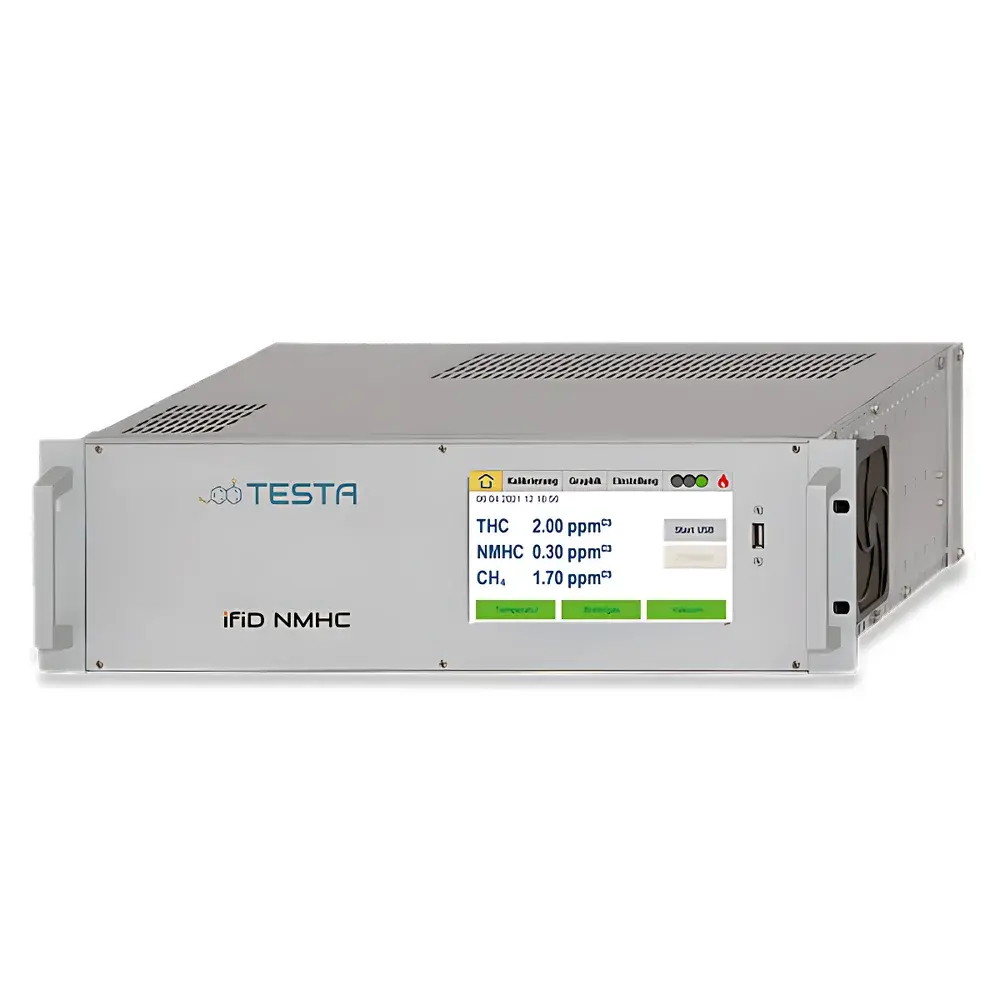
Testa iFiD NMHC Online Total Hydrocarbon Analyzer
| Brand | Testa |
|---|---|
| Origin | Germany |
| Model | iFiD NMHC |
| Detection Principle | Flame Ionization Detection (FID) |
| Instrument Type | Online Analyzer |
| Measurement Range | 0–10,000 ppmC₁ (as methane equivalent) |
| Response Time | 1 s (T₉₀) |
| Detector Temperature | 190 °C |
| Filter Temperature | 300 °C |
| Repeatability | ±1% of full scale |
| Zero Drift | ±1% FS over 24 h |
| Warm-up Time | 15 min |
| Analog Output | 0–20 mA / 0–10 V |
| Digital Interface | Ethernet, RS232 |
| Data Storage | USB |
| Remote Access | VNC/PC |
| Power Supply | 100–240 V AC, 50–60 Hz, 350 W |
| Operating Ambient Temperature | 0–45 °C |
| Enclosure Rating | IP40 |
| Dimensions | 19″ Rack, 133 × 482 × 420 mm |
| Weight | 15 kg |
| Fuel Gas | H₂ (Grade 5) or He/H₂ mixture |
| Zero Gas | N₂ or synthetic air |
| Calibration Gas | C₃H₈ |
| Combustion Air | Internally pumped |
| Fuel Consumption | 70 mL/min H₂ or 400 mL/min He/H₂ |
| Calibration Gas Flow | 1 L/min |
| Pressure Compensation Range | −150 to +500 hPa |
Overview
The Testa iFiD NMHC Online Total Hydrocarbon Analyzer is a high-stability, continuous-emission monitoring (CEM) system engineered for precise, real-time quantification of non-methane hydrocarbons (NMHC) and total hydrocarbons (THC) in industrial gas streams. Based on flame ionization detection (FID) — a reference method standardized under EPA Method 25A, EN 12619, and ISO 8573-5 — the instrument delivers robust, linear response across a wide dynamic range (0–10,000 ppmC₁ as methane equivalent). Its heated sample path (up to 300 °C hot filter, 190 °C detector) ensures complete vaporization of semi-volatile organics and eliminates condensation artifacts common in ambient-temperature sampling lines. Designed for unattended operation in demanding environments — including stack emissions, biogas upgrading, automotive cabin air testing, and thermal oxidizer control — the iFiD NMHC meets core requirements for regulatory compliance, process optimization, and R&D-grade data integrity.
Key Features
- FID-based detection with 1-second T₉₀ response time, enabling rapid transient tracking in dynamic exhaust or purge streams.
- Integrated high-temperature filtration (300 °C) and detector heating (190 °C) to prevent adsorption losses and maintain accuracy for C₂–C₁₂ hydrocarbons.
- Internal pressure-compensated mass flow control (−150 to +500 hPa), eliminating need for external back-pressure regulators in variable-stack-pressure applications.
- Dual-channel analog outputs (0–20 mA / 0–10 V) and digital interfaces (Ethernet + RS232) support seamless integration into DCS, SCADA, and PLC-based control architectures.
- Onboard data logging via USB storage with timestamped records compliant with GLP/GMP audit-trail expectations; optional VNC-enabled remote diagnostics and parameter adjustment.
- Modular configuration options: compatible with single-point or dual-point sampling manifolds, optional NMHC separation module (methane scrubber), and integrated zero-air catalytic purifier for ultra-low background stability.
Sample Compatibility & Compliance
The iFiD NMHC accepts raw, humid, or particulate-laden sample gases from combustion sources, landfill vents, paint booths, and engine test cells — provided inlet particulates are pre-filtered to <1 µm. Its FID response is proportional to carbon atom count, making it suitable for quantifying total volatile organic compounds (TVOC) as ppmC₁ or mgC/m³ (reported as NMHC, CH₄, or THC). The analyzer conforms to key international standards: EN 15267-3 (QAL1 certification framework), EN 14181 (ASTM D6348 alignment), and supports compliance reporting per EU IED Annex VIII, US EPA 40 CFR Part 60 Subpart Ja, and ISO 14001 environmental management systems. All firmware and calibration logs retain immutable timestamps for 21 CFR Part 11-compliant electronic records when paired with validated IT infrastructure.
Software & Data Management
Control and visualization are managed through a 7″ industrial TFT touchscreen interface running embedded Linux OS. The native UI provides real-time trend plots, alarm thresholds (configurable high/low limits), and calibration history with operator ID tagging. Raw measurement data (including analog input diagnostics, detector current, and flow status) are stored locally on removable USB media in CSV format. Optional PC software enables automated calibration scheduling, report generation (PDF/Excel), and export to SQL databases. Audit trails record all configuration changes, zero/span events, and user logins — supporting internal QA reviews and third-party verification audits without requiring proprietary drivers or cloud dependencies.
Applications
- Continuous Emission Monitoring (CEM): Regulatory reporting for VOCs from incinerators, chemical reactors, and coating lines per local air quality ordinances.
- Automotive Interiors Testing: Real-time TVOC profiling during climate-controlled cabin aging tests per ISO 12219-4 and VDA 278 protocols.
- Waste Treatment & Biogas Facilities: Monitoring NMHC slip across thermal oxidizers and flare stacks to ensure destruction efficiency >95%.
- Fuel Cell & Engine Development: Quantifying unburnt hydrocarbons in exhaust recirculation (EGR) streams and aftertreatment durability studies.
- Process Safety & Leak Detection: Integration into LDAR (Leak Detection and Repair) programs for early identification of fugitive emissions in petrochemical plants.
FAQ
What gases does the iFiD NMHC detect?
It measures total ionizable carbon-containing compounds (C₁–C₁₂) via FID, reporting results as ppmC₁ (methane-equivalent), mgC/m³, or %LEL-equivalent. Methane is reported separately when used with the optional CH₄/NMHC dual-channel configuration.
Is hydrogen fuel gas mandatory?
H₂ (Grade 5, ≤1 ppm O₂) is the recommended fuel for optimal sensitivity and linearity. A He/H₂ blend (e.g., 95/5) may be substituted where H₂ infrastructure is unavailable, though with ~30% lower signal-to-noise ratio.
Can the analyzer operate outdoors?
The IP40-rated enclosure is intended for indoor or sheltered outdoor cabinet mounting. For direct exposure, an external NEMA 4X climate-controlled housing is required to maintain ambient temperature within 0–45 °C.
How often is calibration required?
Initial QAL2 validation per EN 14181 recommends quarterly span checks with certified C₃H₈ standard; zero verification should occur daily or before each critical measurement campaign using catalytically purified air or nitrogen.
Does it support automatic zero/span functions?
Yes — programmable auto-zero (N₂/synthetic air) and auto-span (C₃H₈) sequences can be scheduled via touchscreen or remote command, with full event logging and deviation alerts.







