
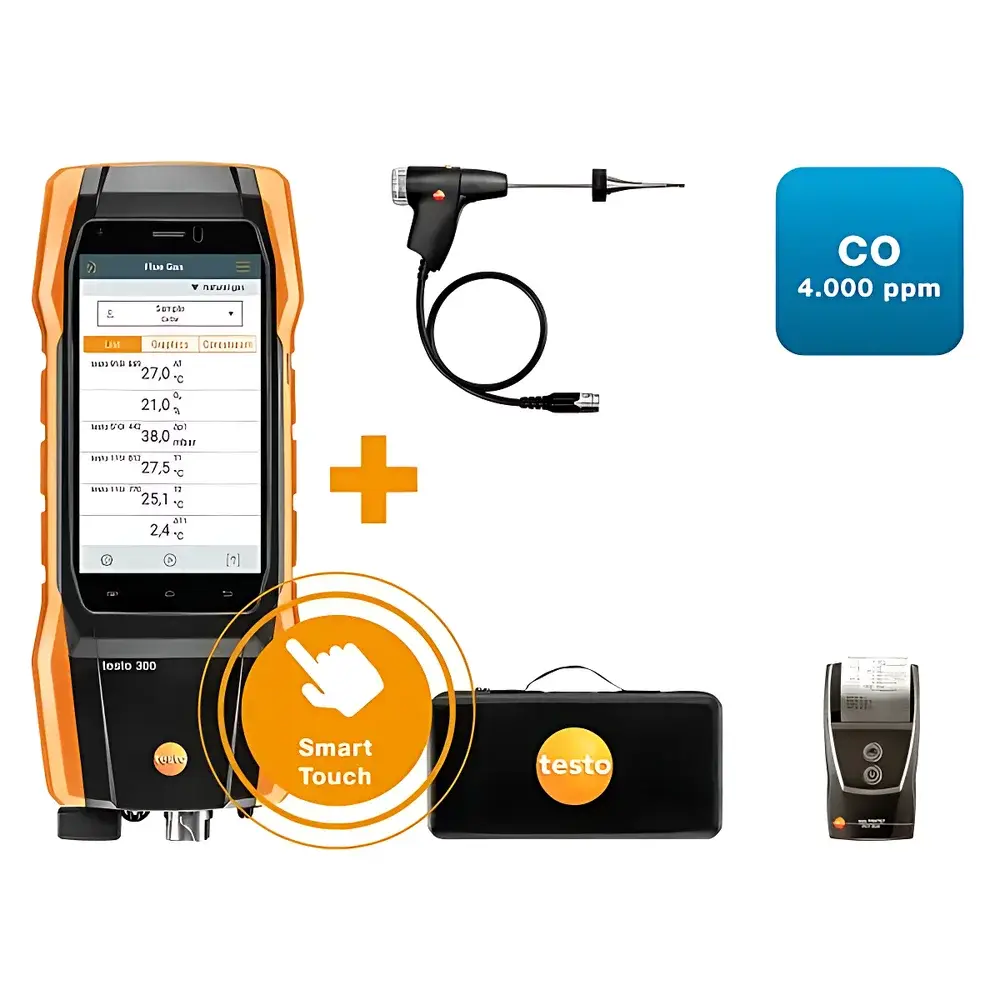
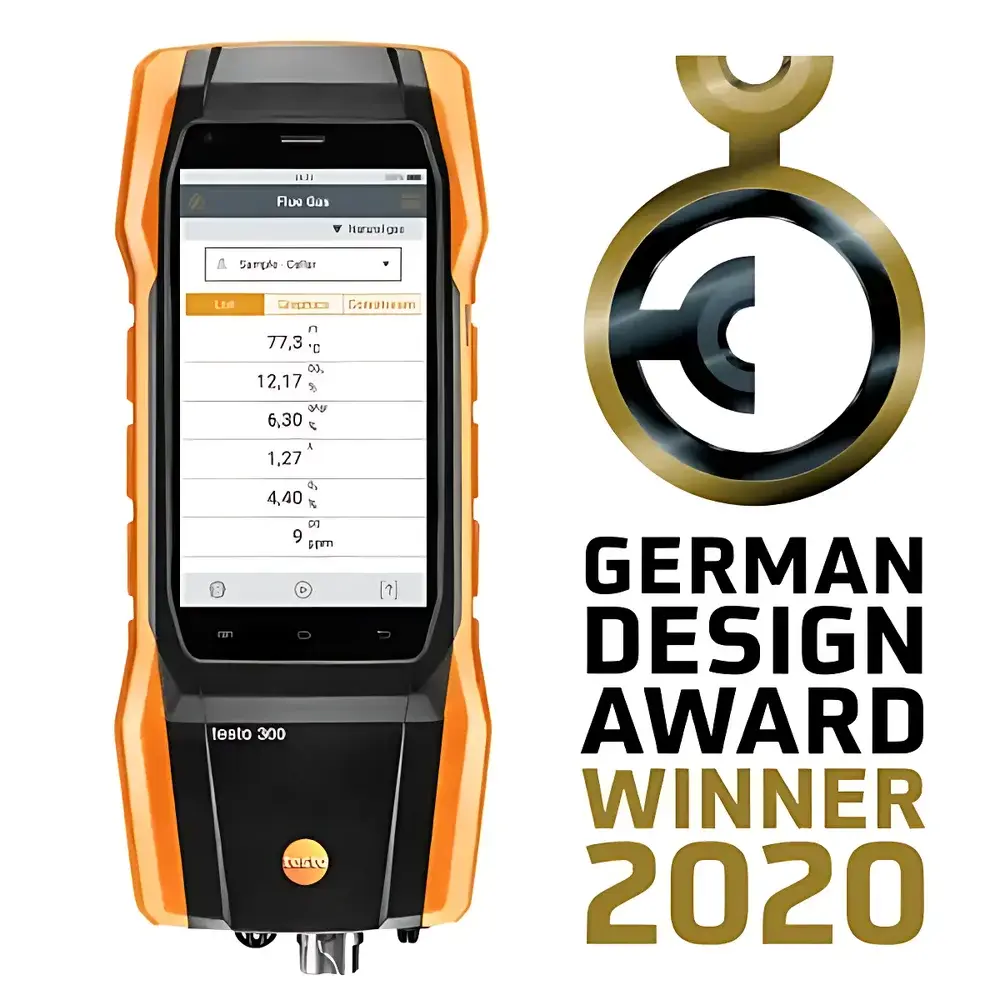
testo 300 Portable Flue Gas Analyzer
| Brand | testo |
|---|---|
| Origin | Germany |
| Model | testo 300 |
| Instrument Type | Portable Flue Gas Analyzer |
| Measurement Accuracy | ≤ ±5% FS |
| Repeatability | ≤ ±5% FS |
| Response Time | ≤ 90 s |
| Drift Stability | ≤ 5% reading over 1 h |
| Measured Gases | O₂, CO |
| O₂ Range | 0–21 vol.% |
| CO Range | 0–4,000 ppm |
| Certified | TÜV-tested per EN 50379-1 & EN 50379-2 |
| Display | Integrated capacitive touch screen |
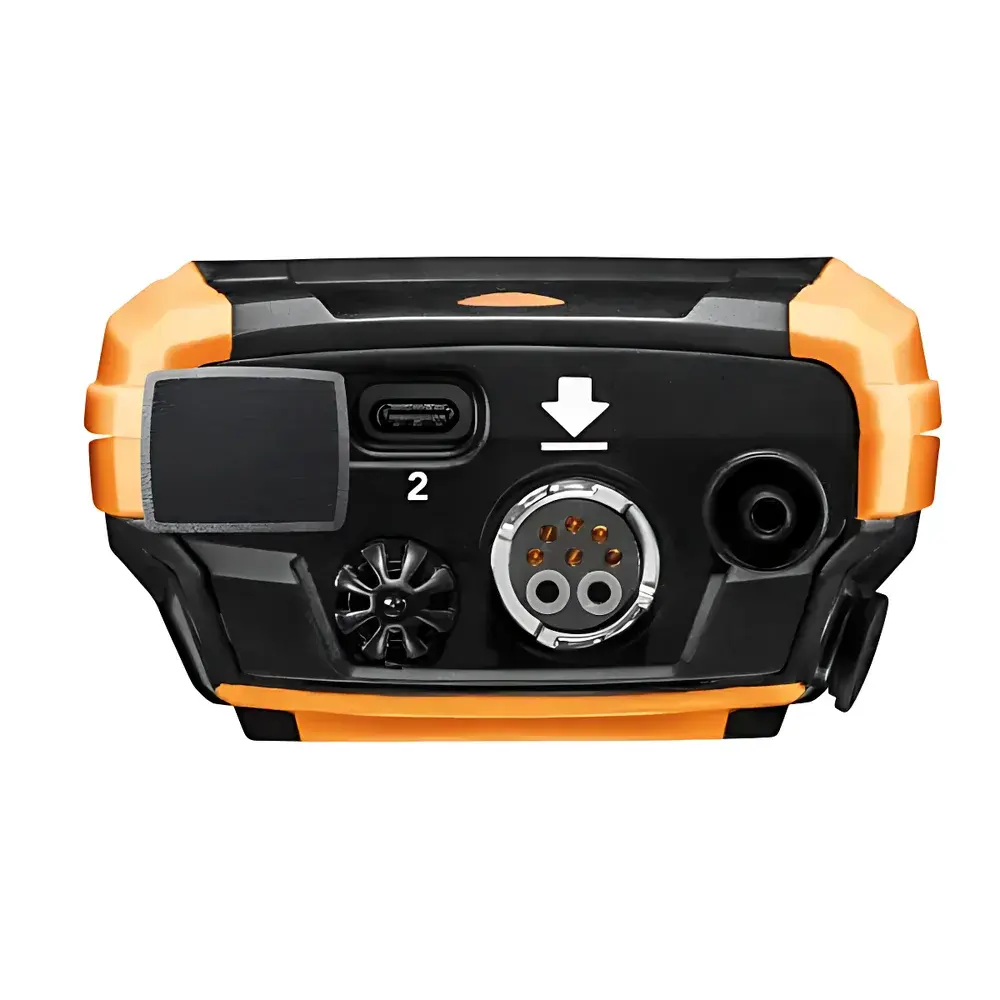
| Connectivity | Bluetooth® v4.2, IRDA |
| Data Output | PDF report generation, email export via companion app |
| Power Supply | Rechargeable Li-ion battery (included), USB power adapter (included) |
| Operating Temperature | 0–+50 °C |
| IP Rating | IP20 |
| Probe Compatibility | Interchangeable modular flue gas probes (e.g., compact probe Ø6 mm, L=180 mm, Tmax=+500 °C) |
Overview
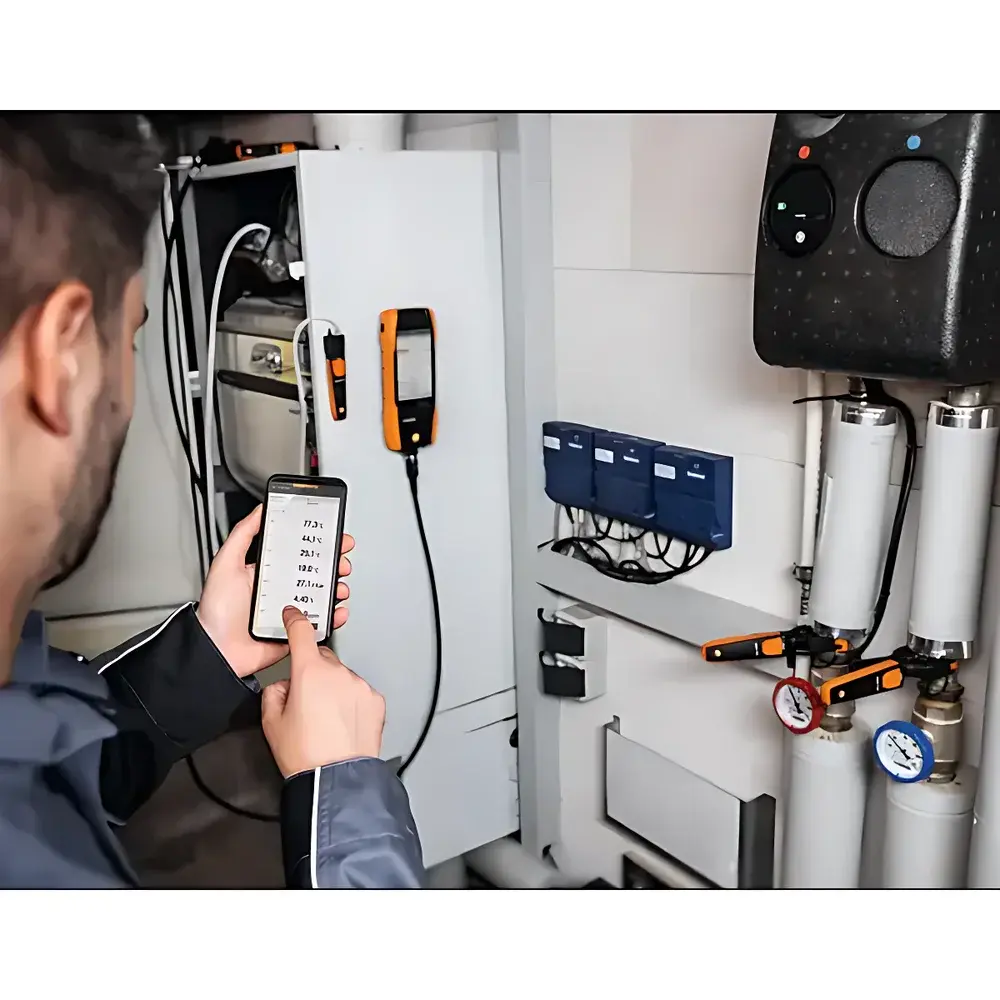
The testo 300 Portable Flue Gas Analyzer is an entry-level, field-deployable instrument engineered for routine combustion efficiency assessment and regulatory-compliant flue gas emission verification in residential, commercial, and light industrial heating systems. It operates on electrochemical sensor principles for O₂ and CO detection—providing real-time, stoichiometrically relevant data to calculate excess air, combustion efficiency, CO₂ concentration (derived), and lambda (λ) values. Designed in accordance with the European standard EN 50379-1 (General requirements) and EN 50379-2 (Performance requirements for portable flue gas analyzers), the device delivers traceable, repeatable measurements under variable ambient conditions. Its compact form factor, integrated micro-pressure sensor (±100 hPa range), and intuitive workflow-driven interface enable single-operator deployment without external calibration gases or PC dependency during on-site diagnostics.
Key Features
- Capacitive touch display with context-sensitive measurement menu—optimized for gloved operation and low-light environments
- Dual electrochemical sensors for O₂ (0–21 vol.%) and CO (0–4,000 ppm), factory-calibrated and TÜV-verified for metrological integrity
- Built-in differential pressure sensor (±100 hPa) supporting draft and fan pressure evaluation per EN 15502 and VDI 2047
- Bluetooth® 4.2 and IRDA wireless modules enabling direct pairing with testo’s mobile reporting app (iOS/Android) and legacy IR printers
- On-device PDF report generation with timestamped measurement logs, operator ID fields, and configurable header metadata
- Modular probe architecture—user-replaceable flue gas probes with standardized mechanical and electrical interfaces; no tools required for swap-out
- Integrated rechargeable lithium-ion battery (up to 6 h continuous operation) and universal USB-C power input with included AC adapter
Sample Compatibility & Compliance
The testo 300 is validated for sampling dry, non-condensing flue gases from gas-fired boilers, oil-fired furnaces, biomass stoves, and condensing heaters operating below 500 °C flue gas temperature. Its standard compact probe (Ø6 mm, 180 mm insertion length, ceramic filter, fixed cone tip) ensures representative sampling in ducts ≥80 mm diameter. All sensor outputs comply with EN 50379-2 linearity, zero stability, and cross-sensitivity requirements. The analyzer meets CE marking directives (2014/30/EU EMC, 2014/35/EU LVD), carries TÜV certification (certificate no. 0000016751), and supports audit-ready documentation per ISO/IEC 17025 laboratory quality management frameworks when used within defined operational limits.
Software & Data Management
Data acquisition and reporting are managed via testo’s free desktop software EasyHeat (v3.0+, Windows only), which imports .csv and .tdf files directly from the device via USB or Bluetooth. The software enables post-measurement correction of reference O₂ levels (e.g., to 3% or 6% O₂ for NOₓ normalization), automatic calculation of net thermal efficiency (ηnet), and comparative trending across multiple boilers. For field reporting, the testo Smart App (iOS/Android) synchronizes measurement sessions, embeds geotags and photo annotations, and exports signed PDF reports compliant with internal QA checklists. All generated reports include embedded digital signatures, operator credentials, instrument serial number, and sensor calibration expiry dates—supporting GLP-aligned record retention practices.
Applications
- Routine annual inspection of domestic gas/oil boilers per national energy efficiency ordinances (e.g., UK Gas Safety Regulations, German BImSchV Annex 17)
- Commissioning support for condensing boiler installations—including flue gas temperature verification and CO safety threshold validation
- Troubleshooting incomplete combustion events in residential heating systems using CO/O₂ ratio diagnostics
- Verification of burner tuning parameters prior to handover in HVAC maintenance contracts
- Educational use in vocational training programs for heating engineers and energy auditors
- Pre-compliance screening for small-scale biomass installations subject to local air quality permitting
FAQ
Does the testo 300 require periodic recalibration by an accredited lab?
No—field zero and span checks can be performed using certified calibration gases (O₂ 20.9%, CO 1,000 ppm); full recalibration is recommended every 12 months or after sensor exposure to >10,000 ppm CO.
Can the testo 300 measure NO or NO₂?
No—this base configuration supports O₂ and CO only. For multi-gas analysis, consider the testo 320 or testo 350 series.
Is the micro-pressure sensor suitable for measuring chimney draft?
Yes—it measures differential pressure across burner air inlets and flue outlets with ±0.1 hPa resolution, meeting VDI 2047 Part 2 requirements for draft assessment.
What happens if the probe filter becomes saturated during extended use?
The device alerts users via visual icon and audible tone when differential pressure across the filter exceeds 5 hPa; replacement filter cores (10-pack supplied) restore nominal flow characteristics.
How is data integrity ensured during Bluetooth transmission?
All wireless transfers use AES-128 encryption; report PDFs contain SHA-256 hash signatures verifiable via testo’s online validation portal.
Related Products







