
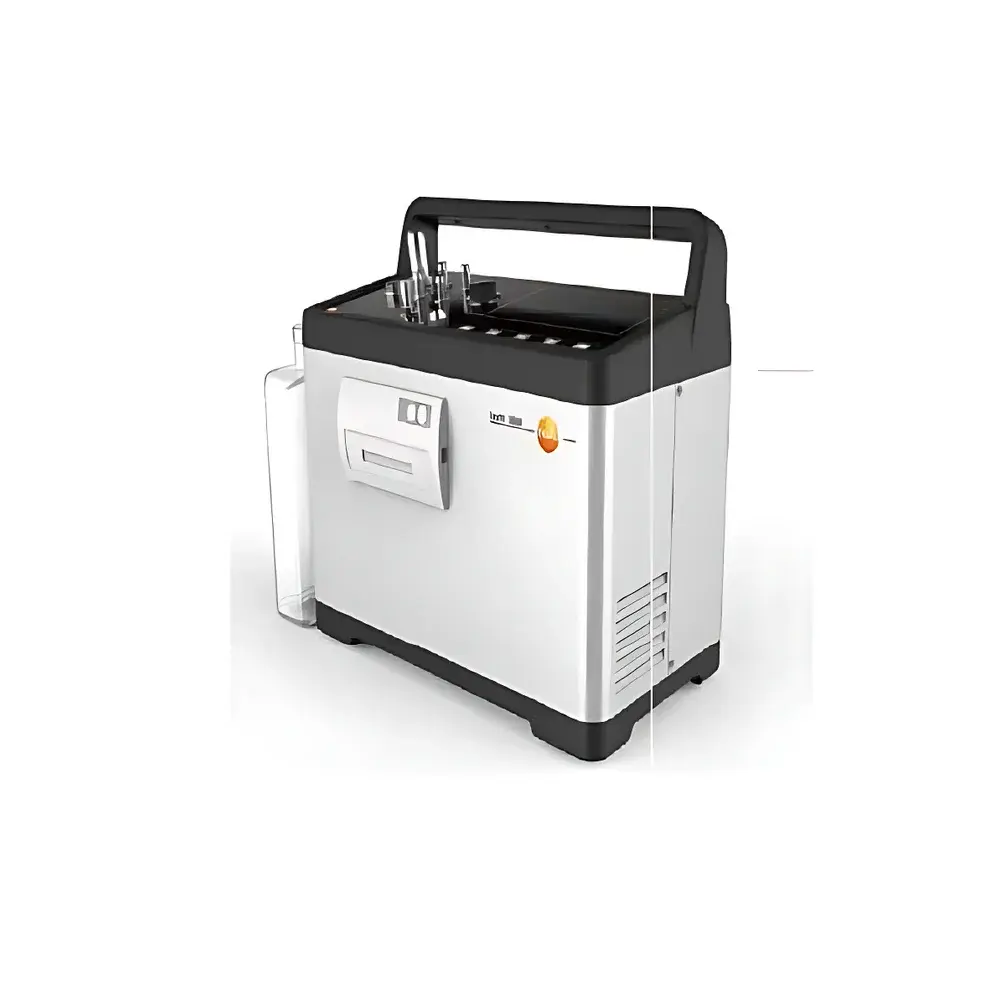
Testo 3008 Flue Gas and Particulate Sampling System
| Brand | Testo |
|---|---|
| Origin | Germany |
| Model | Testo 3008 |
| Operating Temperature Range (Flue Gas Probe) | 0–400 °C (extendable to 800 °C) |
| Dynamic Pressure Range | 0–1500 Pa (±1.5 %) |
| Static Pressure Range | −30 to +30 kPa (±3.0 %) |
| Total Pressure Range | −30 to +30 kPa (±3.0 %) |
| Pre-meter Pressure Range | −30 to +30 kPa (±2.5 %) |
| Wet-Bulb Pressure Range | −30 to +30 kPa (±3.0 %) |
| Pre-meter Temperature | −30 to +50 °C (±1.5 °C) |
| Host Temperature | −30 to +50 °C (±1.5 °C) |
| Dry-Bulb Temperature | 0–150 °C (±1.5 °C) |
| Wet-Bulb Temperature | 0–150 °C (±1.5 °C) |
| Flue Gas Temperature | 0–400 °C (±3.0 °C |
| Volumetric Flow Rate | 5–50 L/min (±2.5 %) |
| Isokinetic Flow Tracking Accuracy | ±5 %, response time < 8 s |
| Sampling Time Range | 0–999 min 59 s (±1.0 ‰) |
| Accumulated Sample Volume | 0–999999 L (±2.5 %) |
| Moisture Content | 0–45 % (±5.0 %) |
| Dimensions (L×W×H) | 430 × 200 × 370 mm |
| Weight | 11.5 kg |
| Power Supply | AC 220 V ± 22 V, 50 Hz |
Overview
The Testo 3008 Flue Gas and Particulate Sampling System is a field-deployable, fully integrated instrument engineered for regulatory-compliant stack testing in stationary emission sources. It operates on the principle of isokinetic sampling—maintaining proportional velocity between the probe nozzle and the flue gas stream—to ensure representative collection of particulate matter (PM) while simultaneously measuring critical thermodynamic and fluid dynamic parameters. Designed in accordance with HJ/T 48 (China’s Technical Specification for Particulate Matter Samplers) and GB/T 16157 (Determination of Particulate Matter and Gaseous Pollutants in Exhaust Gas from Stationary Sources), the system meets foundational requirements for gravimetric PM concentration determination, dust removal efficiency evaluation, and process-level emission verification under ambient and high-temperature industrial conditions.
Key Features
- Real-time isokinetic flow control with automatic adjustment across 5–50 L/min range, achieving tracking accuracy of ±5 % with sub-8-second response time—critical for maintaining sampling integrity during fluctuating stack velocities.
- Multi-parameter thermal and pressure sensing architecture: integrated dry-bulb, wet-bulb, and flue gas temperature sensors (0–400 °C standard, extendable to 800 °C); dynamic, static, total, pre-meter, and wet-bulb pressure transducers calibrated to national metrological standards.
- High-stability volumetric flow measurement using precision laminar flow elements, traceable to NIST-equivalent references, with ±2.5 % full-scale accuracy over operating range.
- Ruggedized transport case and modular probe configuration support rapid deployment in confined access points, rooftop stacks, and multi-point traverse setups per ISO 16911 and EPA Method 5/17.
- Embedded microprocessor with non-volatile memory retains up to 999 sampling sessions, including timestamped raw sensor data, calculated parameters (e.g., isokinetic ratio, moisture-corrected volume, stack velocity), and operator annotations.
- Compliance-ready data structure supports audit trails: all calibration events, zero/span checks, and parameter modifications are logged with user ID, date/time stamp, and checksum validation.
Sample Compatibility & Compliance
The Testo 3008 is validated for use with standard glass fiber filters (e.g., Whatman GF/A or equivalent) and stainless-steel or quartz sampling probes rated for continuous exposure up to 400 °C. Optional high-temperature probe assemblies accommodate extended operation up to 800 °C for cement kilns, waste incinerators, and metallurgical furnaces. The system satisfies method-specific physical requirements outlined in HJ/T 48, GB/T 16157, and aligns with technical prerequisites of ISO 9096 (determination of dust mass concentration), EN 13284-1 (low-range dust measurement), and US EPA Performance Specification 11 (PS-11) for particulate monitoring systems. All pressure and temperature sensors are factory-calibrated against accredited reference standards, with optional on-site verification kits available for field recalibration.
Software & Data Management
Data export is supported via USB 2.0 interface in CSV and XML formats compatible with laboratory information management systems (LIMS) and regulatory reporting platforms. The accompanying PC software (testo IRSoft) enables post-processing of isokinetic correction factors, moisture content derivation using wet/dry bulb psychrometry, and automated calculation of normalized emission concentrations (e.g., mg/m³ @ 11 % O₂, dry basis). Audit logs comply with GLP and GMP documentation requirements, including electronic signature support and 21 CFR Part 11–compliant user access controls when deployed in regulated QA/QC environments. Raw sensor outputs are stored without interpolation, preserving traceability for third-party validation.
Applications
- Regulatory stack testing for coal-fired power plants, biomass boilers, and industrial steam generators.
- Performance evaluation of electrostatic precipitators (ESPs), fabric filters (baghouses), and wet scrubbers—including differential pressure and efficiency analysis.
- Commissioning and periodic verification of continuous emission monitoring systems (CEMS) per EN 14181 and HJ 75–2017.
- Research-grade particulate characterization in pilot-scale combustion facilities and emissions testing laboratories.
- Field validation of low-concentration PM measurement methods (e.g., TEOM, beta attenuation) through co-located gravimetric reference sampling.
FAQ
What standards does the Testo 3008 comply with?
It conforms to HJ/T 48, GB/T 16157, ISO 9096, EN 13284-1, and technical specifications referenced in US EPA Methods 5 and 17 for manual particulate sampling.
Can the instrument operate in high-moisture flue gases?
Yes—the integrated psychrometric module (dry/wet bulb sensors) enables accurate moisture content calculation (0–45 %, ±5.0 %), supporting dilution-corrected mass concentration reporting required by most environmental agencies.
Is field recalibration possible without returning to a service center?
Yes—zero and span verification can be performed in situ using certified pressure calibrators and traceable temperature references; full calibration is recommended annually or after 500 operational hours.
Does the system support automated traverse positioning?
No—the Testo 3008 is a manual sampling platform; however, its real-time isokinetic feedback and integrated data logging enable seamless integration with motorized traverse systems via analog output signals (0–10 V or 4–20 mA).
What is the maximum allowable flue gas temperature during continuous operation?
Standard configuration supports continuous operation up to 400 °C; with optional high-temperature probe and cooling sleeve, it achieves stable sampling at up to 800 °C for limited-duration measurements.







