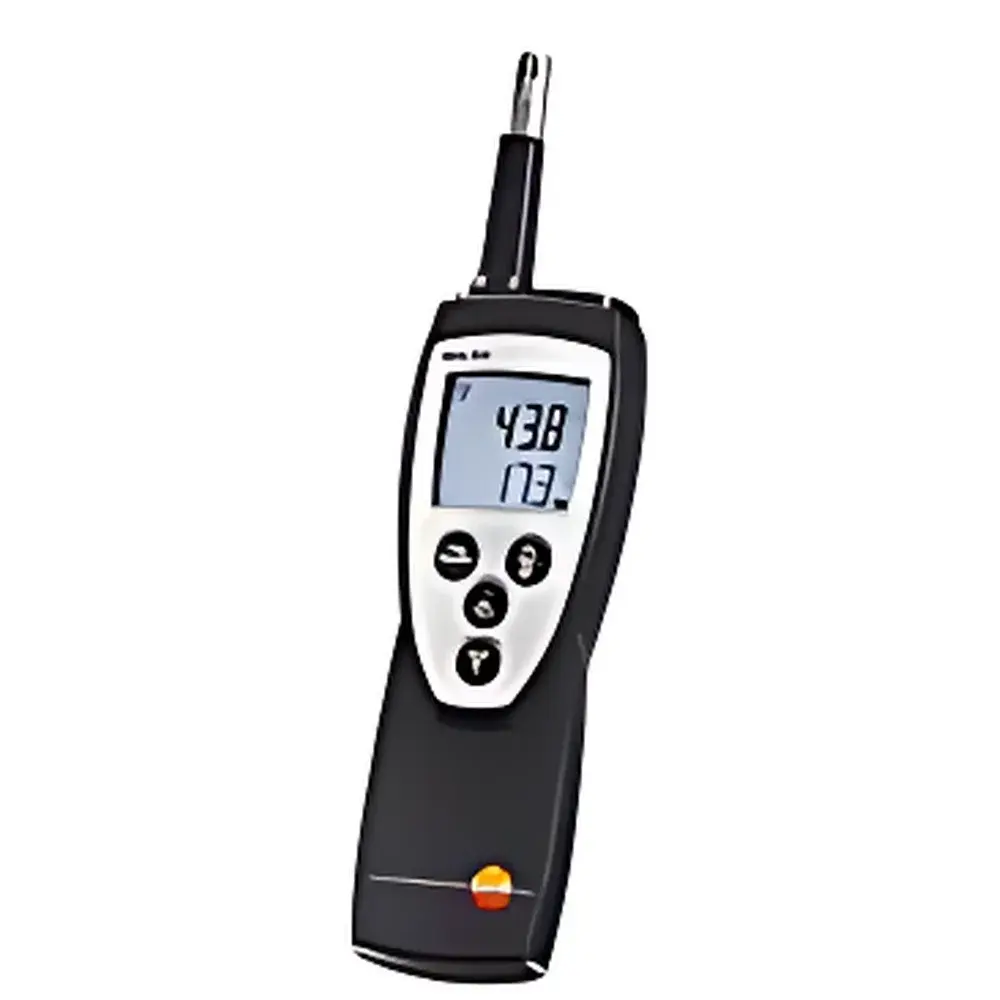
testo 625 Precision Temperature and Humidity Meter
| Origin | Germany |
|---|---|
| Manufacturer Type | Authorized Distributor |
| Origin Category | Imported |
| Model | testo 625 |
| Price Range | USD 1–4,999 |
| Instrument Type | General-Purpose Temperature & Humidity Meter |
| Temperature Range | −10 to +60 °C |
| Temperature Accuracy | ±0.5 °C |
| Temperature Resolution | 0.1 °C |
| Operating Ambient Temperature | −20 to +50 °C |
| Display | Digital LCD |
| Power Supply | 9 V battery |
| Dimensions | 182 × 64 × 40 mm |
| Weight | 195 g |
| Relative Humidity Range | 0–100 %RH |
| RH Accuracy | ±2.5 %RH (5–95 %RH) |
| RH Resolution | 0.1 %RH |
| Storage Temperature | −40 to +70 °C |
| Battery Life | ~70 h |
| Housing Material | ABS |
Overview
The testo 625 Precision Temperature and Humidity Meter is a handheld, field-deployable environmental monitoring instrument engineered for reliable, repeatable measurement of air temperature and relative humidity in non-pressurized ambient environments. Based on capacitive polymer sensor technology, the device employs a patented humidity sensing element co-developed and calibrated by testo GmbH & Co. KGaA in Germany—ensuring long-term stability, minimal drift (<0.5 %RH/year under standard conditions), and resistance to condensation and chemical contaminants commonly encountered in indoor storage, archival, and controlled-environment applications. Its dual-parameter acquisition architecture enables simultaneous real-time logging of temperature and humidity, with on-device calculation of derived thermodynamic parameters including dew point temperature and wet-bulb temperature—both computed per ISO 4677 and ASHRAE Fundamentals Chapter 1 methodology. Designed for routine verification rather than continuous process control, the testo 625 complies with general-purpose metrological requirements outlined in ISO/IEC 17025 for calibration traceability, and supports documented measurement uncertainty estimation when used within its specified operating envelope.
Key Features
- Integrated high-stability capacitive humidity sensor with proprietary testo polymer coating, factory-calibrated against NIST-traceable reference standards
- Simultaneous measurement of air temperature (−10 to +60 °C) and relative humidity (0–100 %RH) with independent accuracy specifications
- On-device calculation of dew point (−40 to +50 °C range) and psychrometric wet-bulb temperature using iterative Magnus-type equations
- Digital LCD display with backlight, supporting max/min value hold, data freeze, and auto power-off after 10 minutes of inactivity
- Robust ABS housing rated IP54 for dust and splash resistance; ergonomic form factor optimized for one-handed operation
- Standard 9 V alkaline battery supply delivering up to 70 hours of continuous use; low-battery indicator integrated into display interface
Sample Compatibility & Compliance
The testo 625 is intended for use in still or gently moving air environments typical of indoor facilities—including archives, museums, pharmaceutical storage rooms, greenhouses, HVAC commissioning zones, and office buildings. It is not suitable for direct immersion, high-velocity airflow (>3 m/s), corrosive gas exposure, or explosive atmospheres. The instrument meets CE marking requirements under the EU Measuring Instruments Directive (MID) Annex MI-005 for portable environmental meters. While not certified to specific GLP or GMP validation protocols out-of-the-box, its documented calibration certificate (included), stable sensor performance, and traceable uncertainty budget support IQ/OQ execution in regulated environments where periodic verification suffices. It conforms to EN 60751 for Pt100-equivalent temperature response linearity and to IEC 60068-2-1/2 for cold/heat operational testing.
Software & Data Management
The testo 625 operates as a standalone meter without onboard memory or USB/Bluetooth connectivity. All measurements are displayed and held locally; no firmware updates or PC-based configuration are required. For audit trail compliance, users may manually record readings alongside time/date stamps and environmental context in laboratory notebooks or LIMS-compatible spreadsheets. Optional testo ComSoft Basic software (sold separately) enables manual entry and export of captured values to CSV or PDF formats for quality documentation. When deployed in ISO 9001-certified facilities, the device satisfies clause 7.1.5.2 (monitoring and measuring resource control) provided calibration status is verified annually against accredited references and records maintained per internal SOPs.
Applications
- Environmental qualification of archival storage spaces per ISO 11799 (document preservation)
- Baseline HVAC system verification in commercial buildings per ASHRAE Guideline 1
- Warehouse temperature/humidity mapping during seasonal transitions
- Greenhouse microclimate profiling for horticultural research and cultivation optimization
- Pre-commissioning checks of cleanroom buffer zones prior to ISO 14644-1 classification
- Field validation of data logger networks in pharma distribution centers (supporting GDP Annex 9)
FAQ
Does the testo 625 require annual recalibration?
Yes—testo recommends annual recalibration against traceable standards to maintain stated accuracy, particularly when used in regulated environments or for compliance reporting.
Can the device measure surface temperature?
No—the testo 625 measures only ambient air temperature and relative humidity via its integrated probe; it does not include infrared or contact surface-sensing capability.
Is the humidity sensor replaceable in the field?
No—the sensor is sealed within the unit and not user-serviceable; full unit recalibration or return-to-factory service is required if sensor drift exceeds specification.
What is the uncertainty contribution of ambient pressure variation?
Dew point calculation assumes standard atmospheric pressure (101.325 kPa); deviations >±5 kPa introduce negligible error (<0.1 °C) within the device’s operational RH range.
Does the testo 625 comply with FDA 21 CFR Part 11?
No—it lacks electronic audit trail, user authentication, or data integrity controls required for Part 11 compliance; it serves best as a supplementary verification tool in validated systems.