
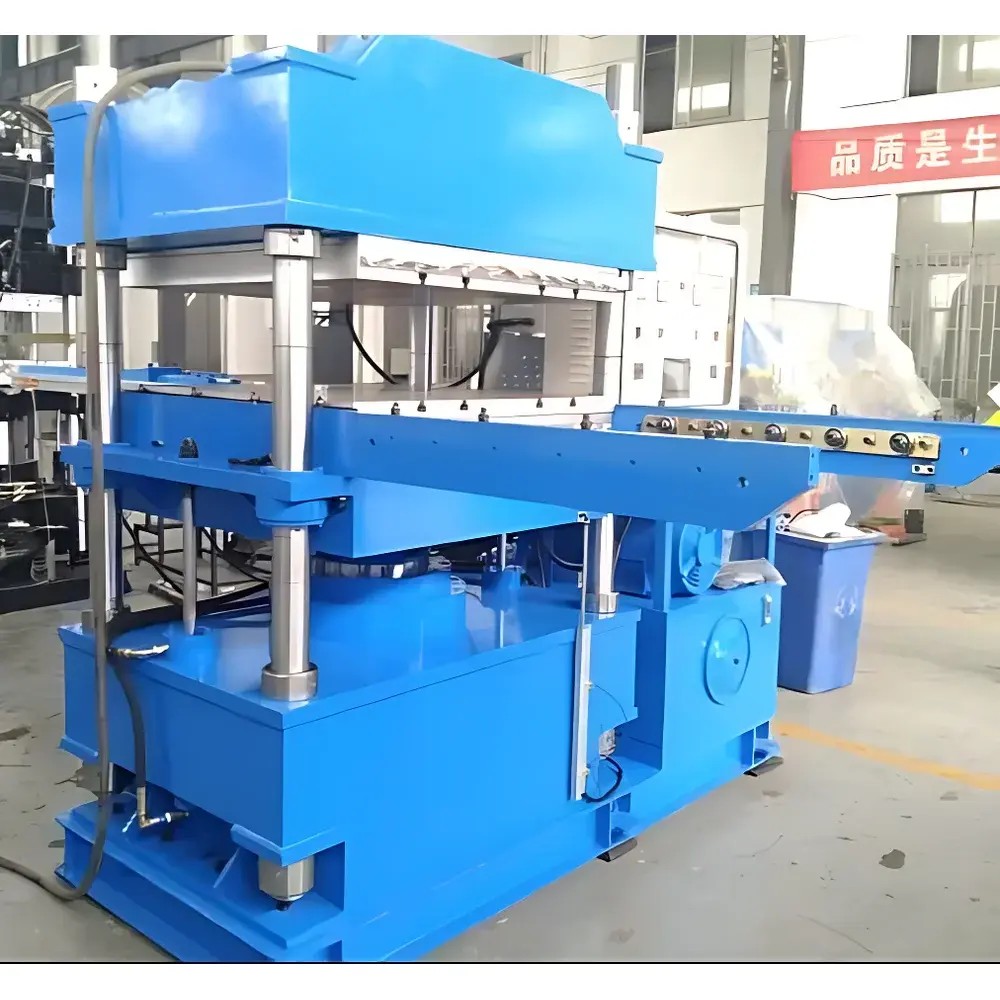
TF-Feng TF-WDW-100T平板硫化机
| Brand | TF-Feng |
|---|---|
| Origin | Shanghai, China |
| Manufacturer Type | Direct Manufacturer |
| Model | TF-WDW-100T |
| Nominal Clamping Force | 1000 kN |
| Platen Dimensions | 600 × 600 mm |
| Platen Spacing | 125 mm |
| Number of Working Layers | 1–4 |
| Maximum Hydraulic Pressure | 16 MPa |
| Platen Unit Area Pressure | 2.8 MPa |
| Plunger Stroke | 500 mm |
| Heating Method | Steam or Electric |
| Motor Power | 3 kW |
| Overall Dimensions (L×W×H) | 2070 × 1050 × 2230 mm |
| Weight | 4200 kg |
Overview
The TF-Feng TF-WDW-100T平板硫化机 is a heavy-duty, multi-layer hydraulic press engineered for precision vulcanization of rubber compounds, elastomeric composites, and thermosetting materials in industrial and R&D environments. Based on the Couette-type compression molding principle, it applies uniform, controllable pressure and temperature across parallel platens to facilitate cross-linking reactions under defined time–temperature–pressure (TTP) profiles. Designed for repeatable batch processing, the machine integrates a robust four-column frame structure with high-rigidity platen alignment mechanisms, ensuring minimal deflection (<0.03 mm/m under full load) and consistent cure uniformity across the entire 600 × 600 mm active surface. Its dual heating capability—compatible with both saturated steam (0.4–0.8 MPa) and electric cartridge heaters (with PID-controlled zone regulation)—enables flexible integration into existing plant utilities while maintaining thermal stability within ±1.5 °C over extended cycles.
Key Features
- Hydraulic system with servo-controlled proportional valves and pressure transducers calibrated to ISO 6789, delivering stable clamping force from 10% to 100% of nominal 1000 kN with ≤±0.5% linearity error.
- Modular multi-layer configuration supporting 1–4 independently actuated platens; each layer features individual temperature monitoring via PT100 sensors (Class A tolerance) and mechanical stroke limit switches compliant with EN ISO 13850.
- Platen parallelism maintained by precision-ground guide columns and self-aligning bronze bushings, verified per ASTM D3182 Annex A1 for rubber processing equipment.
- Integrated safety architecture including dual-channel hydraulic lock valves, emergency stop circuit (EN 60204-1), and light curtain interlock (IEC 61496-1) for operator protection during mold loading/unloading.
- Stainless steel-insulated platen construction with aluminum-silicon alloy heating elements, achieving ramp rates up to 15 °C/min and steady-state thermal gradient <±2.0 °C across full surface area.
Sample Compatibility & Compliance
The TF-WDW-100T accommodates standard ASTM D3182, ISO 34-1, and GB/T 528 test specimens—including dumbbell, ring, and compression set molds—as well as custom tooling up to 550 × 550 mm footprint. All wetted components meet FDA 21 CFR 177.2600 requirements for indirect food contact where applicable. The machine conforms to CE Machinery Directive 2006/42/EC, carries RoHS-compliant electrical subsystems, and supports validation documentation packages aligned with GMP Annex 15 and ISO 9001:2015 manufacturing process controls. Optional IQ/OQ protocols are available for pharmaceutical-grade elastomer curing applications.
Software & Data Management
Equipped with a dedicated HMI panel (7-inch TFT LCD, IP65-rated) running embedded Linux firmware, the system logs real-time pressure, temperature, and position data at 10 Hz resolution. All process parameters—including setpoints, dwell times, ramp profiles, and alarm events—are timestamped and stored locally (16 GB internal flash) with optional Ethernet/Wi-Fi export to SCADA or LIMS via Modbus TCP or OPC UA. Audit trails comply with 21 CFR Part 11 requirements when paired with user authentication modules and electronic signature workflows. Historical batches can be replayed, compared, and exported in CSV or PDF formats for QA review and regulatory submission.
Applications
- Vulcanization of natural rubber (NR), SBR, EPDM, and fluorocarbon elastomers for automotive seals, O-rings, and gaskets.
- Curing of fiber-reinforced rubber composites used in conveyor belts, mining hoses, and vibration isolators.
- Compression molding of silicone elastomers in medical device component manufacturing (e.g., tubing connectors, diaphragms).
- Material qualification testing per ASTM D5300 (cure characteristics), ISO 6502 (vulcanization behavior), and DIN 53529 series.
- Research-scale formulation development requiring precise TTP mapping and repeatability across multiple platen layers.
FAQ
What is the maximum recommended mold height for single-layer operation?
For optimal thermal transfer and mechanical stability, the maximum mold stack height is limited to 125 mm—matching the standard platen spacing. Custom spacers may extend this up to 180 mm with recalibration.
Can the machine operate under vacuum-assisted molding conditions?
Yes—vacuum ports (G1/4″ BSP) are pre-installed on all platens; optional vacuum pump integration kits support pressures down to 5 mbar absolute for void-free composite curing.
Is remote diagnostics supported?
Standard Ethernet connectivity enables secure remote access via TLS-encrypted VNC for firmware updates, parameter tuning, and fault log retrieval—subject to customer network policy approval.
What calibration certificates are supplied with delivery?
Each unit ships with factory calibration reports for pressure transducers (traceable to NIM China), PT100 sensors (certified to IEC 60751 Class A), and timer circuits (verified per ISO/IEC 17025).
Does the system support automated mold ejection sequences?
Yes—programmable auxiliary outputs control external pneumatic or hydraulic ejector cylinders, synchronized with platen opening timing and position feedback.



