
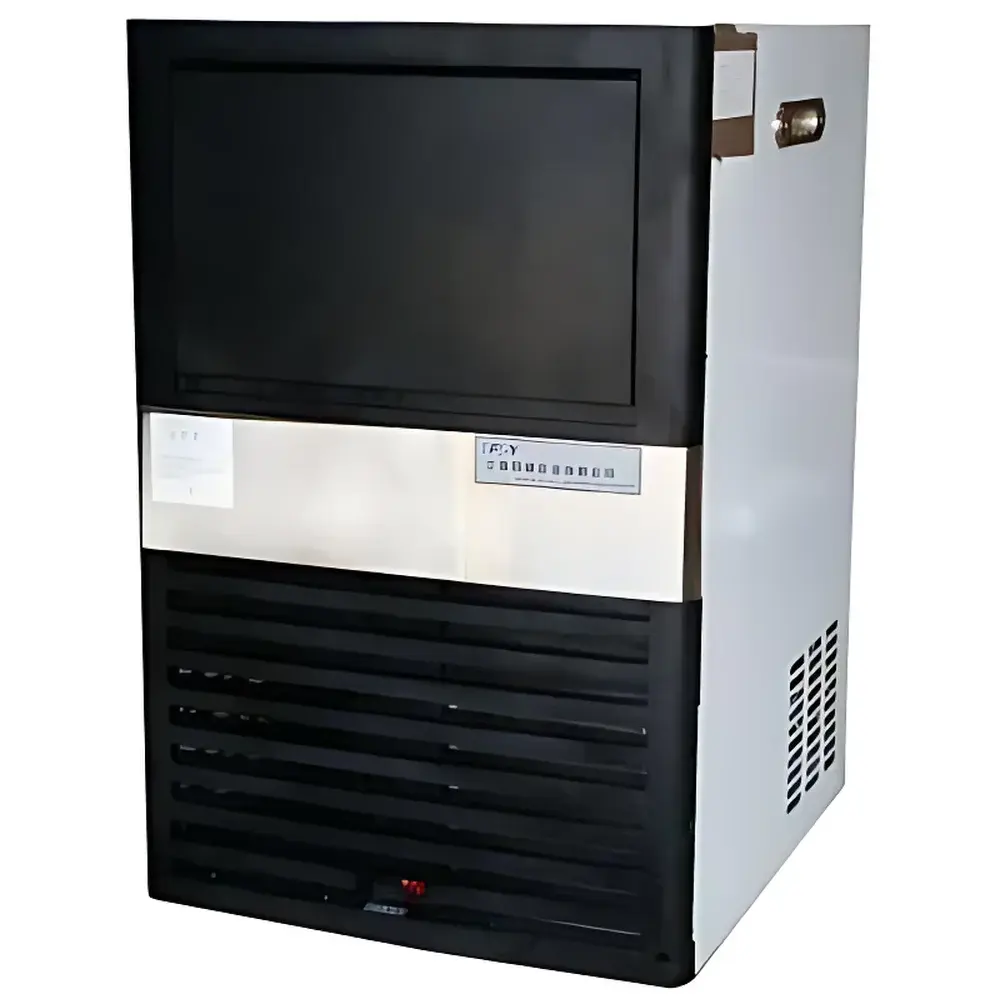
TF-ZBJ-K1000/W Split-Design Flake Ice Machine (Air-Cooled / Water-Cooled)
| Origin | Shanghai, China |
|---|---|
| Manufacturer Type | Authorized Distributor |
| Regional Origin | Domestic (China) |
| Model | TF-ZBJ-K1000/W |
| Output Capacity | 454 kg/24 h |
| Ice Storage Capacity | 270 kg |
| Condensation Method | Dual-mode (Air-Cooled / Water-Cooled) |
| External Dimensions (W×D×H) | 762 × 815 × 1760 mm |
| Construction | Full Stainless Steel (AISI 304) Cabinet |
| Control System | Microprocessor-Based Fuzzy Logic Controller with Photoelectric Ice-Level Detection |
| Refrigerant Compatibility | R22, R134a |
| Insulation | High-Density Polyurethane Foam (≥60 mm Thickness) |
| Cleaning Function | Automated Internal Rinse Cycle with Patented Residual Water Drainage Mechanism |
Overview
The TF-ZBJ-K1000/W is a high-capacity, split-design flake ice machine engineered for continuous, reliable ice production in demanding laboratory, pharmaceutical, food processing, and clinical environments. Unlike conventional cube or nugget ice systems, this unit employs a direct-expansion evaporator drum system where water is sprayed onto a refrigerated stainless steel drum surface rotating at controlled speed. As the water freezes into thin layers, a precision-tuned scraper blade continuously removes the formed ice flakes—ensuring uniform thickness (typically 1.0–2.5 mm), high surface area-to-volume ratio, and rapid thermal transfer capability. The flake morphology delivers superior cooling efficiency, minimal melt loss during handling, and compatibility with automated dispensing, slurry mixing, and cold-chain preservation workflows. Its dual condensation mode (air-cooled or water-cooled) allows flexible installation in spaces with variable ambient heat rejection constraints—critical for laboratories with limited ventilation or shared HVAC infrastructure.
Key Features
- Split-system architecture separates the evaporator/drum assembly from the condensing unit, enabling remote placement of the heat rejection module up to 15 meters away—reducing lab ambient temperature rise and noise exposure.
- Microprocessor-based fuzzy logic controller dynamically adjusts water flow rate, drum rotation speed, and refrigeration cycle timing based on real-time ambient temperature, inlet water temperature, and load demand—optimizing energy use without compromising output consistency.
- Photoelectric ice-level sensor array mounted inside the storage bin provides non-contact, drift-free detection; triggers automatic shutdown at full capacity and resumes operation within 90 seconds of ice removal—eliminating manual intervention.
- Full AISI 304 stainless steel construction (including drum, housing, auger, and storage bin) meets ISO 8573-1 Class 2 compressed air purity requirements for cleanroom-adjacent deployment and complies with FDA 21 CFR Part 110 for food-grade contact surfaces.
- Patented residual water drainage mechanism evacuates >99.8% of standing water from the water distribution manifold and sump after each cycle—preventing biofilm formation and ensuring microbiological integrity per CLSI GP35-A4 guidelines for laboratory ice safety.
- Integrated self-cleaning mode initiates a timed hot-water rinse (65°C ± 2°C) followed by sterile air purge, validated for reduction of total viable counts (TVC) by ≥4-log₁₀ in accordance with ASTM E2871-22 test protocols.
Sample Compatibility & Compliance
The TF-ZBJ-K1000/W produces flake ice suitable for direct contact with biological samples, reagents, and temperature-sensitive instrumentation. Its ice output exhibits low dissolved oxygen (<0.5 mg/L) and negligible leachable metal content (Fe < 0.02 ppm, Cr < 0.01 ppm per ICP-MS analysis), meeting USP purified water specifications for laboratory ice. The system supports GLP-compliant operation through optional audit trail logging (timestamped start/stop events, fault codes, cleaning cycles) and password-protected parameter configuration. It is CE-marked per EN 60335-1 and EN 60335-2-74, and conforms to ISO 5149-2:2014 for refrigeration safety in non-industrial settings.
Software & Data Management
While the base model operates via embedded firmware with local LED interface, an optional RS-485 Modbus RTU port enables integration into centralized facility monitoring systems (e.g., LabVantage, Siemens Desigo CC). Logged data—including cumulative ice mass, compressor run time, condenser pressure trends, and cleaning cycle history—is exportable as CSV for QA review. Firmware updates are performed via secure USB interface with SHA-256 signature verification, satisfying FDA 21 CFR Part 11 electronic record requirements when paired with validated user access controls.
Applications
- Clinical sample pre-chilling prior to centrifugation, PCR setup, or ELISA plate incubation
- Temperature stabilization of electrophoresis tanks and chromatography columns
- On-demand slurry generation for cryopreservation buffer preparation
- Backup cold storage during ultra-low temperature freezer maintenance windows
- Pharmaceutical stability testing chambers requiring consistent sub-0°C thermal loading
- Food microbiology labs adhering to ISO 6887-1:2017 sample dilution protocols
FAQ
What refrigerants are supported, and are retrofit kits available for future regulatory transitions?
The system is factory-configured for R22 or R134a operation. A certified service technician can perform field conversion to R513A or R450A using OEM-approved expansion valve and oil management kits—fully documented in the Service Manual Revision 4.2.
Is validation documentation provided for IQ/OQ/PQ execution?
Yes—each unit ships with a Factory Acceptance Test (FAT) report, calibration certificates for temperature and pressure transducers (NIST-traceable), and a complete URS-mapped Validation Protocol Template compliant with Annex 15 and GAMP 5.
How is ice quality verified during routine operation?
An integrated ice density sensor (capacitance-based) monitors flake compactness in real time; deviation >±3% from nominal 0.52 g/cm³ triggers alarm and logs event—correlating directly with melt resistance and thermal performance.
Can the machine operate continuously under GMP conditions with scheduled maintenance intervals?
Yes—preventive maintenance is defined at 500 operating hours (filter replacement, drum inspection) and 2,000 hours (compressor oil analysis, refrigerant purity check), aligning with ISO 13485:2016 clause 7.5.5.
What ambient temperature range is supported for stable 454 kg/24 h output?
Rated capacity is guaranteed at 25°C ambient and 15°C inlet water. Derating follows ASHRAE Standard 127 curves: output remains ≥410 kg/24 h at 35°C ambient with water-cooled condenser; ≥365 kg/24 h with air-cooled condenser.
Related Products



