
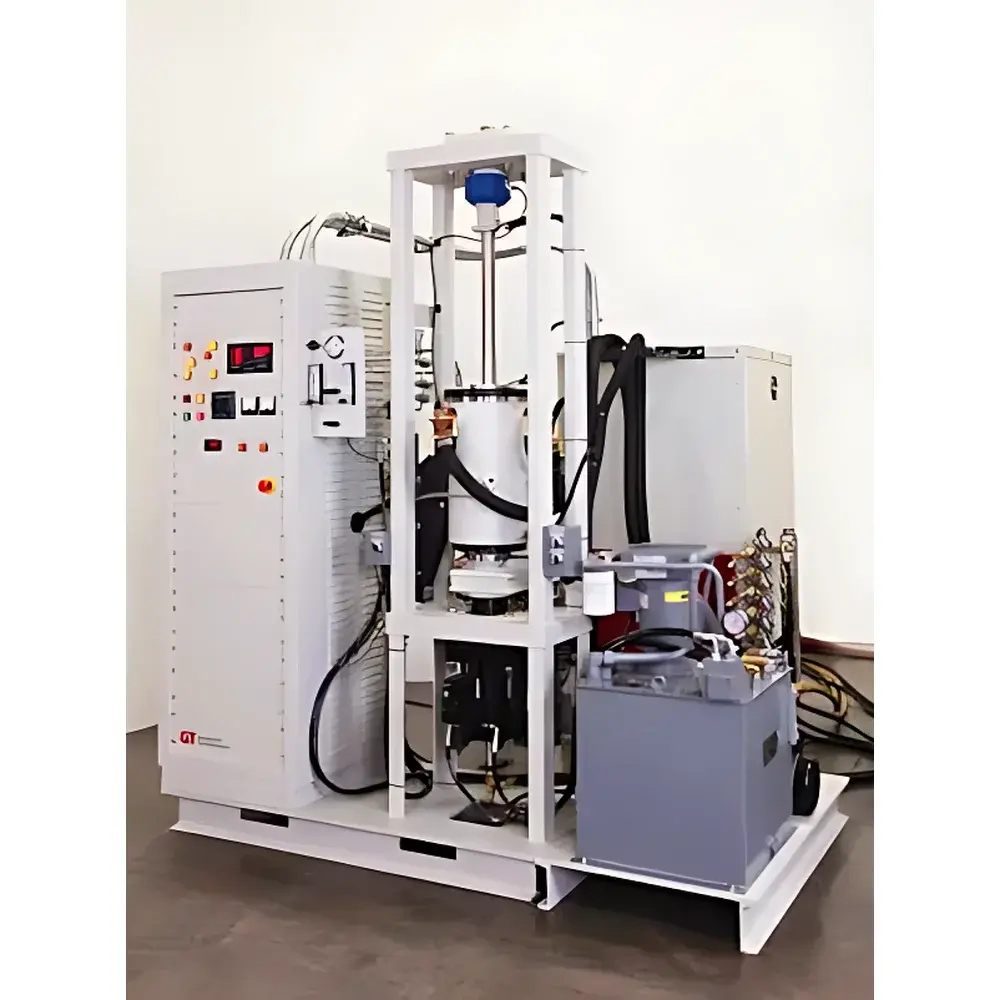
Thermal Technology HP200 High-Temperature Hot Press Furnace
| Brand | Thermal Technology |
|---|---|
| Origin | USA |
| Model | HP200 |
| Type | Graphite/W-Mo Heating Crucible-Type Hot Press Furnace |
| Max Temperature | 2500 °C |
| Temperature Control Accuracy | ±0.1 °C |
| Max Power | 3000 W |
| Ramp Time to Max Temp | 30 min |
| Heating Elements | Graphite, Tungsten, Molybdenum |
| Internal Chamber Dimensions | 30 cm × 20 cm × 20 cm |
| Maximum Applied Pressure | 100 tons |
| Effective Hot Zone | 24″ × 24″ × 30″ (610 mm × 610 mm × 762 mm) |
Overview
The Thermal Technology HP200 High-Temperature Hot Press Furnace is an engineered system designed for simultaneous application of ultra-high temperature and uniaxial compressive load under controlled atmosphere or high vacuum conditions. Based on the principle of resistive heating within a mechanically constrained vacuum chamber, the HP200 integrates a programmable hydraulic press with a modular hot-zone architecture capable of sustained operation up to 2500 °C and 100 tons of applied force. Its design conforms to fundamental requirements for solid-state sintering, diffusion bonding, and reactive hot pressing of advanced ceramics, refractory metals, intermetallics, and fiber-reinforced composites. Unlike conventional muffle furnaces or box-type sintering systems, the HP200 maintains thermal and mechanical stability during pressure application—enabling densification kinetics studies, microstructure evolution under stress, and phase transformation analysis under coupled thermomechanical loading.
Key Features
- Modular hot-zone interchangeability: Four standardized hot-zone configurations (graphite, tungsten, molybdenum, MoSi₂) are pre-integrated into front and rear chamber doors; swapping zones requires only door replacement—no internal reassembly or realignment.
- Dual-wall stainless-steel vacuum chamber with forced water circulation through annular cooling channels; compatible with tap water due to corrosion-resistant 316L construction and suitable for ≤10⁻⁶ mbar base pressure when paired with optional high-vacuum pumping systems.
- Precision electro-hydraulic actuation system with closed-loop pressure feedback, calibrated load cell integration, and real-time force monitoring synchronized with temperature profiles.
- Programmable multi-segment temperature/pressure ramping via ISO/IEC 17025-compliant controller with NIST-traceable calibration support and audit trail capability for GLP/GMP environments.
- Heating element options include high-purity graphite (for inert/vacuum use up to 2500 °C), tungsten mesh (for ultra-high purity applications), molybdenum foil (optimized for intermediate vacuum and low-oxygen partial pressures), and MoSi₂ (for oxidizing or air-atmosphere processing).
- Thermal insulation stack comprises layered graphite fiber, radiation shields, and ceramic fiber modules—engineered to minimize axial/radial thermal gradients (<±5 °C across 100 mm sample zone at 2000 °C).
Sample Compatibility & Compliance
The HP200 accommodates cylindrical, disc-shaped, and rectangular samples up to 305 mm in diameter and 305 mm in height. It supports processing of oxide ceramics (Al₂O₃, ZrO₂), non-oxides (SiC, Si₃N₄, B₄C), carbides (TiC, WC), nitrides (AlN, BN), metallic powders (Ni-based superalloys, Ti-6Al-4V), and C/C or SiC-fiber reinforced matrix composites. The system complies with ASTM C1161 (flexural strength of advanced ceramics), ASTM C814 (thermal expansion measurement), and ISO 14703 (vacuum terminology and classification). Vacuum integrity meets ISO 27934 Class 4 standards; pressure control accuracy adheres to ASTM E2921 (standard practice for evaluating hot pressing equipment performance). Optional 21 CFR Part 11–compliant software modules enable electronic signatures, user access controls, and immutable data archiving for regulated R&D workflows.
Software & Data Management
The integrated control platform runs on a real-time OS with deterministic I/O response (<10 ms latency). Data acquisition records temperature (Type C, S, or B thermocouples), pressure (strain-gauge transducer), displacement (LVDT), and power consumption at configurable intervals (100 Hz max). Export formats include CSV, HDF5, and XML for post-processing in MATLAB, Python (NumPy/Pandas), or Thermo-Calc. Optional add-ons include automated log compression, encrypted network transmission (TLS 1.2+), and integration with LIMS via OPC UA. All firmware updates undergo FIPS 140-2 validated cryptographic signing; configuration backups are timestamped and SHA-256 hashed for traceability.
Applications
- Densification of nanostructured ceramic powders without grain coarsening via field-assisted sintering simulation.
- Diffusion bonding of dissimilar materials (e.g., Cu–Mo, Ni–Ti, Al–Mg alloys) for aerospace heat exchangers and nuclear cladding prototypes.
- Consolidation of spark plasma sintering (SPS)-compatible precursors where rapid thermal cycling is not required but higher ultimate density is critical.
- Thermomechanical testing of solid oxide fuel cell (SOFC) interconnect alloys under simulated operating conditions (e.g., Cr evaporation kinetics at 800–900 °C under 5 MPa load).
- Processing of thermoelectric materials (e.g., Bi₂Te₃, Mg₂Si, half-Heuslers) where lattice strain induced by pressure modulates phonon scattering and carrier mobility.
- Reaction sintering of MAX phases (e.g., Ti₃SiC₂) from elemental powder blends under nitrogen or argon partial pressure.
FAQ
What vacuum level can the HP200 achieve with standard pumping configuration?
With the included two-stage rotary vane mechanical pump, base pressure reaches ≤5×10⁻² mbar. With optional turbomolecular pump upgrade (e.g., Pfeiffer HiPace 700), ultimate pressure improves to ≤1×10⁻⁶ mbar.
Is the HP200 compliant with FDA 21 CFR Part 11 for electronic records?
Yes—when equipped with the optional Validation Package, including IQ/OQ documentation, audit trail logging, role-based access control, and digital signature implementation.
Can the system operate continuously at 2500 °C?
Continuous operation at maximum temperature is limited to 4 hours per cycle due to thermal stress management in graphite hot zones; extended dwell requires derated temperature profiles (e.g., 2300 °C for >12 h) and optional tungsten hot-zone configuration.
What sample geometries are supported for diffusion bonding?
Flat-to-flat interfaces up to 305 mm diameter; custom tooling sets accommodate stepped, tapered, or multi-layer stack configurations with independent thermocouple monitoring per interface.
Does Thermal Technology provide installation qualification (IQ) and operational qualification (OQ) services?
Yes—factory-certified engineers perform on-site IQ/OQ per ASTM E2500 and ISO/IEC 17025 guidelines, including temperature uniformity mapping (per AMS 2750E), pressure linearity verification, and vacuum leak rate validation.



