
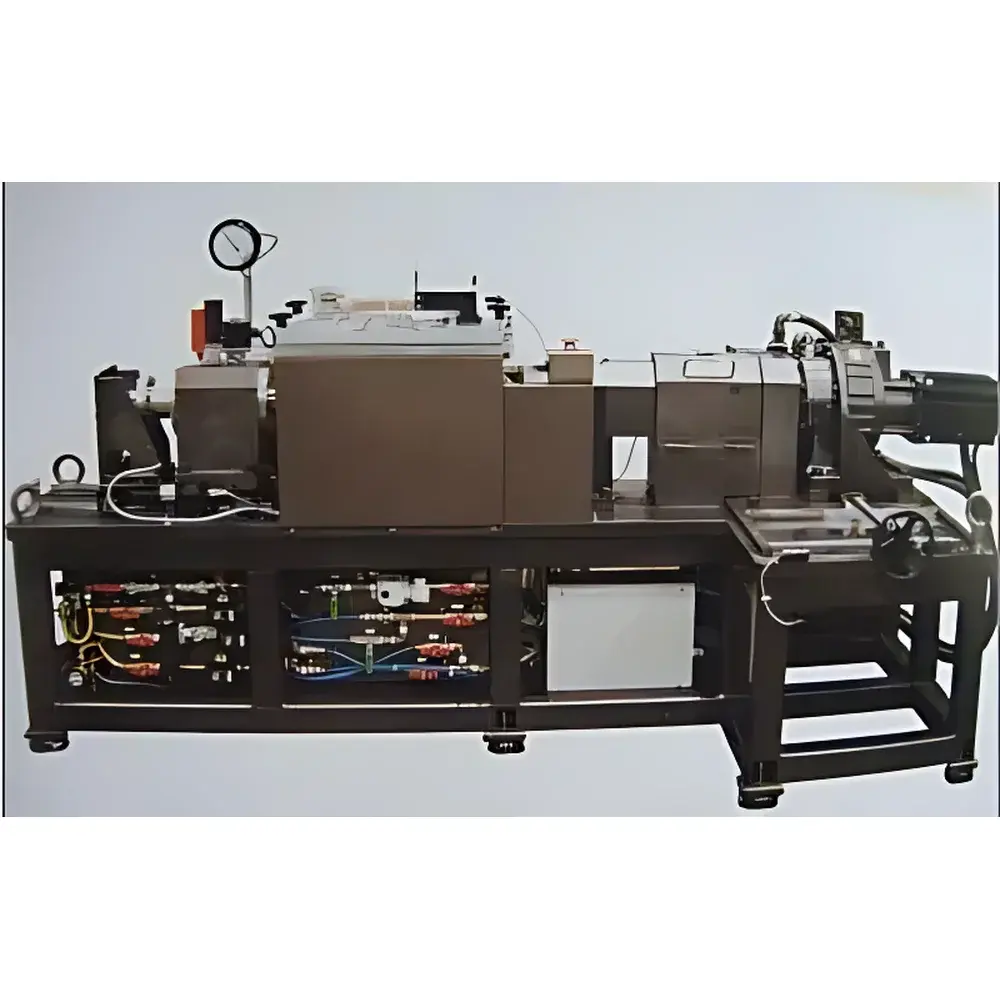
Thermecmaster-W Dynamic Thermal Simulator for Welding Simulation
| Origin | Japan |
|---|---|
| Manufacturer Type | Authorized Distributor |
| Origin Category | Imported |
| Model | Thermecmaster-W |
| Price | USD 1.4M (FOB Yokohama) |
| Sample Geometry | Cylindrical Ø8–10 mm × L140–200 mm |
| Heating System | Dual-mode — High-frequency induction (15 kW, 100 kHz) + Resistive direct-current heating (75 kVA, 50–60 Hz) |
| Restraint Actuation | Hydraulic servo-controlled load frame (100 kN max force, ±5.5 mm displacement range) |
| Thermal Ramp Rates | Heating up to 500 °C/s |
| Cooling Rate | Up to 60 °C/s (800–500 °C range, helium gas quenching) |
| Control Modes | Load control, displacement control, and load–displacement hybrid switching |
Overview
The Thermecmaster-W Dynamic Thermal Simulator is a high-precision, servo-hydraulic thermal-mechanical testing system engineered specifically for quantitative welding thermal simulation under controlled metallurgical and mechanical boundary conditions. Unlike conventional dilatometers or simple furnaces, the Thermecmaster-W replicates the transient thermo-mechanical history of real welds—including localized heating, constrained cooling, and dynamic stress evolution—by integrating synchronized thermal input (induction + resistive), programmable mechanical restraint, and real-time thermomechanical feedback. Its core principle relies on controlled thermal cycling combined with in-situ mechanical loading to simulate weld heat-affected zone (HAZ) behavior, enabling rigorous evaluation of microstructural evolution, phase transformation kinetics, residual stress development, and cracking susceptibility across multiple temperature regimes.
Key Features
- Dual-mode heating architecture: Simultaneous high-frequency induction (15 kW, 100 kHz) for rapid surface heating and low-frequency resistive (75 kVA, 50–60 Hz) for uniform bulk heating—ensuring reproducible thermal gradients and peak temperatures up to 1600 °C.
- Hydraulic servo load frame with 100 kN capacity and ±5.5 mm stroke, supporting precise load, displacement, or hybrid load–displacement control during thermal transients—critical for simulating restrained weld joints and quantifying crack initiation thresholds.
- Ultra-fast thermal ramp capability: Programmable heating rates up to 500 °C/s and helium-gas-cooled quenching at up to 60 °C/s (800–500 °C), matching actual arc welding thermal histories per ISO 15614-1 and AWS D1.1 Annex Q protocols.
- Modular sample holder design accommodating both cylindrical (Ø8–10 mm × 140–200 mm) and square-section (11 × 11 mm × 60–200 mm) specimens—enabling compatibility with standard metallographic, hardness, and fracture toughness test specimen geometries.
- Integrated thermocouple feedthroughs (Type K or S, calibrated to ±1.5 °C), optical pyrometry option (0.5–2.5 µm spectral band), and strain gauge interface for concurrent thermal, mechanical, and dimensional monitoring.
Sample Compatibility & Compliance
The Thermecmaster-W accepts wrought, cast, and additively manufactured metallic specimens—including carbon steels, stainless steels, aluminum alloys, nickel-based superalloys, and titanium grades—without requiring proprietary fixtures. Specimen geometry adheres to ASTM E8/E8M, ISO 6892-1, and JIS Z 2241 standards for tensile and creep testing, ensuring seamless correlation with downstream mechanical property validation. The system meets functional requirements for GLP-compliant thermal simulation per ASTM E2368 (Standard Practice for Welding Procedure Qualification Testing), supports traceable calibration per ISO/IEC 17025, and is routinely deployed in laboratories undergoing ASME Section IX, EN 15614-1, and NORSOK M-650 audits. All thermal profiles are logged with time-stamped, audit-ready metadata compliant with FDA 21 CFR Part 11 when paired with optional validated software modules.
Software & Data Management
Control and data acquisition are managed via the proprietary TMS-Studio v4.2 platform—a Windows-based application supporting multi-channel synchronized logging (up to 32 analog inputs at 10 kHz sampling), real-time PID loop tuning, and script-driven thermal-mechanical profile sequencing. Raw data are stored in HDF5 format with embedded metadata (operator ID, calibration certificate IDs, environmental conditions), enabling automated post-processing for CCT/TTT diagram generation, HAZ hardness mapping, and critical cooling rate (t8/5) calculation. Export options include CSV, MATLAB .mat, and XML formats compatible with Thermo-Calc, DICTRA, and commercial FEA workflows. Optional 21 CFR Part 11 compliance package includes electronic signatures, role-based access control, and immutable audit trails.
Applications
- Weld thermal cycle simulation: Reproduction of single- or multi-pass thermal histories including peak temperature, t8/5, t8/3, and cooling rate profiles for HAZ microstructure prediction.
- Stress-restraint thermal cycling: Quantification of cracking susceptibility under varying constraint levels (e.g., root pass restraint, clamping force) to evaluate solidification and liquation cracking resistance.
- Low-temperature cracking (LTC), high-temperature cracking (HTC), and stress-relief (SR) cracking studies using standardized Gleeble-type test methods aligned with ISO 17642 and AWS A4.2.
- Delayed hydrogen-induced cracking (HIC) initiation and propagation analysis via post-thermal hold under sustained load in controlled humidified or H2-charged environments (requires optional environmental chamber).
- Melt-solidification behavior characterization, including dendrite arm spacing measurement, segregation mapping, and solidification shrinkage strain monitoring via digital image correlation (DIC) integration.
FAQ
What standards does the Thermecmaster-W support for welding procedure qualification?
It complies with ASTM E2368, ISO 15614-1, AWS D1.1 Annex Q, and EN 15614-1 for thermal simulation-based WPS validation.
Can the system perform in-situ dilatometry during thermal cycling?
Yes—when equipped with LVDT or laser displacement sensors, it delivers sub-micron resolution strain data synchronized with thermal profiles.
Is helium gas quenching mandatory for achieving 60 °C/s cooling?
Helium is required for the specified 60 °C/s rate between 800–500 °C; nitrogen or air cooling yields lower rates (~10–25 °C/s) and is suitable for slower thermal simulations.
Does the system support closed-loop temperature control during rapid heating?
Yes—via cascaded PID control using thermocouple feedback and predictive ramp compensation to minimize overshoot and ensure thermal profile fidelity.
What maintenance intervals are recommended for the hydraulic load frame?
Servo valve and seal inspection every 1,000 operational hours; full hydraulic fluid replacement and filter service every 5,000 hours or biannually, whichever occurs first.



